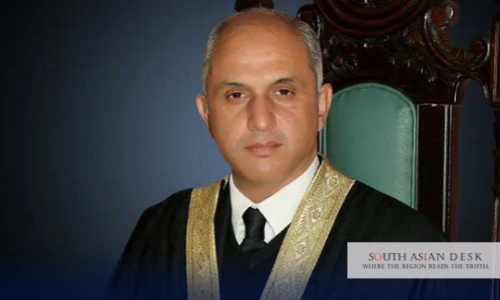
Justice Mohsin Akhtar Kayani has returned to the twin cities following a reshuffle at the Lahore High Court (LHC), according to the court’s duty roster for November and December 2026. He will preside over a single bench at the LHC’s Rawalpindi registry, in a posting that has drawn attention because of his earlier standing in the judiciary and his pending challenge to the transfer of judges between high courts.
Return to the Twin Cities
Justice Kayani hails from Islamabad, while Islamabad and Rawalpindi are traditionally referred to as the twin cities. He was transferred to the LHC in April this year and assigned to its principal seat in Lahore. Despite being a senior judge of the LHC, he was not assigned to any division bench there.
The new duty roster will remain in effect from November 2 to December 24, 2026. Under it, Justice Mohsin Akhtar Kayani has been assigned only to a single bench at the Rawalpindi registry.
How the Rawalpindi Registry Roster Is Structured
The Rawalpindi registry will have three division benches and six single benches during the period covered by the roster. The division benches are composed as follows:
- Justice Sadaqat Ali Khan and Justice Syed Farhad Ali Shah will handle criminal matters.
- Justice Mirza Viqas Rauf and Justice Muhammad Raza Qureshi will handle civil matters.
- A special division bench will comprise Justice Mirza Viqas Rauf and Justice Syed Farhad Ali Shah.
The six single benches will be headed by Justice Sadaqat Ali Khan, Justice Mirza Viqas Rauf, Justice Mohsin Akhtar Kayani, Justice Muhammad Raza Qureshi, Justice Malik Javid Iqbal Wains and Justice Syed Farhad Ali Shah.
Background of Justice Mohsin Akhtar Kayani
Before his move to the LHC, Justice Kayani served as the senior puisne judge of the Islamabad High Court (IHC) and was expecting to be elevated to chief justice. That expectation changed after the transfer of Justice Sardar Muhammad Sarfraz Dogar from the LHC to the IHC, along with the transfer of two other judges from the Sindh and Balochistan high courts. The inter-high court transfers prompted Justice Kayani to mount a legal challenge.
The Supreme Court’s constitutional bench upheld the transfers to the IHC, including that of Justice Dogar, who is now the chief justice of the IHC. The decision, however, triggered a broader legal battle. Justice Kayani and other senior IHC judges approached the Supreme Court to challenge the administrative powers exercised by Chief Justice Dogar. They alleged that the office had been turned into a “monocracy” and that judges could be excluded from the roster at will.
Seniority and the Pending Challenge
Following his own transfer to the LHC, Justice Kayani lost his seniority and was placed 12th on the high court’s seniority list. The latest duty roster assigns him to only a single bench at the Rawalpindi registry. This is notable in light of his previous position as the senior puisne judge of the IHC and his pending challenge to the inter-high court transfers.
The posting does not, on the information available, alter the status of that challenge, which remains pending. Nor does the roster indicate whether Justice Kayani will be assigned to a division bench at any point after December 24, 2026, when the current arrangement ends.
What the Posting Means
Duty rosters determine which judges hear which categories of cases, and they are therefore closely watched within the legal community, particularly where senior judges are concerned. The assignment of Justice Mohsin Akhtar Kayani to a single bench at the Rawalpindi registry places him in the city closest to his home base of Islamabad, while limiting his role to single bench matters for the duration of the roster.
How the arrangement evolves, and how the Supreme Court proceeds on the administrative questions raised by Justice Kayani and his fellow senior judges, will determine whether this posting proves to be a temporary adjustment or part of a longer pattern.
Follow SouthAsianDesk on X, Instagram and Facebook for insights on business and current affairs from across South Asia.
Read More: