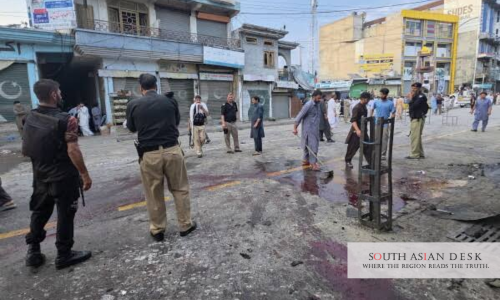
The Kabal police station attack in Swat left at least 14 people dead and 18 others injured on Sunday, after a suicide bomber detonated explosives near the entrance of the station. Police officials confirmed that the toll includes several members of the force, making it one of the deadliest single strikes on law enforcement in the district in recent months.
Swat police spokesperson Nasir Iqbal Karimi confirmed the death toll to Dawn, while Malakand Division Deputy Inspector General of Police Fida Hussain told AFP that police officers were among those martyred. He added that a separate body, suspected to belong to the bomber, had also been brought to hospital.
How the Suicide Bombing in Swat Unfolded
According to Swat District Police Officer (DPO) Umar Khan, the bomber set off his explosives after police personnel attempted to stop and search him at the gate of the station. The DPO said police remained on high alert following the blast and that the surrounding area had been cordoned off while an investigation was carried out to gather further evidence.
The explosion took place while hundreds of residents were gathered nearby at Kabal Chowk for a public demonstration against the recent wave of terrorism in Swat Valley. The blast occurred as the final speaker was addressing the crowd, sending people fleeing in panic. No group has so far claimed responsibility for the attack.
Rescue 1122 spokesperson Bilal Ahmed Faizi said nine of the victims were taken to Central Hospital Saidu Sharif, while five others were moved to Kabal Hospital, where doctors confirmed their deaths. Two of the injured are reported to be in critical condition.
What the Protesters Were Demanding
Before the blast, speakers at the demonstration had condemned the resurgence of violence in the region and called on the government to guarantee lasting peace. They said the protest movement had a single goal: restoring peace and ending terrorism in the area.
Several speakers argued that maintaining law and order was the state’s responsibility, warning that continued insecurity could fuel broader public unrest, and pointed to recent protest movements elsewhere as a sign of mounting frustration. They also criticised authorities for acting against peaceful citizens while, they alleged, terrorists continued to operate openly in Swat’s mountainous areas and circulate videos on social media.
“Our children deserve education, and our families deserve to live in peace,” one speaker told the crowd, adding that residents had endured years of bloodshed and did not want another generation of widows and orphans.
Condemnations Following the Attack
President Asif Ali Zardari expressed sorrow over the loss of life and called for a thorough investigation, according to a statement from his office. He directed authorities to provide the best possible medical care to the injured and said terrorists would never succeed in undermining peace, national unity, or the writ of the state. He also praised the sacrifices of the Khyber Pakhtunkhwa (KP) police.
KP Governor Faisal Karim Kundi condemned the bombing as well, saying attacks of this kind would not demoralise the nation. KP Chief Minister Sohail Afridi sought a report from the provincial Inspector General of Police and offered condolences to the families of the deceased, adding that those hostile to peace would not be allowed to succeed.
A Wider Pattern of Terrorism in Swat Valley
The Kabal police station attack adds to a troubling pattern of violence across Khyber Pakhtunkhwa in recent weeks. Earlier the same day, an IED blast near the Peshawar-Islamabad motorway toll plaza injured two policemen in Peshawar. On July 30, a separate terrorist attack on a police checkpost in Hangu martyred nine policemen.
Data from the Pakistan Institute for Conflict and Security Studies shows that KP, excluding its merged districts, recorded 154 terrorism-related deaths in July, up from 75 in June, an increase of 105 per cent. The rise underscores why residents in Kabal had gathered to demand government action even before the bombing struck their own demonstration.
As investigators continue examining the site, the attack has renewed pressure on authorities to address the security gaps that communities in Swat Valley say have allowed militant activity to persist in nearby mountainous areas.
Published in SouthAsianDesk, August 3rd, 2026
Follow SouthAsianDesk on X, Instagram and Facebook for insights on business and current affairs from across South Asia.