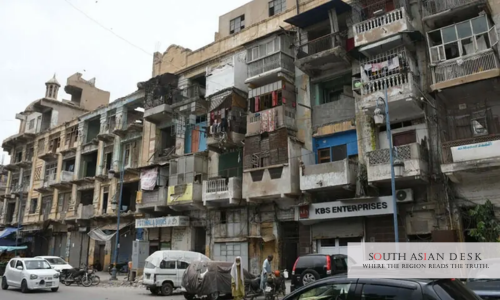
A comprehensive Karachi fire safety audit has revealed widespread non-compliance with basic safety standards across the city, raising serious concerns over emergency preparedness in commercial and residential structures. The exercise, carried out across seven districts, assessed 783 buildings and found that only 370 of them, roughly 47 per cent, showed substantial compliance with fire safety regulations.
Karachi Fire Safety Audit Ordered After Gul Plaza Tragedy
The audit was ordered by the provincial government following the devastating Gul Plaza fire on M.A. Jinnah Road in January, which killed scores of people. In response, the chief secretary constituted sub-divisional fire safety audit committees headed by assistant commissioners to conduct the citywide survey. Buildings were assessed on four key parameters, namely adherence to approved layout, availability of emergency exits, presence of portable fire extinguishers, and overall risk categorisation.
Fire Extinguishers Karachi Buildings Widely Lacking
Among the most striking findings, 310 buildings across the city had no fire extinguishers at all, while 416 lacked emergency exits altogether. The audit further found that 408 buildings did not have approved layouts and that 455 had not been constructed according to their original plans. Deviations of this kind, officials said, often lead to blocked passages and inadequate compartmentalisation, both of which could hamper evacuation during an emergency. Overall, 239 buildings across the city were classified as high risk, while 115 were found to be entirely non-compliant and 298 showed only partial compliance.
Emergency Exits Karachi Districts Compared
The report showed significant variation in compliance across Karachi’s seven districts. Central district recorded the highest number of high-risk structures at 103 out of 176 buildings inspected, with only seven having emergency exits and 57 equipped with fire extinguishers. As a result, 42 buildings in Central were marked non-compliant and 64 showed only partial compliance.
East district performed comparatively well, with 142 of its 181 audited buildings having emergency exits and 175 equipped with fire extinguishers, leaving only seven buildings non-compliant. Keamari, the smallest sample with 36 buildings, recorded the best overall safety record, with just one building classified as high risk and 27 showing substantial compliance.
Korangi, where 183 buildings were audited, the highest number of any district, led the city in substantial compliance with 120 buildings meeting standards, even though 95 buildings still lacked emergency exits and 85 had no fire extinguishers. Malir saw 22 of its 41 buildings with emergency exits but only 16 with fire extinguishers, while District South presented some of the weakest results, with 72 of its 117 buildings lacking emergency exits and only 18 achieving substantial compliance. District West recorded 40 buildings with both emergency exits and fire extinguishers out of 49 inspected, with 11 rated high risk.
Officials Flag Urgent Gaps in Infrastructure
The data indicates that while districts such as Keamari and Korangi performed comparatively well on compliance, Central and South face serious gaps in both infrastructure and safety equipment that officials say require urgent attention. Taken together, the findings of the Karachi fire safety audit point to a citywide pattern in which structural deviations and missing safety equipment continue to leave large numbers of commercial and residential buildings vulnerable in the event of a fire, months after the Gul Plaza tragedy first prompted the survey.
Published in SouthAsianDesk, July 20, 2026
Follow SouthAsianDesk on X, Instagram and Facebook for insights on business and current affairs from across South Asia.