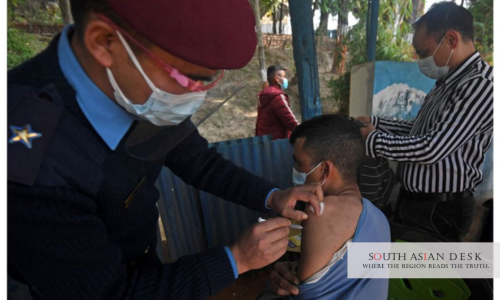
Nepal child vaccination coverage remains strong overall, but new data shows a surprising gap: children in cities and metropolitan areas are less likely to receive all recommended vaccines than those in rural municipalities.
According to government immunisation data cited by The Kathmandu Post, the median full immunisation rate in Nepal’s metropolitan areas stood at only 64% in the last fiscal year. In rural municipalities, the figure was far higher at 95%. The nationwide full immunisation rate also declined from 96% in fiscal year 2023-24 to 92% in 2024-25.
The findings challenge the common assumption that children in remote villages are always at a greater disadvantage than those in cities. In Nepal’s immunisation programme, the opposite appears to be happening in many places.
Nepal Child Vaccination Gap in Urban Areas
Public health officials say the urban vaccination gap is not necessarily because children in cities receive no vaccines at all. Many children may receive some doses but fail to complete the full routine immunisation schedule.
This matters because incomplete vaccination leaves children vulnerable to vaccine-preventable diseases such as measles, rubella, pneumonia, tuberculosis, diphtheria, pertussis, tetanus, hepatitis B, rotavirus, Japanese encephalitis, typhoid and HPV-related illness.
Nepal provides 14 types of antigens free of cost under its regular immunisation programme. Routine immunisation has been one of the country’s most successful public health efforts and has contributed to a significant reduction in under-five mortality.
However, the latest figures suggest that access alone is not enough. Urban populations are harder to track, and children can fall through the system even when health services are physically nearby.
Why Are Cities Falling Behind?
Experts point to several reasons behind low Nepal immunisation coverage in cities.
The first is migration. Large cities have floating populations, including internal migrants, daily wage workers, families living in informal settlements and people who frequently move for work. These families may not be properly counted in official population data, making it harder for health workers to identify children who have missed vaccines.
The second issue is urban poverty. Children living in slums, squatter settlements or temporary housing may not have stable access to health posts. Their parents may also prioritise daily earnings over clinic visits, especially if vaccination centres are far from their place of work or open only during working hours.
The third problem is weak urban micro-planning. Rural immunisation campaigns often rely on close community networks, local volunteers and clearer household mapping. In large cities, populations are more scattered, mobile and anonymous, making follow-up harder.
The fourth factor is awareness. Some families may not understand the full vaccine schedule or may assume that partial vaccination is enough. Others may delay doses due to misinformation, work pressure or lack of proper reminders.
Rural Areas Show Stronger Vaccine Acceptance
The report highlights an important contrast. In remote areas such as Upper Dolpa, health workers may face extreme physical barriers but still find strong community support.
In one example, immunisation workers travelled for days on foot to reach Chharka Bhot, a remote settlement in upper Dolpa located at about 4,350 metres. Despite the difficult terrain, officials said the HPV vaccination campaign there was successful because local communities welcomed the effort and supported the health workers.
This shows that geography is not the only barrier. Remote villages may be difficult to reach, but once health workers arrive, community cooperation can be high. In cities, services may be closer, but population mobility, weak tracking and social exclusion can prevent full vaccine coverage.
Risk of Measles and Other Outbreaks
The urban vaccination gap is not just a technical concern. Low or incomplete vaccination coverage can increase the risk of outbreaks.
Nepal has reported measles outbreaks in multiple districts since the start of 2026. Health officials have linked such outbreaks to low vaccination coverage, particularly among marginalised communities and children who were not fully immunised.
Measles is especially dangerous because it spreads quickly in crowded areas. If coverage remains low in cities, densely populated urban neighbourhoods could become vulnerable to future outbreaks.
This is why experts are urging authorities to focus on high-risk urban groups rather than relying only on broad national averages.
What Should Nepal Do Next?
Nepal’s child vaccination challenge now requires a more targeted strategy. The country has already built a strong routine immunisation system, but urban coverage gaps show that the programme must adapt to changing population patterns.
Authorities can improve coverage by mapping informal settlements, tracking migrant families, expanding outreach in working-class neighbourhoods and using door-to-door campaigns to identify children who missed doses.
Health officials should also develop micro-plans for metropolitan areas, using ward-level data instead of relying only on official population estimates. Flexible vaccination hours could help working parents, while schools, community groups and local volunteers can support follow-up.
Digital reminders and stronger records may also reduce dropout rates, especially for families that move between districts.
A Warning for Public Health Progress
Nepal’s experience shows that urbanisation does not automatically improve health outcomes. Cities may have hospitals, clinics and roads, but children can still be missed if public health systems fail to reach mobile and marginalised families.
The fall in the national full immunisation rate from 96% to 92% is a warning sign. The much lower 64% median coverage in metropolitan areas is more serious still.
Nepal child vaccination efforts have helped save lives for decades. The next challenge is to make sure that children in fast-growing cities are not left behind while rural areas continue to perform better than expected.
Published in SouthAsianDesk, July 4, 2026
Follow SouthAsianDesk on X, Instagram and Facebook for insights on business and current affairs from across South Asia.