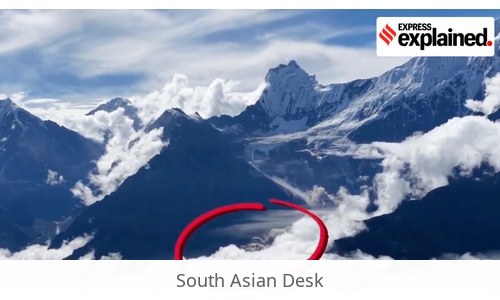
The Nepal glacier collapse on August 28, 2026, has triggered catastrophic floods that have claimed 579 lives and left nearly 2,000 people missing, including at least 320 Indians. The Indian government has mobilized 62 tonnes of relief supplies to assist Nepal, while over 14,000 security personnel have been deployed for search and rescue operations. The disaster, caused by a wall of ice, rock, and muddy water collapsing into a river, has caused widespread destruction across towns and valleys, particularly in the Nuwakot region. The incident has drawn international attention, with the United Nations emphasizing the growing risks posed by melting glaciers in the Himalayas, a region that serves as a critical water source for millions across South Asia.
Nepal glacier collapse: What Caused the Floods?
The floods were triggered by a glacier collapse, a phenomenon increasingly linked to climate change. Before-and-after satellite images reveal extensive destruction in Nuwakot, where a wall of ice and debris surged into the river system. Such events are becoming more frequent as Himalayan glaciers retreat due to rising temperatures, raising concerns about the region’s vulnerability to similar disasters. The Nuwakot region, located in the Bagmati River basin, has historically been prone to glacial lake outburst floods (GLOFs), though the scale of this event has exceeded previous recorded incidents. Scientists have noted that the rapid melting of glaciers, accelerated by global warming, has led to the formation of unstable glacial lakes, which can burst suddenly, unleashing catastrophic floods. This particular collapse is believed to have been exacerbated by heavy monsoon rains, which further destabilized the ice and surrounding terrain.
Regional and International Response
Rescue operations continue, with helicopters deployed to search for survivors and deliver emergency supplies to isolated communities. The Indian government’s rapid mobilization of aid underscores the cross-border cooperation between Nepal and India, with relief supplies including food, water, medical kits, and shelter materials. Over 14,000 security personnel, including Nepalese police, Indian paramilitary forces, and international volunteers, have been deployed to coordinate search and rescue efforts in the affected areas. The Indian External Affairs Ministry has emphasized the importance of regional solidarity, stating that the disaster highlights the need for enhanced disaster preparedness Nepal. Meanwhile, the United Nations has called for increased investment in early warning systems and infrastructure resilience in the Himalayan region, citing the growing frequency of such events as a direct consequence of climate change impact. The UN’s appeal aligns with recent reports from the Intergovernmental Panel on Climate Change (IPCC), which warn that Himalayan glaciers could lose up to two-thirds of their current mass by 2100 if global emissions remain unchecked.
Long-term Implications of Climate Change
The Nepal glacier collapse highlights the urgent need for climate action and improved disaster resilience in South Asia. Himalayan glaciers, a critical water source for millions, are retreating at an accelerating pace, increasing the risk of glacial lake outburst floods (GLOFs). Scientists warn that without significant emissions reductions and adaptive infrastructure, such events could become more frequent, threatening ecosystems and livelihoods across the region. The retreat of glaciers not only poses immediate risks to human settlements but also disrupts the hydrological cycle, affecting agricultural productivity and water availability for downstream countries, including India, Bangladesh, and Pakistan. In Nepal, where over 70% of the population relies on glacial meltwater for irrigation and drinking, the long-term implications of such disasters could be severe. The government has acknowledged the need for a comprehensive national strategy to address climate-induced disasters, though implementation has been hampered by limited resources and competing priorities. International experts have urged South Asian nations to prioritize climate adaptation measures, including the construction of flood barriers, the restoration of natural catchment areas, and the development of community-based early warning systems.
Follow SouthAsianDesk on X, Instagram and Facebook for insights on business and current affairs from across South Asia.
The wider context of this developing story also includes Nepal floods.
This report focuses on Nepal glacier collapse and the verified developments surrounding it.
Sources
- Nepal flash floods LIVE: Death toll rises to 579; nearly 2,000 people still missing – thehindu.com
- Nepal disaster: What is a glacier collapse and how does it happen? – indianexpress.com
- India races to Nepal’s aid after deadly floods, sends 62 tonnes of relief – dailymirror.lk
- As the Himalayas melt, deadly floods become the new normal – news.un.org
- As flood swept through Nuwakot school, teachers raced to save their students – english.onlinekhabar.com
Image: images.indianexpress.com