Nepal India Cross-Border Digital Payments: Both countries have operationalized a peer-to-peer digital payments link between their respective national payment systems, resolving technical and cost-sharing hurdles that had stalled the initiative for more than two years.
Nepal and India jointly launched a live peer-to-peer (P2P) cross-border digital payments system on Saturday, June 6, 2026, in New Delhi, when the two countries’ foreign ministers formally activated a long-awaited linkage between India’s Unified Payments Interface (UPI) and Nepal’s National Payments Interface (NPI), enabling ordinary citizens in both countries to transfer funds digitally across the border for the first time.
Nepal India Cross-Border Digital Payments: What Was Agreed
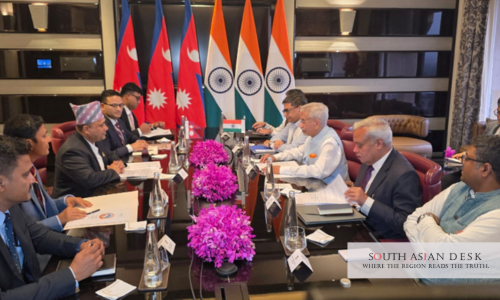
Nepal’s Foreign Affairs Minister Shisir Khanal and Indian External Affairs Minister S. Jaishankar jointly launched the Peer-to-Peer linkage between India’s Unified Payments Interface and Nepal’s National Payments Interface to facilitate cross-border personal remittances between the two countries.
The linkage between India’s UPI and Nepal’s National Payments Interface will facilitate cross-border personal remittances, according to Jaishankar, who announced the development on the social media platform X.
The digital payments announcement was one of three major deliverables from the visit. The two ministers also jointly announced the handing over of 72 health sector and 12 cultural sector post-earthquake reconstruction projects in Nepal, built with India’s development assistance, and witnessed the exchange of a Memorandum of Understanding between Kathmandu University School of Engineering’s Centre for Digital Public Infrastructure and the Artificial Intelligence and Digital India Bhashini Division for co-creating a National Digital Infrastructure for a “Voice First” Language Translation Platform.
Nepal’s Foreign Minister Khanal arrived in New Delhi on an official visit from June 5 to 7, 2026, at the invitation of External Affairs Minister Jaishankar, providing an opportunity for both sides to review the India,Nepal partnership and discuss its future direction.
Why the P2P Launch Matters: Resolving a Two-Year Technical Deadlock
The formal activation of P2P payments is significant precisely because a related system had already been in place — yet had fallen short in practice. When India and Nepal launched a cross-border QR payment system in March 2024 under the 2023 agreement, it was celebrated as a milestone. However, more than two years after the system went live, unresolved technical issues had prevented the full operationalisation of peer-to-peer remittances.
A central sticking point was the question of processing costs: when Nepali users paid in India, it had been unclear whether the cost would be borne by the Nepali issuing bank, the Indian acquiring bank, or the merchant. Saturday’s agreement has sorted out these technical issues.
The P2P operationalisation is rooted in an MoU signed between the Nepal Clearing House Limited (NCHL) and NPCI International Payments Limited (NIPL) — the international arm of India’s National Payments Corporation (NPCI) — in New Delhi in June 2023, with the objective of enabling cross-border digital payments and remittances between the two countries.
The significance for ordinary citizens, particularly the millions of Nepali workers employed in India, is considerable. India is the largest source of remittances to Nepal, with estimates based on Nepal Rastra Bank data showing Nepal received over USD 1 billion from India in 2022/23 alone. More broadly, Nepali migrant workers sent home a total of NPR 1,449.65 billion in remittances during the first eight months of the fiscal year running from mid-July 2025 to mid-March 2026, a surge of 37.7 percent year on year, according to Nepal Rastra Bank data.
Wider Bilateral Agenda: Energy, Connectivity, and AI
The cross-border payments agreement sat within a notably broad bilateral agenda. During the meeting, the two ministers held wide-ranging and productive discussions on Nepal India bilateral relations, encompassing trade and economic cooperation, cross-border connectivity, energy partnerships, water resources management, and the promotion of people-to-people ties, including through sports.
Jaishankar, in his opening remarks, described the bilateral relationship as built on “a strong foundation of vibrant people-to-people ties, cross-border connect and shared cultural and religious traditions”, adding that it is “anchored by shared trust, goodwill, and mutual benefit.” He noted an opportunity to advance ties in newer domains including startups, artificial intelligence, information technology, and renewable energy.
Foreign Minister Khanal also said that discussions were held regarding the air route for operating Gautam Buddha International Airport in Bhairahawa, a longstanding issue for Nepal’s aviation sector. During his visit, Khanal also met National Security Advisor Ajit Doval.
Background
This was the first visit at the level of Foreign Minister between the two countries since the new government assumed office in Nepal in March 2026. Nepal is a priority partner of India under its ‘Neighbourhood First’ policy, and the visit reinforced the tradition of regular high-level exchanges between the two close neighbours.
India was the major donor for reconstruction in Nepal after the 2015 earthquake, pledging USD 1 billion in grants and loans. The handing over of 84 completed reconstruction projects, 72 in the health sector and 12 in the cultural heritage sector- marked the formal conclusion of that reconstruction commitment.
The Reserve Bank of India has been actively pursuing cross-border payment linkages through the interlinking of UPI on both bilateral and multilateral bases with fast-payment systems of other countries, for personal remittances and merchant payments. The UPI PayNow linkage with Singapore was operationalised in 2023, and UPI acceptance via QR code has since been extended to several countries including Bhutan, France, Mauritius, Nepal, the United Arab Emirates, and Qatar.
What’s Next
Nepal’s Foreign Minister Khanal described his three-day India visit as “fruitful”, stating that concrete steps had been taken towards enhancing bilateral ties, and expressed confidence that the new AI language translation agreement would contribute to the promotion of artificial intelligence technology in both countries.
With the processing cost and interoperability issues now formally resolved, the operationalisation of Nepal India cross-border digital payments is expected to reduce the friction and cost of remittances for millions of Nepali workers in India, bringing a long-delayed but economically consequential financial integration into practical effect.
Published in SouthAsianDesk, June 8, 2026
Follow SouthAsianDesk on X, Instagram and Facebook for insights on business and current affairs from across South Asia.