Nepal turns to drones to deliver flood relief to displaced communities after last month’s devastating floods left roads and bridges destroyed and its helicopter fleet stretched thin by ongoing search and rescue operations. At least 1,367 people have been confirmed dead and more than 5,000 remain missing in Nepal since a Himalayan glacier broke off near the Nepal-China border in late August, sending a wall of water and debris downstream that wiped out entire stretches of infrastructure along the way.
Why Nepal Turns to Drones for Flood Relief
With so much of the country’s helicopter capacity tied up in locating survivors, army officials say drones have become the only practical way to reach communities that roads can no longer serve. Santosh Budhathoki, a contract drone pilot for the Nepal army, said most of the fleet’s helicopters remain committed to rescue operations, leaving drones as the only realistic option for moving food, essential supplies, medicine and fuel into affected areas. He said the equipment was proving to be the best option available and that the army should prioritise it further as the relief effort continues.
Flood Relief Reaches Stranded Communities by Air
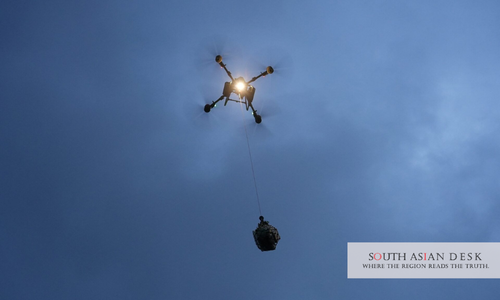
The drones now form a visible part of daily relief operations in villages along the Trishuli River and surrounding districts, where flash floods and mudslides cut off ordinary supply routes almost overnight. Able to fly distances of three to four kilometres and carry loads of up to 60 kilograms, the aircraft have already begun making a measurable difference for communities that would otherwise have had to wait far longer for aid to arrive by land or by air. For households left isolated by collapsed bridges and washed out roads, a drone drop is often the fastest and, in some cases, the only route supplies can take.
Search and Rescue Operations Stretch Helicopter Fleets Thin
The pressure on helicopters reflects the scale of the ongoing search and rescue operations still underway across the disaster zone. With more than 5,000 people still unaccounted for, aircraft that might otherwise be repurposed for aid deliveries remain committed to locating the missing, leaving a gap that drones have stepped in to fill. That division of labour, helicopters focused on rescue while drones handle much of the routine resupply, has allowed the relief effort to keep moving even as the search for survivors continues in difficult terrain.
How Nepal’s Drone Fleet Works
The army is currently completing around 10 to 16 aid deliveries a day using a fleet of four DJI FlyCart 100 drones, all of which were donated from China as part of a recent aid package. Each aircraft is loaded with essential supplies before technicians send it out toward flood affected areas, a process that has become increasingly routine even as crews work long hours to keep pace with demand. The scale of the operation remains modest compared with the scope of the disaster, but officials say every delivery matters for communities that have had no other way to receive help.
A Grim Additional Task
Beyond delivering aid, the drones have also been used for a more sombre purpose, moving the bodies of flood victims out of some of the worst affected areas, while separate reconnaissance drones have been used extensively to support search and rescue operations by helping teams locate people trapped or stranded across the disaster zone. Milan Pandey, of the drone operating company Airlift Technology, described the pace of the work as relentless, saying crews have been operating back and forth from early in the morning because the need for immediate action leaves little room for delay.
Terrain Built for Drones
For those running the operation, Nepal’s mountainous geography has made the case for drones almost by itself. Pandey said the country’s terrain is precisely the kind of environment where drones outperform other options, offering a faster, quicker and cheaper way to move supplies than trying to rebuild access by road or rely solely on a limited number of helicopters. As recovery efforts continue in the weeks ahead, that combination of speed and cost may determine how much of Nepal’s relief effort continues to move by air rather than by land.
Published in SouthAsianDesk, September 10th, 2026
Follow SouthAsianDesk on X, Instagram and Facebook for insights on business and current affairs from across South Asia.