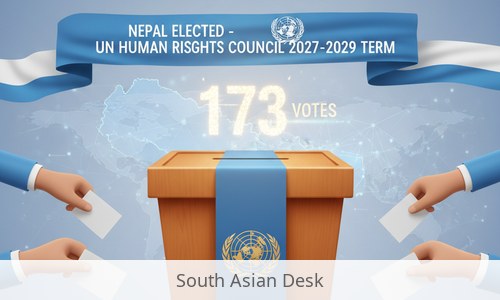
The Nepal UN Human Rights Council election on October 14, 2026, marked a significant achievement in Nepal’s diplomatic efforts as the country was elected to the UN Human Rights Council for the 2027–2029 term with 173 votes. The election took place at the UN headquarters in New York, where a total of 180 votes were cast. Nepal received the highest number of votes among countries elected from the Asia-Pacific region, underscoring its growing role in international human rights discussions and aligning with its commitment to human rights advocacy.
This milestone reflects Nepal’s increasing influence in global governance and its dedication to advancing human rights both domestically and internationally. The election not only highlights Nepal’s diplomatic success but also positions the country as a key player in shaping human rights agendas within the UN framework. As a member of the UN Human Rights Council, Nepal will have the opportunity to contribute to global human rights initiatives while addressing regional challenges.
Nepal UN Human Rights Council election: Implications for Nepal’s Foreign Policy
Nepal’s election to the UN Human Rights Council may influence its diplomatic relationships with other countries, particularly as it assumes a more active role in human rights advocacy. The council’s mandate requires member states to promote and protect human rights globally, which could align with Nepal’s foreign policy priorities. However, the extent of this alignment will depend on how Nepal navigates its responsibilities on the council, balancing regional interests with global human rights commitments.
This election also positions Nepal as a key player in the UN General Assembly 2026, where its voice will carry weight in shaping human rights agendas. The country’s participation in the council is expected to enhance its diplomatic outreach, particularly with other Asia-Pacific countries that share similar developmental and human rights challenges. By engaging with regional partners, Nepal can foster collaborative efforts to address issues such as poverty, inequality, and access to justice.
Reactions from Human Rights Organizations
Human rights organizations have expressed mixed reactions to Nepal’s election. While some praised the country’s commitment to human rights, others emphasized the need for accountability. The United Nations Human Rights Office highlighted that Nepal’s election reflects its dedication to advancing human rights globally. However, organizations such as Amnesty International have called for Nepal to uphold its own human rights standards domestically before advocating internationally. This feedback underscores the importance of Nepal’s role in human rights advocacy and the expectations placed on it by the global community.
The election has also sparked discussions among human rights organizations about the potential impact of Nepal’s membership on regional and global human rights discourse. Some organizations have welcomed the opportunity for Nepal to contribute to the council’s work, while others have urged the government to address domestic human rights concerns to strengthen its credibility on the international stage.
Context within the Asia-Pacific Region
Nepal’s election places it among other Asia-Pacific countries elected to the UN Human Rights Council, including Japan, Indonesia, and the Philippines. These nations have varying human rights records, and Nepal’s inclusion highlights the council’s diverse composition. The election also underscores the importance of regional representation in global human rights governance, ensuring that voices from the Asia-Pacific region are heard in international forums.
As part of this regional group, Nepal’s participation will be critical in addressing shared challenges and promoting collaborative human rights initiatives. The country’s unique position as a landlocked nation with a complex political landscape adds to its potential contributions to the council’s work. By engaging with other Asia-Pacific countries, Nepal can leverage its experiences to advocate for more inclusive and equitable human rights policies.
The Road Ahead for Nepal
With its election to the UN Human Rights Council, Nepal faces both opportunities and challenges. The country must now translate its commitment to human rights into concrete actions, both domestically and internationally. This includes addressing domestic human rights issues, such as gender inequality, access to education, and the protection of minority rights, while also contributing to global human rights initiatives.
Nepal’s foreign policy will likely be shaped by its new role on the council, requiring a balance between regional cooperation and global human rights advocacy. The government will need to engage with other member states to build alliances and promote its agenda on human rights. Additionally, Nepal must ensure that its domestic policies align with its international commitments to maintain credibility on the global stage.
Conclusion
The Nepal UN Human Rights Council election represents a significant milestone in the country’s diplomatic and human rights journey. As Nepal assumes its role on the council, it has the opportunity to contribute meaningfully to global human rights discourse while addressing regional challenges. The election underscores the importance of human rights advocacy and the need for countries like Nepal to uphold their commitments both domestically and internationally.
Follow SouthAsianDesk on X, Instagram and Facebook for insights on business and current affairs from across South Asia.
Sources
- Nepal elected to UN Human Rights Council for 2027–2029 term with 173 votes – english.onlinekhabar.com
- UN Human Rights Council elects 15 members in uncontested vote – aljazeera.com