Pakistan Crypto Diplomacy Draws Scrutiny After World Liberty Financial Deal
Pakistan crypto diplomacy is facing renewed scrutiny after Al Jazeera reported that Islamabad’s agreement with a Trump family-linked crypto venture has produced little visible progress on stablecoin payments, but may have helped Pakistan gain access to the Trump administration.
The report centres on World Liberty Financial, a crypto venture associated with US President Donald Trump’s family, and its affiliate SC Financial Technologies. In January 2026, Pakistan’s Ministry of Finance signed a memorandum of understanding with SC Financial Technologies to explore the use of USD1, a dollar-pegged stablecoin, for cross-border payments.
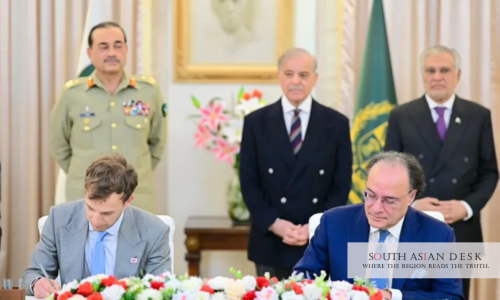
The signing ceremony was politically significant. Pakistan’s Finance Minister Muhammad Aurangzeb signed the agreement with Zach Witkoff, while Prime Minister Shehbaz Sharif, army chief Field Marshal Asim Munir and Deputy Prime Minister Ishaq Dar were present. Zach Witkoff is the son of Steve Witkoff, a Trump adviser and senior figure linked to World Liberty Financial.
According to Al Jazeera, nearly six months after the MoU, Pakistani officials confirmed that there had been no USD1 pilot project, no licences issued and no known transactions using the stablecoin in Pakistan. That gap has raised questions over whether the agreement was primarily about financial technology or political access.
The issue has become more sensitive because Trump’s latest financial disclosures show how lucrative crypto has become for him. Reuters reported that Trump disclosed more than $1.4 billion in income from crypto-related ventures in 2025, including hundreds of millions of dollars connected to World Liberty Financial token sales.
World Liberty Financial Pakistan Deal Raises Questions
The World Liberty Financial Pakistan agreement was presented as part of Islamabad’s broader push to modernise digital finance. Stablecoins are digital tokens usually pegged to fiat currencies, most commonly the US dollar. In theory, they can help move value across borders quickly and cheaply, especially where banking systems are slow or expensive.
USD1 is World Liberty Financial’s dollar-linked stablecoin. Like other stablecoin issuers, the business model depends on reserves backing the token. Those reserves can generate income, meaning wider adoption of USD1 could benefit the company and its owners.
That is where the political controversy begins. If a foreign government explores use of a stablecoin connected to the sitting US president’s family business, the arrangement inevitably raises conflict-of-interest questions. The White House has denied conflicts of interest, but critics argue that the overlap between presidential power, foreign policy and private crypto income is difficult to ignore.
For Pakistan, the agreement appeared to offer a potential fintech solution for cross-border payments and remittances. But analysts cited by Al Jazeera questioned whether USD1 solves an actual payments problem. Pakistan already receives large remittance inflows through formal channels, and informal crypto flows are difficult to measure.
The State Bank of Pakistan’s recent remittance data also complicates the argument that stablecoins are urgently needed for formal inflows. Pakistan received a record $4.251 billion in workers’ remittances in May 2026, while inflows during July-May FY26 reached about $38.1 billion, according to SBP data reported by local outlets.
Pakistan Crypto Regulation Is Still Developing
Pakistan has moved quickly to build a formal crypto regulatory framework. The Pakistan Virtual Assets Regulatory Authority, or PVARA, now describes itself as the country’s independent federal regulator for virtual assets under the Virtual Assets Act, 2026.
PVARA says virtual asset service providers must obtain formal authorisation before offering services in Pakistan. Its no-objection certificate process is a preliminary step that allows firms to move toward registration, local incorporation and full licensing.
The State Bank of Pakistan has also opened the door for licensed virtual asset service providers to access the banking system. Reuters reported in April that Pakistan’s central bank allowed banks to open accounts for licensed crypto firms, reversing a 2018 restriction and bringing crypto-related businesses into a more regulated framework.
However, this does not mean all crypto services are fully operational in Pakistan. A no-objection certificate is not the same as a full licence, and the system still requires onboarding, compliance checks, bank arrangements and regulatory supervision.
This distinction matters for the USD1 question. Even if Pakistan wants to test stablecoin-based payments, the regulatory and operational pipeline remains incomplete. A signed MoU does not automatically create a functioning payment system.
Stablecoin Payments Pakistan Plan Faces Practical Problems
The stablecoin payments Pakistan plan faces several practical obstacles.
First, Pakistan’s formal remittance system is already performing strongly. If overseas Pakistanis are sending record amounts through banks and regulated channels, the case for replacing or supplementing those flows with a Trump-linked stablecoin becomes less obvious.
Second, informal channels exist for reasons that a new token may not solve. People may avoid banks because of documentation requirements, tax concerns, exchange rate preferences or the desire to bypass formal scrutiny. If USD1 were introduced through regulated channels, it would likely face similar compliance requirements.
Third, Pakistan would still need real dollars for many external payments unless trading partners directly accepted USD1. If the token had to be converted back into dollars before use, that could add another layer rather than remove friction.
Fourth, stablecoin systems require trust in reserves, redemption, compliance and governance. For a country managing external financing pressures, foreign exchange constraints and IMF-linked reforms, any new payments architecture would need careful coordination with the central bank and regulators.
That does not mean stablecoins have no possible use in Pakistan. They may eventually support faster settlement, fintech innovation, tokenised assets or controlled cross-border payment pilots. But the current evidence suggests the World Liberty Financial MoU has not yet produced a working financial product.
Crypto Adoption Gives Pakistan a Strong Market Case
Pakistan is still an important crypto market. Chainalysis ranked Pakistan third in its 2025 Global Crypto Adoption Index, behind India and the United States. That ranking reflects strong grassroots activity across centralised services, retail use and institutional flows.
This gives Pakistan a real reason to regulate virtual assets rather than ignore them. A large informal crypto market can create risks around fraud, money laundering, terrorist financing, tax evasion and consumer harm. Bringing exchanges and service providers into a licensing framework could help reduce those risks while allowing innovation.
Pakistan’s challenge is to distinguish between genuine digital finance reform and politically attractive announcements. Crypto can be useful, but it can also be used to create headlines without solving structural problems.
The World Liberty Financial agreement sits right on that fault line. It was presented as a fintech partnership, but its measurable financial impact appears limited so far. Its diplomatic value, however, may have been more immediate.
US Pakistan Relations and the Access Argument
The strongest part of Al Jazeera’s report is the access argument. Analysts quoted by the outlet suggested that Pakistan’s engagement with World Liberty Financial gave Islamabad a channel into Trump’s circle at a time when Pakistan was trying to rebuild influence in Washington.
This matters because US Pakistan relations have shifted repeatedly over the past two decades. After the US withdrawal from Afghanistan, Pakistan’s importance in Washington appeared to decline. But recent regional tensions, counterterrorism concerns, Iran-related diplomacy and Pakistan’s military leadership have brought the relationship back into focus.
Al Jazeera noted several developments in this wider context, including Pakistan’s nomination of Trump for the Nobel Peace Prize, Trump’s meeting with Field Marshal Asim Munir and Washington’s acknowledgement of Pakistan’s role in regional diplomacy.
From Islamabad’s perspective, access to the Trump White House may have been worth more than an experimental stablecoin pilot. That does not mean the MoU was illegal or that it proves wrongdoing. But it does show how crypto, diplomacy and personal political networks can overlap in ways that are difficult to separate.
The Conflict-of-Interest Problem Will Not Go Away
The central problem is not only whether USD1 works. The deeper issue is whether foreign governments can build relationships through ventures that financially benefit a sitting US president or his family.
Trump’s crypto earnings have already drawn scrutiny in the United States. Reuters reported that crypto-related ventures accounted for a large part of his disclosed income, while World Liberty Financial generated hundreds of millions of dollars from token sales.
When a foreign state signs an agreement with an affiliate of that ecosystem, the arrangement becomes politically sensitive even if no pilot follows. The appearance of access can be as important as the underlying product.
For Pakistan, the risk is reputational. If the deal is seen as a serious fintech experiment, it fits within the country’s broader digital finance reforms. If it is seen as a route to political access, it may raise questions about governance, transparency and foreign policy judgment.
For the United States, the risk is institutional. A president’s private financial interest in crypto ventures can create doubts about whether foreign policy decisions are being shaped by national interest or by private commercial relationships.
What Pakistan Actually Gained
So far, Pakistan appears to have gained more diplomatically than financially.
There is no confirmed USD1 pilot in Pakistan. There are no known transactions using the stablecoin. There is no evidence that Pakistani remittances have moved through the system. The regulatory framework is still developing, and firms still need full authorisation before operating.
But Pakistan did gain visibility. It positioned itself as an early partner in a Trump-linked crypto project. It deepened contact with figures close to the US president. It used digital finance as a diplomatic signal at a time when Islamabad was seeking renewed relevance in Washington.
That makes Pakistan crypto diplomacy a revealing case study. It shows how emerging technologies can become tools of statecraft, even before they become useful infrastructure.
The question now is whether Pakistan can turn its crypto push into a transparent, regulated and economically useful system, or whether the World Liberty Financial episode will be remembered mainly as a political access play.
For now, the evidence points to a cautious conclusion: the stablecoin promise remains unproven, but the diplomatic bet appears to have paid off.
Published in SouthAsianDesk, July 4, 2026
Follow SouthAsianDesk on X, Instagram and Facebook for insights on business and current affairs from across South Asia.