Pakistan’s push to expand its defense exports has taken a concrete step forward with the announcement that two new industrial plants will be brought into production at the country’s largest defense industrial complex by the end of the year. The military disclosed the plan on Saturday after army chief Field Marshal Asim Munir visited the Pakistan Ordnance Factories in Wah, which produce weapons and ammunition for Pakistan’s armed forces and are increasingly central to Islamabad’s ambitions of capitalising on growing international interest in its military hardware.
Munir’s Visit and the Drive for Pakistan Defense Exports
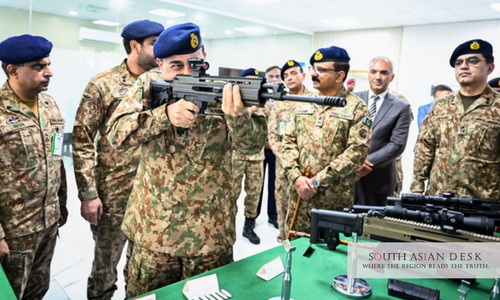
During the visit, Munir reviewed the production capabilities of the Pakistan Ordnance Factories, their export potential, and their broader contribution to Pakistan’s defense industrial base. According to a statement from the military’s media wing, Inter-Services Public Relations, the visit reflected the armed forces’ commitment to self-reliance, indigenous production, and technological innovation within the country’s defense sector. Munir, who also serves as Pakistan’s chief of defense forces, was briefed on the two new plants, which the military described as part of an ongoing effort to indigenise and upgrade national defense production. Neither their intended output nor their planned production capacity was disclosed.
The expansion fits within a wider strategy by Islamabad to increase domestic weapons manufacturing and grow Pakistan defense exports across a range of categories, including ammunition, drones, training aircraft, and fighter jets. Pakistani officials have pointed to rising international demand for locally produced hardware as a key driver behind the investment in new manufacturing capacity.
Growing International Interest in Pakistani Military Hardware
Reuters reported in January that Pakistan was engaged in talks with thirteen countries over potential defense deals, with negotiations at an advanced stage with between six and eight of them. Those discussions reportedly covered the JF-17 fighter jet, which is jointly produced by Pakistan and China, along with Mushshak training aircraft, Pakistani-made drones, air defense systems, and armoured vehicles. The scale of that outreach underlines how seriously Islamabad is treating the defense sector as a potential source of foreign revenue, alongside its traditional role of supplying the country’s own armed forces.
Restructuring the Sector Through DIPRA
Munir’s visit also included a briefing on the corporatisation of the Pakistan Ordnance Factories following the establishment this year of the Defense Industrial Production and Regulatory Authority, a newly created body designed to restructure Pakistan’s defense production sector and expand private-sector participation. The authority was formed under an ordinance promulgated in June, which brought both state-owned defense establishments and private manufacturers under a single regulatory framework. The move is widely seen as an attempt to modernise a sector that has historically been dominated by state enterprises and to make it more competitive in international markets.
While at the facility, Munir also observed tests and trials of locally designed and manufactured arms and ammunition, underscoring the military’s emphasis on demonstrating indigenous capability alongside its export ambitions.
What the Expansion Means Going Forward
The addition of two new plants at Wah, combined with the regulatory overhaul introduced through the Defense Industrial Production and Regulatory Authority, signals a deliberate attempt by Pakistan to position its defense industry as a larger and more structured contributor to national exports. With advanced-stage negotiations already underway with several countries and production capacity being expanded at home, Pakistan defense exports appear poised to become an increasingly significant component of the country’s broader economic and strategic planning in the years ahead.
Published in SouthAsianDesk, August 30th, 2026
Follow SouthAsianDesk on X, Instagram and Facebook for insights on business and current affairs from across South Asia.