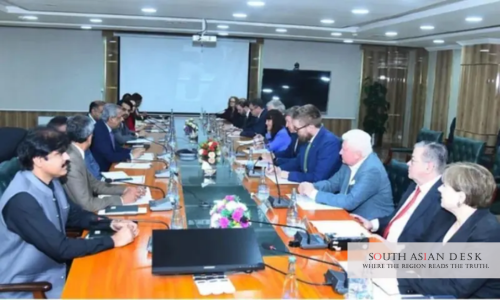
Pakistan GSP Plus obligations were reaffirmed by Federal Minister for Law and Human Rights Azam Nazeer Tarar during a meeting with a European Union delegation and ambassadors of European countries in Islamabad.
The meeting focused on Pakistan-EU relations, the GSP Plus framework, human rights, rule of law and areas of mutual cooperation. The delegation was led by EU Ambassador to Pakistan Raimundas Karoblis and included senior diplomats from Sweden, Norway, France, the Netherlands, the Czech Republic, Ireland and Canada.
Tarar assured the delegation that Pakistan would continue constructive engagement with the European Union on human rights, legal reforms and implementation of commitments under the GSP Plus framework. The discussion comes at a politically and economically important moment for Pakistan, whose preferential access to the EU market remains tied to effective implementation of international conventions on human rights, labour standards, environmental protection and good governance.
Pakistan GSP Plus obligations remain central to EU ties
Pakistan GSP Plus obligations remain central to the country’s trade relationship with the European Union because the scheme gives Pakistani exporters preferential access to one of their most important markets.
Since January 2014, Pakistan has benefited from GSP Plus status after ratifying 27 core international conventions covering human rights, labour rights, environmental protection, climate change and good governance. The arrangement allows duty suspensions on products across about two-thirds of EU tariff lines.
The economic value of the scheme is significant. According to the EU’s GSP Hub, EU imports from Pakistan amounted to €8.3 billion in 2024, of which €7.1 billion entered under GSP Plus preferences. Pakistan is the largest beneficiary among all GSP Plus countries.
The same data shows that 86 percent of the EU’s total imports from Pakistan used GSP Plus preferential tariffs in 2024, while Pakistan’s preference utilisation rate stood at 95 percent. The EU is also Pakistan’s most important export destination, taking 24 percent of Pakistan’s exports in 2024.
These figures explain why Islamabad continues to prioritise engagement with Brussels. For Pakistan’s export sector, especially textiles and apparel, maintaining access to the EU market is not only a trade issue. It is linked to employment, foreign exchange earnings and industrial competitiveness.
Tarar briefs delegation on human rights reforms
During the meeting, Tarar briefed the European delegation on the government’s legal and institutional reforms aimed at protecting fundamental rights, improving access to justice and strengthening the rule of law.
The visiting diplomats appreciated Pakistan’s recent initiatives in the human rights field, including the establishment of the National Commission for Minorities and the enactment of the Protection of Journalists and Media Professionals Act. They also discussed the death penalty moratorium and Pakistan’s wider human rights commitments.
Tarar said the government was committed to safeguarding human rights while ensuring that counterterrorism measures were implemented in accordance with the Constitution and the law. He also said legal reforms were being pursued to strengthen democratic institutions and improve the justice system.
The discussion reflects the dual nature of the GSP Plus framework. It is a trade arrangement, but its continuation depends on progress in areas that go beyond tariffs and exports. Human rights, labour protections, media freedom, minority protections and rule of law remain part of the wider compliance conversation.
EU continues to seek tangible progress
The EU has welcomed Pakistan’s engagement but has repeatedly said that continued preferential market access depends on measurable implementation of the conventions linked to the scheme.
During a separate recent engagement, EU foreign policy chief Kaja Kallas described Pakistan as an important partner for the European Union and highlighted the importance of GSP Plus to bilateral economic ties. She also said continued access depends on progress in implementing the international conventions underpinning the scheme, including good governance, environmental protection, labour rights and human rights.
EU monitoring has focused on several areas, including enforced disappearances, torture prevention, the death penalty, freedom of expression, freedom of belief, minority rights, violence against women and minorities, labour inspection, collective bargaining, child and forced labour, climate action, corruption and drug control.
These areas show that Pakistan’s task is not limited to passing laws. The EU’s emphasis is on implementation, institutional practice and tangible improvements. That means reforms must produce results in court processes, labour enforcement, protection of journalists, minority safeguards, anti-corruption systems and access to justice.
Trade benefits linked to reform performance
Pakistan’s continued GSP Plus access is especially important because the country’s exports to the EU are highly concentrated in textiles and apparel.
The EU GSP Hub notes that apparel alone accounted for 74 percent of all preferential imports from Pakistan in 2024. Silk, wool and other fibres and fabrics accounted for another 10 percent. This concentration shows how deeply Pakistan’s textile sector depends on preferential treatment in the EU market.
The scheme has helped Pakistan compete in a demanding export environment, but it also creates a compliance responsibility. Preferential trade access is granted in exchange for effective implementation of the conventions required under the GSP Plus framework.
The existing GSP arrangement has been extended until the end of 2027. A revised EU GSP regulation is expected to govern the next cycle, with stricter requirements and an expanded set of commitments. Pakistan has expressed interest in joining the future scheme, making current reforms and engagement more important.
For Islamabad, the challenge is to protect trade access while addressing concerns that have repeatedly appeared in EU monitoring reports. Failure to show credible progress could increase scrutiny of Pakistan’s eligibility in future reviews.
Legal and institutional reforms under scrutiny
The meeting with EU diplomats placed Pakistan’s legal and institutional reforms at the centre of the discussion. The establishment of the National Commission for Minorities and the Protection of Journalists and Media Professionals Act were highlighted as positive developments.
However, Pakistan will need to show that such reforms are implemented effectively. Institutions must be adequately empowered, accessible and credible if they are to satisfy concerns around rights protection.
The same applies to labour rights. Pakistan’s export industries rely heavily on textile and garment production, where labour inspection, workplace safety, minimum wage enforcement and freedom of association remain important issues for EU monitoring.
Rule of law concerns also matter. Access to justice, judicial independence, protection from arbitrary detention and due process are not separate from trade policy under GSP Plus. They form part of the governance commitments that Pakistan has accepted.
Continued dialogue seen as necessary
Both sides concluded the meeting by expressing satisfaction over ongoing dialogue and reaffirming their commitment to maintain regular engagement.
That dialogue is important because GSP Plus compliance is not assessed through a single meeting or statement. It is an ongoing monitoring process involving reporting, diplomatic engagement, legal reforms and evaluation of practical outcomes.
For Pakistan, regular engagement with the EU allows officials to present progress, clarify reforms and respond to concerns before they become larger disputes. For the EU, it provides a mechanism to press for implementation and monitor whether legal changes are translating into real improvements.
The meeting also comes amid wider Pakistan-EU cooperation in trade, investment, climate change, migration, sustainable development, connectivity and security. GSP Plus remains one of the most visible parts of that relationship because it directly affects Pakistan’s export economy.
Pakistan must convert commitments into results
Pakistan GSP Plus obligations remain a major test for the country’s trade diplomacy and domestic reform agenda.
Tarar’s assurance to EU diplomats signals that Islamabad understands the importance of continued engagement and legal reform. The government is presenting recent human rights and institutional initiatives as evidence of progress under the GSP Plus framework.
However, the central question will be implementation. The EU has made clear that Pakistan’s preferential access depends on tangible progress in applying the conventions linked to the scheme. That places responsibility on federal and provincial institutions, courts, labour departments, rights bodies and law enforcement agencies.
The stakes are high. Pakistan is the largest beneficiary of the EU’s GSP Plus arrangement, and the EU remains one of the country’s most important export markets. Maintaining that access requires more than diplomatic assurances. It requires reforms that are credible, measurable and sustained.
For now, the latest meeting shows that Pakistan and the EU intend to keep the dialogue open. Whether Pakistan can secure its position in the future GSP framework will depend on how convincingly it translates its commitments into institutional performance and rights protections on the ground.
Published in SouthAsianDesk, July 11, 2026
Follow SouthAsianDesk on X, Instagram and Facebook for insights on business and current affairs from across South Asia.