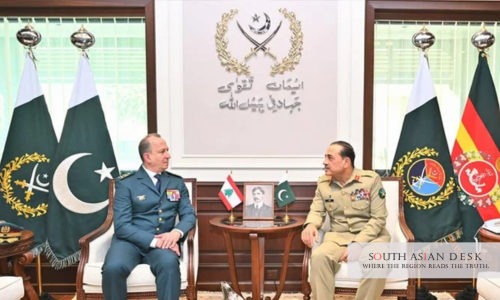
Field Marshal Syed Asim Munir, Pakistan’s Chief of Army Staff and Chief of Defence Staff, received Lebanese Armed Forces Commander-in-Chief General Rodolphe Haykal at the General Headquarters (GHQ) in Rawalpindi on Tuesday, June 9, 2026, for talks focused on Pakistan-Lebanon defence cooperation and the regional security landscape.
Lebanese Commander Accorded Guard of Honour at GHQ Rawalpindi
Upon his arrival at GHQ, General Haykal was presented a guard of honour by a smartly turned-out tri-services contingent, according to a statement issued by the Inter-Services Public Relations (ISPR).
During the meeting, both military leaders exchanged views on matters of mutual interest, the regional security situation, defence cooperation and prospects for enhancing bilateral military relations.
The discussions specifically focused on expanding professional interactions, training cooperation and institutional linkages between the armed forces of the two countries.
Pakistan-Lebanon Defence Cooperation: Field Marshal Munir Reaffirms Commitment to Bilateral Ties
Field Marshal Munir reaffirmed the significance Pakistan attaches to its longstanding and friendly relations with Lebanon and reiterated the Pakistan Army’s commitment to further enhancing defence collaboration with the Lebanese Armed Forces.
General Haykal, for his part, praised the professionalism and operational excellence of the Pakistan Armed Forces, acknowledging their contributions to regional peace, stability and international peacekeeping efforts.
According to the ISPR, the visit underscored the shared commitment of both armed forces to fostering closer military-to-military cooperation.
Meeting Takes Place Amid Evolving Regional Security Environment
The talks at GHQ come at a time of heightened volatility across the Middle East. Lebanon remains at the centre of regional tensions linked to the recent Israel-Iran conflict. Pakistan has repeatedly called for an end to Israeli military operations in Lebanon and supported diplomatic efforts to reduce tensions in the region.
General Haykal departed Beirut on Saturday to meet his Pakistani counterpart, with a Lebanon-based source telling AFP that the visit was linked to the broader peace talks that Pakistan has been facilitating between the United States and Iran.
Tehran has insisted that any deal to end the conflict must include Lebanon, where Israel has been fighting Iran-backed Hezbollah. Hezbollah militants fired rockets at Israel on March 2 to avenge the US-Israeli killing of Iran’s supreme leader, and Israel responded with an extensive campaign of airstrikes and a ground invasion that have killed nearly 3,600 people.
Lebanese state institutions, including the armed forces, have assumed an increasingly important role in maintaining stability amid continuing security challenges in the country. That context lends particular significance to the defence cooperation discussions between the two armies.
Background
Pakistan-Lebanon Military Ties
The bilateral military relationship between Islamabad and Beirut is long-established. Pakistan and Lebanon share longstanding ties through United Nations peacekeeping missions, with Pakistani troops having served in Lebanon under the UN Interim Force in Lebanon (UNIFIL). Pakistan remains one of the world’s largest contributors of personnel to UN peacekeeping operations globally.
The Lebanese Armed Forces, meanwhile, face growing demands on their operational capacity. The UN Security Council voted unanimously earlier this year to terminate the UNIFIL mandate and halt its operations at the end of 2026. The process of withdrawing the mission’s 10,800 military and civilian personnel is already under way. With UNIFIL’s departure, the Lebanese army will bear greater responsibility for security in the country’s south, making the strengthening of its capabilities through partnerships such as the one discussed on Tuesday all the more relevant.
Pakistan’s Role as Regional Mediator
On April 8, 2026, the United States and Iran agreed to a two-week ceasefire in the ongoing conflict, mediated by Pakistan. Since then, Islamabad has remained actively engaged in diplomatic efforts. Pakistan hosted discussions with Saudi Arabia, Turkey and Egypt as part of a broader coalition working to de-escalate the Middle East crisis.
Prime Minister Shehbaz Sharif said earlier this week that a US-Iranian agreement to end the war was close to being achieved before fresh fighting between Iran and Israel erupted on Sunday, June 8.
What’s Next
The Rawalpindi meeting is likely to be followed by further bilateral engagement as the regional situation continues to develop. With the Lebanese Armed Forces set to assume greater security responsibilities following UNIFIL’s planned withdrawal, and Pakistan positioned as a key mediator in the wider Middle East conflict, the deepening of Pakistan-Lebanon defence cooperation could take on added strategic importance. Field Marshal Munir’s explicit commitment to expanding military ties signals that Islamabad views the partnership as a meaningful avenue for contributing to both bilateral and regional stability.
Published in SouthAsianDesk, June 9, 2026
Follow SouthAsianDesk on X, Instagram and Facebook for insights on business and current affairs from across South Asia.