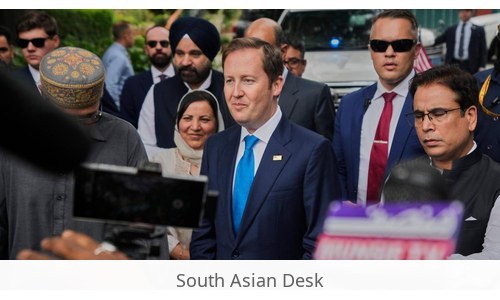
Pakistan U.S. relations: Pakistan summoned the U.S. Chargé d’Affaires in response to remarks made by Sergio Gor regarding Jammu and Kashmir. The Pakistani government described Gor’s statement as “irresponsible” and stated that his comments negated the long-standing U.S. position on the Jammu and Kashmir dispute. This incident underscores the sensitivity of the Kashmir issue in bilateral relations, where even perceived deviations from established diplomatic norms can trigger formal diplomatic responses.
Pakistan U.S. relations: Implications for Pakistan-U.S. Relations
The remarks by Sergio Gor, the U.S. Ambassador to Pakistan, have sparked immediate diplomatic reactions. Pakistani officials emphasized that the U.S. must maintain a consistent stance on Kashmir, a core issue in South Asia geopolitics. The summoning of the U.S. Chargé d’Affaires underscores Pakistan’s sensitivity to any perceived deviation from established diplomatic norms. Analysts note that such incidents could strain ongoing bilateral dialogues, particularly as both nations navigate complex security and trade dynamics. The U.S. has historically positioned itself as a mediator in the Kashmir dispute, but Gor’s comments appear to have disrupted this carefully balanced approach.
The U.S. has long maintained a policy of neutrality on the Kashmir issue, emphasizing the need for a peaceful resolution through dialogue and adherence to international law. This stance has been a cornerstone of Pakistan U.S. relations, particularly in the context of counterterrorism cooperation and regional stability. However, Gor’s remarks, which reportedly suggested a reevaluation of the U.S. position, have raised concerns in Islamabad about the potential for a shift in American policy that could undermine Pakistan’s strategic interests. The incident highlights the delicate nature of Pakistan U.S. relations, where trust is built on mutual understanding of regional sensitivities.
Regional Reactions
India has not publicly commented on the incident, though regional analysts suggest New Delhi may view the U.S. remarks as an opportunity to reinforce its own position on Kashmir. The broader South Asia geopolitics landscape remains tense, with the Kashmir dispute continuing to serve as a flashpoint for regional rivalries. The incident also raises questions about the U.S. role in South Asian affairs, particularly as it seeks to balance relations with both Pakistan and India. Regional experts caution that such diplomatic missteps could have ripple effects on multilateral initiatives, including the South Asian Association for Regional Cooperation (SAARC).
The Kashmir dispute has long been a central pillar of South Asia geopolitics, with both Pakistan and India vying for territorial claims and strategic influence. The U.S. has traditionally played a role in mediating between the two nations, though its influence has waned in recent years due to shifting global priorities and regional dynamics. The current incident could further complicate these efforts, as any perceived tilt in U.S. policy may be interpreted by both Islamabad and New Delhi as a signal of alignment with one side over the other. This could undermine the fragile trust required for sustained regional cooperation.
The SAARC framework, which aims to foster economic and political collaboration among South Asian nations, has often struggled with the Kashmir issue. The absence of a resolution to the dispute has hindered progress on regional integration, with Pakistan and India frequently at odds over the issue. The U.S. remarks, if perceived as an endorsement of one perspective, could exacerbate these divisions and further stall multilateral initiatives. Analysts warn that such developments may push smaller South Asian nations to seek alternative partnerships, potentially altering the regional balance of power. Additionally, the Pakistan summons U.S. diplomat incident highlights the need for greater diplomatic clarity in addressing the Kashmir dispute, which remains a linchpin of South Asia geopolitics.
Follow SouthAsianDesk on X, Instagram and Facebook for insights on business and current affairs from across South Asia.
Sources
- Pakistan summons U.S. Chargé d’Affaires over Sergio Gor’s remarks on J&K – thehindu.com
- Sergio Gor’s remark, Pakistan’s protest, and the changing US stance on Kashmir – indianexpress.com
Image: th-i.thgim.com