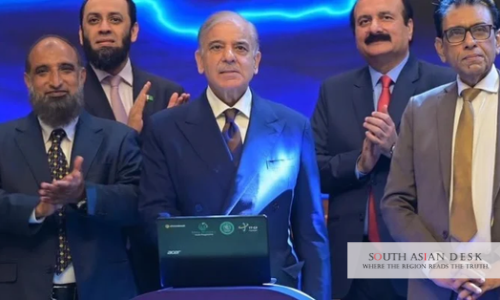
The Prime Minister’s Youth Chromebook Scheme was formally launched in Islamabad on Sunday, with Prime Minister Shehbaz Sharif announcing that the government would distribute 500,000 Chromebooks to students across the country over the next two years. Speaking at the launch ceremony, he said that providing young people with modern technology was his duty and the state’s collective responsibility.
What the Prime Minister Announced
Shehbaz Sharif told the audience that the country’s young men and women were its true assets and that the devices would help them become what he called the great builders of Pakistan. He said the Chromebooks were being distributed on the basis of the youth’s hard work and ability, and he stressed that intelligence and diligence should not be limited by poverty.
The prime minister said he hoped the laptops would allow students to attend school remotely and place them among the most educated people in the country. He added that the devices would help recipients pursue further education and, later, secure employment.
“Education is a jewel,” he said, adding that it distinguishes a person in society regardless of background. Recalling the recent inauguration of a Daanish School in Islamabad, he argued that education should be the priority of any government and that all resources should be provided for the development of the nation’s children.
Eligibility and the Role of Religious Seminaries
One of the points the prime minister clarified was that the facility would be open to students of religious seminaries, as it had been in the past. He recalled that laptops had previously been given to students of prominent seminaries alongside those at universities and colleges. The 500,000 Chromebooks, he said, would be distributed on the basis of ability alone.
The reporting on the launch did not describe how students will apply, how selection will be carried out, or which institutions will be covered first. Those details will matter for assessing how fairly the Prime Minister’s Youth Chromebook Scheme works in practice.
Comparison With Earlier Laptop Programmes
Shehbaz Sharif pointed to a precedent. He said earlier governments led by his party, the PML-N, distributed 600,000 laptops over a decade, and he vowed that the present government would hand out 500,000 Chromebooks in just two years. That comparison is the prime minister’s own, and the figure has not been independently verified here.
In August, speaking on International Youth Day, he said 250,000 high-achieving students would be awarded Chromebook laptops this year. The reports do not make clear whether those devices form part of the new two-year target or are separate, a point the government may need to clarify.
Local Assembly Behind the Scheme
The programme builds on an industrial step taken last year. On 4 November 2025, Deputy Prime Minister and Foreign Minister Ishaq Dar inaugurated Pakistan’s first Chromebook assembly line at the National Radio and Telecommunication Corporation’s facility in Haripur, in partnership with Google and its education partner Tech Valley. Dar described the project as a milestone that would make digital tools more affordable, particularly in education, and lay the foundation for jobs, supply chain development and future technology exports.
According to ProPakistani, the line was designed to produce up to 500,000 Chromebooks annually by 2026. Local assembly is intended to lower costs and reduce reliance on imports, which could make a nationwide distribution more practical, although the sources reviewed here do not state how many of the scheme’s devices will be assembled at Haripur or what the programme will cost.
Questions That Remain
Large device distributions have often drawn scrutiny over procurement, selection criteria and whether students receive adequate connectivity and training to use the equipment. Neither the launch coverage nor the prime minister’s remarks addressed internet access, teacher training or budget allocation. Education analysts typically argue that hardware delivers its full benefit only when paired with reliable connectivity and digital skills, a gap that policymakers have tended to acknowledge in general terms.
Prime Minister’s Youth Chromebook Scheme – Outlook
The government has set a clear numerical target and a two-year timeline, giving the public a benchmark against which to measure delivery. Whether the Prime Minister’s Youth Chromebook Scheme reaches students in remote and underserved areas, and whether selection is seen as transparent, will determine its credibility. For now, the launch signals that the government intends to make the Chromebook a central tool of its education and digital policy.
Follow SouthAsianDesk on X, Instagram, and Facebook for insights on business and current affairs from across South Asia.
Read More: