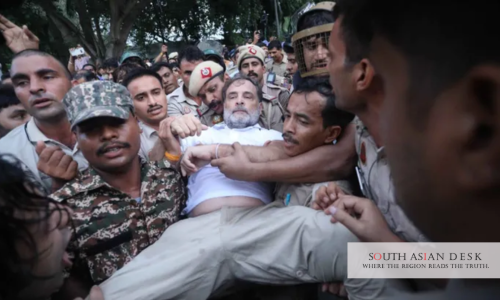
Rahul Gandhi detained by Delhi Police outside Prime Minister Narendra Modi’s official residence on Tuesday after opposition leaders staged a sit-in over the treatment of students protesting alleged examination failures and paper leaks.
The Leader of the Opposition in the Lok Sabha was taken into custody alongside Congress president Mallikarjun Kharge, Priyanka Gandhi Vadra, Karnataka Chief Minister D K Shivakumar and Samajwadi Party leader Akhilesh Yadav after a protest lasting nearly three hours at Lok Kalyan Marg in New Delhi.
The leaders were released later in the evening. Gandhi said after his release that the opposition would press for a parliamentary discussion and called on Modi to apologise to students over the police action during a march towards Parliament a day earlier.
The detention marked a significant escalation in a youth-led campaign over the integrity of India’s competitive examination system, particularly the controversy surrounding the 2026 National Eligibility-cum-Entrance Test for medical admissions.
Rahul Gandhi detained after nearly three-hour sit-in
The Modi residence protest was organised after Congress leaders visited students injured during Monday’s confrontation between police and supporters of the Cockroach Janta Party, or CJP.
Congress lawmakers initially gathered at Kharge’s residence, where they were informed of plans to march towards the prime minister’s home. The protest had not been publicly announced in advance.
Gandhi, Priyanka Gandhi and other party leaders later sat on the road near the heavily secured official residence at 7 Lok Kalyan Marg. Akhilesh Yadav and Nationalist Congress Party leader Supriya Sule subsequently joined the demonstration.
Gandhi urged supporters to join the sit-in, saying the opposition wanted answers over what he described as police brutality against young protesters. Images from the demonstration showed some Congress leaders fastening their wrists with plastic ties as police prepared to remove them.
Police eventually dispersed the gathering and transported the detained leaders to different locations. Gandhi was taken to Chhatrasal Stadium in Model Town, while Priyanka Gandhi was taken to Mandir Marg police station.
Why was Rahul Gandhi detained?
Rahul Gandhi detained after the government and opposition failed to reach an agreement on ending the protest.
Minister of State Jitendra Singh and Union Home Secretary Govind Mohan were sent to speak with the Congress leaders. Singh said Gandhi initially offered to end the sit-in if the government agreed to discuss the NEET controversy and the student movement in Parliament.
According to Singh, the government accepted the demand for a parliamentary debate. He alleged that Gandhi then added a further condition, seeking Education Minister Dharmendra Pradhan’s resignation.
The Congress presented a broader list of demands during the protest. These included Pradhan’s resignation, a parliamentary statement from Home Minister Amit Shah, debates in both houses of Parliament, a formal hearing for student representatives and an inquiry into the police action during Monday’s march.
Officials also told the opposition leaders that the area outside the prime minister’s residence was unsuitable for a prolonged demonstration because of security restrictions and disruption to the public.
The government described the Congress protest as a political confrontation staged after an offer of parliamentary debate had been made. Congress maintained that a discussion alone was insufficient without accountability for the examination controversy and the treatment of protesters.
Rahul Gandhi detained after police action against student march
The Congress protest followed a much larger demonstration led by the Cockroach Janta Party on Monday.
Thousands of young people attempted to march from central Delhi towards Parliament to demand examination reforms and Pradhan’s resignation. Police used tear gas and batons after protesters moved beyond barricades and continued towards restricted areas.
Delhi Police said 118 security personnel and more than 60 protesters were injured. Protesters and opposition parties accused officers of using excessive force, while police said demonstrators had violated restrictions and engaged in violence.
Videos showing officers striking and dragging protesters circulated widely online, increasing public attention on the movement and prompting opposition leaders to visit injured students and the CJP protest camp at Jantar Mantar.
Rahul Gandhi said the protest concerned more than a single examination. He argued that competitive tests represented one of the few remaining routes to advancement for many young Indians and that repeated failures had undermined confidence in that system.
NEET paper leak fuels India student protests
The India student protests have been driven primarily by allegations surrounding the NEET-UG 2026 examination, which is used for admission to undergraduate medical programmes.
Around two million candidates were affected by the examination controversy. The National Testing Agency subsequently arranged a re-examination, which was held on June 21.
Authorities have said 13 suspects were arrested in connection with the alleged leak. Modi has called for the strictest punishment for those responsible, while the government has pointed to the arrests and re-examination as evidence that action was taken.
The Cockroach Janta Party argues that conducting another examination does not fully address the disruption faced by students, the financial burden placed on families or broader weaknesses in the management of competitive tests.
Its demands include Pradhan’s resignation, structural examination reforms and compensation for families of students whose deaths the movement associates with academic pressure and repeated institutional failures.
The movement has also received support from educationist and environmental activist Sonam Wangchuk, whose prolonged hunger strike over examination accountability became a major focus of the campaign.
Cockroach Janta Party protest continues at Jantar Mantar
Despite the detention of Rahul Gandhi and other opposition leaders, the central Cockroach Janta Party protest remained active at Jantar Mantar under a substantial police presence.
Founder Abhijeet Dipke said supporters would not leave until the government addressed their demands. The movement, which began as an online satirical campaign, has expanded beyond students to attract professionals, parents and opposition politicians.
Government representatives made their first major outreach to the movement when Health Minister J P Nadda met a CJP delegation. The group submitted its demands, but the talks did not produce an announced settlement.
The CJP had also announced a separate sit-in outside Delhi Police headquarters over claims that supporters detained during Monday’s march were being denied access to lawyers.
It later cancelled that demonstration after its representatives said all detainees had been released. Delhi Police separately stated that nobody remained in custody and rejected claims that detainees were being denied legal access.
Government agrees to discuss examination controversy
The government’s offer to discuss the NEET paper leak in Parliament represents the most concrete concession announced following the protests.
Pradhan said the government remained prepared for a comprehensive debate and was committed to addressing genuine concerns about NEET. He accused Congress of using students to manufacture political disruption despite the offer of parliamentary discussion.
Congress rejected that characterisation and said the detention of opposition leaders reinforced its criticism of the government’s response to dissent.
After his release, Gandhi said the opposition wanted the issue discussed in Parliament and suggested that Modi should apologise to students for Monday’s police action.
No agreement had been announced on an inquiry into the confrontation, Pradhan’s resignation or the CJP’s wider demands by late Tuesday.
Opposition parties rally behind examination reforms
The Rahul Gandhi detention brought several opposition parties into closer alignment with the youth-led campaign.
Alongside Congress and the Samajwadi Party, leaders from the Nationalist Congress Party, Shiv Sena, Trinamool Congress and Aam Aadmi Party visited the protest site or expressed support for the students’ demands.
Sharad Pawar, Arvind Kejriwal and Uddhav Thackeray were among those who visited the CJP gathering at Jantar Mantar.
The Aam Aadmi Party, however, also questioned the Congress demonstration outside Modi’s residence, suggesting that it risked drawing attention away from the original student-led movement.
The different opposition parties remain united in criticising the police response but have not presented a single agreed position on all the CJP demands.
Police investigations continue after Parliament march
Delhi Police have registered five cases connected with alleged violence, stone-throwing and property damage during Monday’s march.
Police said investigators were reviewing more than 250 videos to identify people suspected of involvement in the disturbances. Opposition leaders have demanded an inquiry into police conduct, including the use of batons and tear gas.
The competing allegations mean the circumstances surrounding the violence remain disputed. Police maintain that force was used after protesters crossed barricades and violated restrictions, while demonstrators say the march was met with an excessive response.
The treatment of students has now become inseparable from the underlying examination dispute, widening the controversy from educational administration to policing, political accountability and the right to protest.
Rahul Gandhi detention increases pressure ahead of parliamentary debate
Rahul Gandhi detained outside Modi’s residence has moved the examination crisis firmly into the centre of national politics.
What began as anger over an alleged NEET paper leak has developed into a broader protest over examination security, access to education, student welfare and government accountability.
The immediate confrontation eased after the opposition leaders and CJP supporters were released. However, the main protest at Jantar Mantar continued, and no resolution was announced on the demand for Pradhan’s resignation.
The next stage will depend on whether Parliament holds the proposed debate, whether the government opens further negotiations with the CJP and whether investigations into both the paper leak and Monday’s violence produce additional action.
Published in SouthAsianDesk, July 22, 2026
Follow SouthAsianDesk on X, Instagram and Facebook for insights on business and current affairs from across South Asia.