The United Nations says declining donor support threatens essential services for Rohingya refugees in Bangladesh as the camps face new arrivals, monsoon risks and prolonged uncertainty.
Rohingya crisis conditions in Bangladesh could worsen in 2026 after the United Nations warned on Tuesday, June 2, 2026, that falling humanitarian funding may disrupt food, shelter, health, education and protection services for nearly 1.2 million refugees.
Rohingya crisis under pressure from funding cuts
The United Nations has warned that the Rohingya crisis in Bangladesh is entering a more fragile phase as aid agencies struggle to maintain essential services in Cox’s Bazar and on Bhasan Char amid declining international funding.
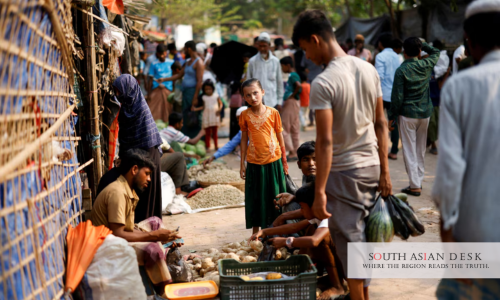
The warning comes nearly nine years after hundreds of thousands of Rohingya fled Myanmar’s Rakhine State during a military crackdown in 2017. Bangladesh now hosts one of the world’s largest refugee populations, with most Rohingya living in densely populated camps and relying heavily on humanitarian assistance.
The UN and its partners, working in coordination with the Government of Bangladesh, launched an appeal for USD 710.5 million on Wednesday, May 20, 2026, to meet critical needs in 2026. The appeal covers food, shelter, health care, education, protection and other services for Rohingya refugees and Bangladeshi host communities.
The 2026 appeal is 26 percent lower than the previous year’s requirement, despite continuing needs and new arrivals from Myanmar. UN agencies have described the plan as a scaled-down and highly prioritised response intended to protect the most essential services while donor budgets remain under pressure.
Aid appeal targets refugees and host communities
The 2026 Joint Response Plan update aims to reach up to 1.56 million people, including Rohingya refugees and affected Bangladeshi host communities. The UN says the reduced appeal reflects severe financial constraints rather than reduced need.
Aid agencies have warned that lower funding could reduce the availability of health services, learning centres, food assistance, water and sanitation support, and protection activities for women, children and older people. The camps are also vulnerable to fires, flooding, landslides and disease outbreaks during the monsoon season.
Rohingya refugees in Bangladesh generally have limited access to formal work and education, leaving many families dependent on aid. Humanitarian groups say reductions in assistance could increase child labour, early marriage, exploitation, trafficking and unsafe onward journeys.
The UN refugee agency has also warned that prolonged underfunding may weaken coordination, staffing, monitoring and emergency response capacity across the camps. Those cuts could make it harder to respond quickly to fires, storms, disease outbreaks or sudden new arrivals.
New arrivals add to pressure in Bangladesh
The funding warning comes as conflict in Myanmar continues to push more Rohingya across the border. UNHCR has reported that around 150,000 Rohingya have newly arrived in Bangladesh since early 2024, fleeing renewed violence and insecurity in Rakhine State.
The new arrivals have added pressure to already congested camps, where shelters are built closely together and many families depend on basic public services delivered by aid agencies and local partners.
The Government of Bangladesh has repeatedly called for greater international support, saying the burden of hosting Rohingya refugees should not fall on Bangladesh alone. Dhaka has also continued to describe safe, voluntary and dignified return to Myanmar as the preferred long-term solution.
However, large-scale repatriation has not taken place because conditions in Myanmar remain unsafe. Rohingya continue to face statelessness, insecurity and restrictions on basic rights, while conflict between the Myanmar military and armed groups has intensified in parts of the country.
Background
The Rohingya are a mostly Muslim minority from Myanmar’s Rakhine State. Myanmar has long denied them citizenship, leaving many stateless. More than 700,000 Rohingya fled to Bangladesh in 2017 after a military campaign that the United Nations and human rights groups described as involving serious abuses. Myanmar’s military has denied genocide allegations.
Since then, Bangladesh has hosted Rohingya refugees in camps in Cox’s Bazar, including the Kutupalong-Balukhali settlement, widely described as one of the largest refugee settlements in the world. A smaller number of refugees have also been relocated to Bhasan Char, an island facility developed by Bangladesh.
Humanitarian conditions have remained difficult because the camps are overcrowded and refugees have limited freedom of movement, limited formal employment opportunities and restricted access to national systems. Aid cuts in previous years have already affected food support and other services.
Sea crossings have also become more dangerous. UNHCR reported that nearly 900 Rohingya were dead or missing at sea in 2025, making it the deadliest year on record for Rohingya sea journeys. Many attempted to reach countries such as Malaysia, Indonesia or Thailand by boat, often through smuggling networks.
UN agencies warn of wider regional risks
Aid agencies say deepening hardship in the camps could have consequences beyond Bangladesh. Reduced assistance may increase pressure on refugees to leave by unsafe routes, heighten tensions with host communities and create protection risks for vulnerable families.
Bangladeshi host communities in Cox’s Bazar have also faced economic, environmental and social pressures since 2017. The UN appeal includes assistance for those communities, recognising that support for local residents is central to maintaining stability around the camps.
The World Food Programme, UNICEF, UNHCR, IOM and other agencies have all warned in recent years that predictable funding is necessary to preserve health, nutrition, education and protection gains.
Donor fatigue has become a growing concern as global crises compete for humanitarian resources. Aid agencies say that while the Rohingya crisis has become prolonged, the needs remain urgent because refugees cannot safely return to Myanmar and cannot fully support themselves in Bangladesh.
What’s next
The immediate test will be whether donors close the funding gap for the 2026 response plan before deeper cuts affect essential services. Aid agencies are expected to continue seeking support from governments, development institutions and private donors.
Bangladesh and the UN are also expected to keep pressing for political action on conditions in Myanmar, arguing that humanitarian aid can manage immediate needs but cannot replace a durable solution.
Until safe repatriation becomes possible, the Rohingya crisis will remain dependent on sustained international funding to protect refugees and support Bangladeshi communities hosting them.
Published in SouthAsianDesk, June 3, 2026
Follow SouthAsianDesk on X, Instagram and Facebook for insights on business and current affairs from across South Asia.