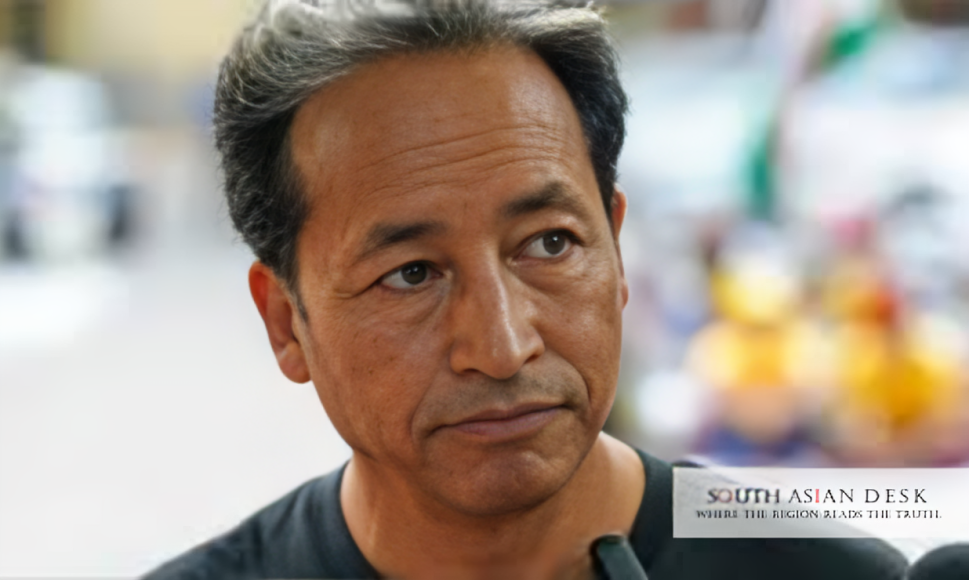
Sonam Wangchuk’s hunger strike entered a critical phase on Saturday when authorities moved the prominent Indian education reformer and environmental activist from a protest site in New Delhi to a government hospital against his stated wishes.
Wangchuk, 59, was taken from Jantar Mantar to Safdarjung Hospital on the 21st day of his indefinite fast. He had been protesting since June 28 in support of the youth-led Cockroach Janta Party, which is demanding the resignation of Union Education Minister Dharmendra Pradhan over examination paper leaks and alleged failures in India’s competitive examination system.
Delhi Police said the transfer was conducted following medical advice and in compliance with directions issued by the Delhi High Court. Wangchuk had previously informed government doctors that he did not want to be hospitalised.
Footage from the protest site showed security personnel surrounding the stage and holding large white sheets while Wangchuk was taken away on a stretcher. Some protesters attempted to prevent his removal, leading to a brief confrontation with police.
Sonam Wangchuk’s hunger strike raises medical concerns
Safdarjung Hospital said Wangchuk was weak because of prolonged fasting and dehydration but remained in a stable condition under continuous medical observation.
Doctors recommended intravenous fluids, oral rehydration and medication. However, the hospital said Wangchuk had refused intravenous fluids, oral rehydration solutions and other treatment.
His personal physician expressed concern about the possibility of hypokalaemia, a condition involving abnormally low potassium levels in the blood. A significant fall in potassium can affect muscular and cardiac functions and may become life-threatening without medical intervention.
The Delhi High Court had earlier directed authorities to closely monitor Wangchuk’s health and intervene if his condition required urgent treatment. The directions were issued during proceedings initiated by a petitioner seeking official action as the activist’s condition deteriorated.
Wangchuk’s family and supporters questioned the manner in which he was removed. They maintained that the court had not explicitly ordered authorities to take him away by force and objected to any medical procedure being conducted without his consent.
His wife, Gitanjali J Angmo, subsequently requested that he be moved to a medical facility selected by the family. She also raised concerns about transparency surrounding his treatment and medical condition.
Protest linked to India exam paper leaks
The Cockroach Janta Party protest has focused on alleged irregularities affecting national entrance examinations, particularly the NEET-UG medical admission test.
The controversy intensified after an examination taken by approximately 2.3 million candidates was cancelled following reports of a paper leak and administrative failures. The test was later conducted again in June, but the disruption generated widespread anger among students who had spent months or years preparing for the examination.
Protesters argue that repeated leaks and examination irregularities have damaged confidence in India’s education and recruitment systems. They are demanding greater accountability, stronger safeguards against leaks, compensation for affected families and structural reforms to the administration of competitive examinations.
The movement has also called for Dharmendra Pradhan’s resignation, arguing that the education minister should accept political responsibility for the disruption faced by students.
Neither the minister nor the federal government had publicly accepted the protesters’ demand for his resignation at the time of Wangchuk’s hospitalisation.
Cockroach Janta Party protest gains momentum
The Cockroach Janta Party emerged as a largely online youth movement before organising demonstrations in New Delhi. Its social media accounts attracted millions of followers within days, reflecting broader frustration among young Indians over unemployment, examination failures and limited economic opportunities.
Although the movement uses satirical language and imagery, its demonstrations have centred on demands for democratic accountability and education reforms.
Wangchuk’s involvement gave the campaign greater national prominence. Known for his work in alternative education and sustainable engineering in Ladakh, he became one of the most recognisable figures at the Jantar Mantar protest.
Before his condition deteriorated, Wangchuk said he was prepared to continue fasting for as long as six weeks unless the government responded to the protesters’ demands. Opposition politicians and other public figures repeatedly urged him to end the fast because of the growing risk to his health.
The protest also gained significant attention online, with thousands of videos and messages calling on Wangchuk to abandon the hunger strike while supporting demands for examination reforms.
Protesters maintain plans for Parliament march
Police asked Cockroach Janta Party supporters to leave the Jantar Mantar site after Wangchuk was taken to hospital. Several hundred protesters later returned, and party founder Abhijeet Dipke announced that he would begin his own indefinite hunger strike.
The movement said it intended to proceed with a march towards Parliament on July 20, coinciding with the beginning of the Indian Parliament’s monsoon session.
Reports indicated that the organisers had not obtained formal police permission for the proposed march as of Saturday. The authorities increased security around Jantar Mantar, deployed additional personnel and installed barricades near the protest area.
Dipke and other organisers said Wangchuk’s removal would not end the campaign. They called for demonstrations in other parts of India and maintained that the movement would continue until the government addressed its demands.
Wangchuk’s history of protest and detention
Wangchuk has previously organised hunger strikes and public demonstrations over constitutional and environmental protections for Ladakh.
In 2025, the government accused him of making provocative statements during protests in Ladakh that later turned violent. Wangchuk denied inciting violence and said the unrest reflected public frustration over the federal government’s handling of Ladakh’s political demands.
He spent approximately six months in detention before being released in March 2026.
His latest hunger strike has placed him at the centre of a separate national debate involving examination integrity, youth unemployment, political accountability and the authorities’ treatment of peaceful protesters.
The immediate focus remains on Wangchuk’s medical condition and whether he will agree to receive treatment. At the same time, the Cockroach Janta Party’s decision to continue its protest suggests that his hospitalisation may intensify rather than conclude the campaign.
Published in SouthAsianDesk, July 19, 2026
Follow SouthAsianDesk on X, Instagram and Facebook for insights on business and current affairs from across South Asia.