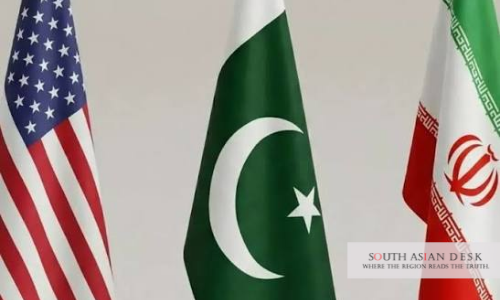
US-Iran tensions remained high on Sunday as Pakistan pressed for continued dialogue and Iran said it would not yield to intimidation, while keeping open an offer to reopen the Strait of Hormuz. Deputy Prime Minister and Foreign Minister Ishaq Dar spoke by telephone with Iranian Foreign Minister Abbas Araghchi, the Foreign Office (FO) said, at a time when the region is contending with the US-Iran conflict and renewed fighting in Yemen.
Pakistan Presses for Diplomacy Amid US-Iran Tensions
According to the FO, the two ministers discussed the evolving regional situation and the ongoing meeting of the Organisation of Islamic Cooperation (OIC) Council of Foreign Ministers in Baghdad. Dar underscored the importance of continued dialogue and diplomacy in addressing regional challenges, and both sides agreed to remain in close contact.
Dar also held a separate telephone conversation with Egyptian Foreign Minister Badr Abdelatty. The two ministers strongly condemned Houthi attacks against Saudi Arabia and reaffirmed their solidarity with the kingdom, including support for its sovereignty, territorial integrity and security. They also discussed cooperation under the Regional Four (R-4) framework, which brings together Pakistan, Egypt, Turkiye and Saudi Arabia, and said they looked forward to the next R-4 meeting to coordinate further on regional issues.
Pakistan’s Established Role as an Intermediary
The call fits a pattern of Pakistani involvement in the conflict. Al Jazeera reported in August that Pakistan hosted the first direct US-Iran talks in decades in April, and that an April ceasefire collapsed within days, prompting a US naval blockade on Iran’s southern ports. The memorandum signed in Islamabad lasted barely a month, according to the same report, as the two sides exchanged attacks and the blockade was reimposed. Iran’s foreign ministry spokesperson nonetheless reaffirmed at that time that Pakistan remained the mediator in talks concerning Iran and the United States.
In this regard, Dar’s emphasis on dialogue reflects continuity rather than a new initiative. Islamabad has sought to keep channels open even as the diplomatic track has repeatedly stalled.
Iran Rejects Coercion but Keeps Hormuz Offer Open
Speaking at the OIC meeting in Baghdad, Araghchi said that Iran “does not accept coercion, threats, or intimidation” from the United States and would not relinquish its sovereign rights under pressure. He added that Tehran remains ready for dialogue based on mutual respect and credible guarantees.
Araghchi told the media in Baghdad that Iran’s proposal to reopen the Strait of Hormuz within seven days remained on the table. He said the United States had shared comments on the proposal, which Tehran was reviewing, and that the path towards reopening the strait would be clear if Washington showed honesty. Iran’s conditions include lifting the US blockade on its ports, removing sanctions on its oil exports and ending hostilities across regional fronts. If Washington accepted these terms, Araghchi said, the strait could reopen within six days, with talks resuming the following day.
A Warning From Tehran’s New Defence Minister
Iran’s newly appointed defence minister, Mehrdad Akhlaghi, struck a harder tone. Speaking to reporters shortly after securing a parliamentary vote of confidence, he said that Iranians could rest assured that the United States would most likely not dare to attack, and that any renewed US military action would inflict enormous damage on Washington, its regional allies and the region as a whole.
Competing Positions, Limited Common Ground
The statements from Tehran combine an offer of dialogue with a refusal to negotiate under duress, a position that mirrors the stance Pakistan has described as essential for progress. However, the gap between the parties remains considerable. Iran has tied the reopening of the strait to the lifting of the blockade and of oil sanctions, and the reporting does not indicate that Washington has accepted those conditions. The report also does not set out the content of the US comments on the seven-day proposal.
For Pakistan, the immediate priority is to preserve the diplomatic space in which such proposals can be exchanged. Its ministers have framed the approach as one of sustained engagement, both with Tehran and with partners within the R-4 framework, while firmly backing Saudi Arabia against Houthi attacks. Whether that dual posture can help narrow the divide will depend on how Washington responds to the offer now under review, and on whether the renewed fighting in Yemen further complicates efforts to ease US-Iran tensions in the days ahead.
Follow SouthAsianDesk on X, Instagram and Facebook for insights on business and current affairs from across South Asia.