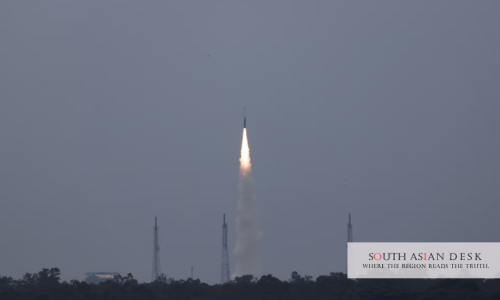
Vikram-1 launch operations successfully placed customer payloads into low-Earth orbit on Saturday, marking the first time a privately developed Indian rocket completed an orbital mission.
The Vikram-1 rocket, developed by Hyderabad-based Skyroot Aerospace, lifted off from the Satish Dhawan Space Centre in Sriharikota at 12:05 pm Indian Standard Time on July 18.
The rocket reached its intended orbit approximately 15 minutes after launch and deployed its payloads at an altitude of nearly 450 kilometres. The achievement made Skyroot Aerospace the first private Indian company to successfully launch a rocket into orbit from Indian soil.
The maiden orbital flight, named Mission Aagaman, represents a significant step in India’s effort to expand private participation in its space programme and secure a larger share of the international small satellite launch market.
Skyroot described Mission Aagaman as a successful test flight and said further missions would be conducted before routine commercial operations begin.
Vikram-1 launch successfully reaches low-Earth orbit
The Vikram-1 launch initially faced a brief delay after the planned launch time was temporarily placed on hold. The rocket was subsequently cleared for flight and lifted off from Sriharikota, producing a large plume of fire and smoke as it climbed through the atmosphere.
The Vikram-1 rocket carried several payloads and in-orbit experiments from Indian and overseas organisations. The payloads included technology demonstration satellites and equipment intended to test operations in space.
ISRO confirmed that two satellites, identified as SCOPE and Grahaa, were injected into low-Earth orbit. Additional experimental payloads remained attached to the rocket’s upper stage for in-orbit testing.
The successful Vikram-1 launch validated several critical systems developed by Skyroot Aerospace, including propulsion, avionics, telemetry, guidance, navigation and flight control technologies.
Data collected during Mission Aagaman will be examined before the company conducts additional test flights and begins regular commercial launch services.
The orbital mission also moved India into a small group of countries where private enterprises have successfully developed and launched orbital-class rockets.
How the Vikram-1 rocket works
The Vikram-1 rocket stands approximately 22 metres tall and is designed to transport small satellites into low-Earth orbit.
The launch vehicle uses three solid-fuel stages and a liquid-fuel orbital adjustment module. The final module provides the precision required to place satellites into their intended orbit after the main propulsion stages complete their burns.
Skyroot Aerospace said Vikram-1 can carry payloads weighing up to 350 kilograms into low-Earth orbit. It can also transport up to 260 kilograms into a sun-synchronous orbit, which is commonly used by Earth observation and imaging satellites.
The rocket’s structure is primarily manufactured using carbon composite materials. These materials reduce the overall weight of the launch vehicle while maintaining the strength required to withstand vibration, heat and pressure during flight.
Another notable feature of the Vikram-1 rocket is its 3D-printed liquid engine. Skyroot has presented additive manufacturing as a method of reducing the number of individual engine components and simplifying the production process.
The Vikram-1 launch was the first flight in India to use several of these technologies together in an operational orbital rocket.
Mission Aagaman tests privately developed space systems
Mission Aagaman was primarily designed as a test flight rather than the beginning of immediate commercial operations.
The mission allowed Skyroot Aerospace to assess how the Vikram-1 rocket performed under actual flight conditions. Engineers are expected to analyse information collected from the propulsion stages, navigation equipment, communication systems and orbital adjustment module.
A successful ground test cannot completely reproduce the conditions experienced during an orbital mission. Launch vehicles must withstand intense vibration, aerodynamic pressure, rapidly changing temperatures and the physical forces generated during stage separation.
The Vikram-1 launch therefore provided the company with data that will be used to refine future rockets and improve the reliability of its commercial launch services.
Skyroot said it planned to conduct several flights before moving towards routine commercial missions. The company is positioning Vikram-1 as a flexible launch vehicle for small satellites requiring either dedicated launches or shared rides to orbit.
Dedicated launches allow a customer to determine the schedule and orbital requirements of a mission. Rideshare missions divide the available rocket capacity among several customers, reducing costs for smaller satellite operators.
Vikram-1 launch follows the Vikram-S mission
The Vikram-1 launch builds upon Skyroot Aerospace’s earlier Vikram-S mission, which was conducted in November 2022.
Vikram-S became the first privately developed rocket to launch from Indian soil. However, the vehicle conducted a suborbital flight and did not attempt to place a satellite into orbit.
The Vikram-S mission, named Prarambh, reached an altitude of nearly 89 kilometres and tested technologies that would later be incorporated into Skyroot’s orbital launch vehicles.
These systems included carbon composite structures, solid propulsion, avionics and telemetry equipment. The mission allowed Skyroot Aerospace to demonstrate that a privately developed Indian rocket could successfully operate beyond most of the Earth’s atmosphere.
The Vikram-1 launch represented a substantially more complex technical challenge. An orbital rocket must achieve sufficient horizontal velocity to prevent its payload from immediately returning to Earth.
Mission Aagaman therefore marked the transition of Skyroot Aerospace from suborbital testing to orbital launch capability.
India’s private space sector expands after reforms
The Vikram-1 launch comes six years after India opened more of its space sector to private investment and commercial participation.
Before the reforms introduced in 2020, most major launch vehicle, satellite and space infrastructure activities were conducted by the state-owned Indian Space Research Organisation.
The policy changes allowed Indian space startups to develop rockets, manufacture satellites, provide launch services and use certain government facilities.
IN-SPACe, India’s space promotion and authorisation agency, was established to regulate private space activity and facilitate cooperation between commercial companies and government institutions.
ISRO and IN-SPACe provided technical assistance and access to facilities during the development and launch of the Vikram-1 rocket.
ISRO supported motor casting, static testing, engine trials, trajectory analysis, vehicle integration and pre-launch preparations. Its safety teams also worked with Skyroot personnel at the Satish Dhawan Space Centre.
The cooperation illustrates the model India is using to develop its commercial space industry. Government institutions provide infrastructure, technical expertise and regulatory support, while private companies develop launch vehicles and compete for customers.
Skyroot Aerospace emerges as major space startup
Skyroot Aerospace was founded in 2018 by former ISRO scientists and engineers Pawan Kumar Chandana and Naga Bharath Daka.
The company has developed a family of launch vehicles named after Vikram Sarabhai, who is widely regarded as the father of India’s space programme.
Skyroot has attracted investment from major international and Indian investors as interest in the private space sector in India has increased. The company says it has raised approximately $160 million and achieved a valuation exceeding $1 billion.
The valuation made Skyroot Aerospace one of India’s most prominent space technology startups.
Its current Vikram rocket family includes Vikram-1 and the planned Vikram-2 vehicle. Vikram-2 is expected to provide greater payload capacity and use an advanced cryogenic propulsion system.
The immediate priority, however, will be assessing Mission Aagaman and preparing the Vikram-1 rocket for further test and commercial flights.
Vikram-1 launch targets the small satellite market
The Vikram-1 launch positions Skyroot Aerospace to compete in the growing small satellite launch market.
Small satellites are increasingly used for Earth observation, communications, scientific research, weather monitoring, navigation and national security applications.
Satellite manufacturers frequently depend on large rockets carrying several payloads at the same time. Although rideshare services can reduce costs, operators may face delays or be required to accept an orbit selected for another customer.
Smaller launch vehicles such as the Vikram-1 rocket are designed to provide greater flexibility. A customer may be able to select a more suitable launch date and orbital destination without purchasing capacity on a much larger rocket.
Skyroot Aerospace is seeking to offer both dedicated and rideshare services. Its ability to manufacture rockets efficiently and conduct launches on demand will be central to its competitiveness.
The global small satellite launch market already includes established companies and several emerging startups. Skyroot will therefore need to demonstrate reliability, maintain competitive prices and secure a regular pipeline of customer missions.
India targets a $44 billion space economy
The Vikram-1 launch also supports India’s wider ambition to increase the value of its domestic space economy.
The Indian government aims to expand the country’s space economy from approximately $8 billion to $44 billion by 2033. Private companies are expected to contribute by developing launch vehicles, satellites, data services and space-based applications.
India already has extensive experience in satellite development, planetary exploration and cost-effective government launch missions. However, its share of the global commercial space market remains relatively limited.
A stronger private space sector could help India attract international satellite operators, increase domestic manufacturing and create specialised engineering jobs.
The success of the Vikram-1 launch demonstrates that Indian space startups are beginning to move beyond technology development and towards operational missions.
Vikram-1 launch opens new phase for commercial missions
The Vikram-1 launch does not immediately establish Skyroot Aerospace as a regular commercial launch provider. Further flights will be required to demonstrate that the rocket can perform reliably across different missions and orbital requirements.
Nevertheless, Mission Aagaman represents a major breakthrough for the private space sector in India.
Skyroot Aerospace successfully completed the country’s first privately developed orbital rocket mission, deployed customer payloads and collected data needed for future launches.
The mission also demonstrated how private companies, ISRO and IN-SPACe can cooperate within India’s reformed space framework.
As Skyroot prepares for additional Vikram-1 missions, the focus will shift from proving that a private Indian rocket can reach orbit to establishing a dependable and commercially sustainable launch service.
Published in SouthAsianDesk, July 19, 2026
Follow SouthAsianDesk on X, Instagram and Facebook for insights on business and current affairs from across South Asia.