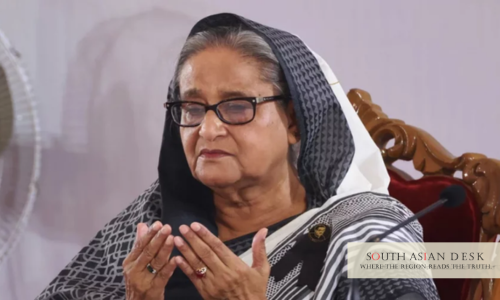
Hasina Bangladesh return plans have been outlined for the first time since the former prime minister fled to India, with Sheikh Hasina saying she and senior Awami League colleagues intend to go back around December and surrender in court.
In an interview from exile in India, Hasina said she was prepared to face arrest after returning to Bangladesh. Her comments mark the first time she has publicly set out a tentative timetable for returning home and presenting herself before the courts.
Hasina, Bangladesh’s longest-serving leader, fled the country in August 2024 after a student-led uprising ended her rule. She has since remained in India, while Bangladesh’s interim authorities have pursued legal action against her and repeatedly sought her extradition.
Hasina Bangladesh return plan could test Dhaka’s legal process
Hasina Bangladesh return plans come as the former premier faces a death sentence in absentia from Bangladesh’s war-crimes court over the deadly crackdown on protesters during the uprising that forced her from power. Hasina denies the charges and has criticised the proceedings against her.
She told Reuters that she had not consulted any foreign government on whether or when to return. She also said she had not been in contact with authorities in Dhaka over the matter.
Bangladesh has repeatedly urged India to extradite Hasina. India has said it is examining the request, but no final decision has been announced. Hasina said Dhaka wanted her sent back, but that she intended to go voluntarily.
Her proposed return would place Bangladesh’s courts, security agencies and interim authorities under intense scrutiny. It would also test whether one of the country’s most divisive political figures can face legal proceedings without triggering further unrest.
Awami League ban remains central issue
Hasina also used the interview to call for the ban on the Awami League to be lifted. The party’s activities remain restricted in Bangladesh, while many of its leaders and workers face legal cases, arrest or hiding, according to Hasina and media reports.
The former prime minister said she has held online meetings covering 125 of Bangladesh’s 300 parliamentary constituencies as part of efforts to reorganise the party from exile.
Her position is that the Awami League should be allowed to return to politics and that voters should decide its future. She said she may not be able to contest elections because of her conviction, but questioned why the party itself should be suspended.
The issue is likely to remain highly contentious. Critics of Hasina accuse her government of crushing dissent and weakening democratic institutions during her years in power. The Awami League and its supporters argue that the party is being politically excluded after its removal from office.
Bangladesh and India ties strained by exile
Hasina’s continued stay in India has become a sensitive issue in Bangladesh-India relations. New Delhi gave her refuge after she fled Dhaka, while Bangladesh’s interim government has sought her return through official channels.
The matter is diplomatically delicate because Hasina maintained close relations with India during her time in power. Since her fall, ties between Dhaka and New Delhi have faced new pressure.
A voluntary return could remove one source of bilateral tension, but it could also create new political and legal complications in Bangladesh. If Hasina and other Awami League leaders return together, authorities would need to manage arrests, court appearances and potential public reaction.
Spokespeople for Bangladesh’s government did not respond to Reuters requests for comment on Hasina’s remarks. India’s foreign ministry also did not respond to Reuters questions.
Crackdown deaths remain at centre of dispute
The political dispute around Hasina’s return is shaped by the violence that preceded her fall. A United Nations report estimated that as many as 1,400 people were killed during the crackdown on the student-led uprising.
Hasina has denied responsibility for the charges against her and said the legal process would show what she described as the weakness of the case. She has also acknowledged that governments can make mistakes, but said the public should judge her record.
That argument is unlikely to satisfy victims’ families, protest groups and political opponents who are demanding accountability for the violence. For them, Hasina’s return would be significant only if it leads to a credible and transparent legal process.
The former prime minister’s comments therefore place two competing claims at the centre of Bangladesh’s transition: the demand for justice over protest deaths and the demand by the Awami League to be allowed back into political life.
Return plan adds uncertainty to Bangladesh politics
The December plan remains uncertain. Hasina declined to provide an exact date for her return, say which court she would appear before, or identify all the party colleagues who would join her.
Reuters reported that former home minister Asaduzzaman Khan Kamal, who also faces a death sentence, is among the senior Awami League figures expected to return. Reuters could not contact other party members or establish where they were located.
For now, the announcement gives Bangladesh’s political crisis a new focal point. It also keeps Hasina at the centre of national politics despite her exile and conviction.
If she returns, Bangladesh will face a major legal and security test. If she does not, the statement may still help rally Awami League supporters and keep pressure on the interim authorities over the party’s political future.
Hasina Bangladesh return plans are therefore not only about one leader’s legal position. They are also about whether Bangladesh can manage accountability, party politics and regional diplomacy after two years of upheaval.
Published in SouthAsianDesk, July 11, 2026
Follow SouthAsianDesk on X, Instagram and Facebook for insights on business and current affairs from across South Asia.