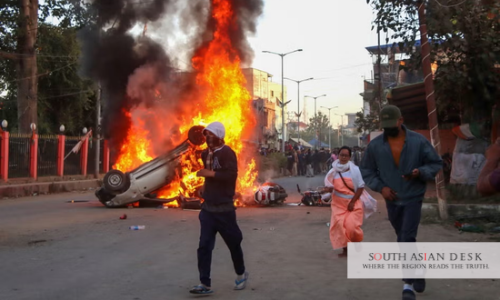
Manipur violence has returned to India’s north-eastern border state, with at least three people killed and four injured on Monday in an attack that threatens a fragile calm between two rival ethnic communities. Senior police officials and government sources told Reuters that the victims belonged to the Meitei community, and that the assault ended a period of relative quiet in which the last reported death in fighting between the two groups had occurred in January.
What Happened in the Latest Manipur Violence
According to Lhari Dorjee Lhatoo, a senior police official, unidentified armed militants opened fire on 14 Meitei villagers who were cutting and transporting firewood. “Three individuals succumbed to bullet injuries. Others sustained injuries and are undergoing further medical treatment,” Mr Lhatoo told reporters. The police did not publicly identify the attackers in the account relayed by Reuters.
Meitei groups blamed militants from the Kuki community for the attack, an allegation that Kuki groups deny. Such competing claims over responsibility are common in the dispute and make independent verification difficult.
Protests in Imphal and the Government Response
The killings prompted protests in Imphal, the state capital, where local media reported that residents placed two of the bodies in front of the residence of the chief minister. Officials said the bodies were later removed. The protest reflects the anger among Meitei groups over the killings.
Chief Minister Y Khemchand Singh held a security meeting to review the overall situation in the state, according to a statement from his office. Mr Singh, a Bharatiya Janata Party leader, took office on February 4, after the central government revoked President’s Rule, which had been in place in Manipur since February 2025. His government includes a deputy chief minister from the Kuki community, Nemcha Kipgen, and another from the Naga People’s Front, L Dikho.
Background to the Ethnic Violence
The conflict between the Meitei community, who are mostly Hindu, and the predominantly Christian Kuki community began on May 3, 2023. Reuters describes the dispute as one over economic benefits and job quotas. The first clashes followed a tribal solidarity march held in protest against a demand by Meitei groups for Scheduled Tribe status, which Kuki leaders feared could open the way for Meiteis to acquire land in restricted hill areas. The wider ethnic violence has also been linked to disputes over land, forest evictions and alleged illegal migration from Myanmar, according to published accounts of the conflict.
The human cost has been considerable. Government figures cited in the most widely referenced accounts put the death toll at 258 as of November 2024, with about 60,000 people displaced. More recent reports describe at least 260 deaths. Hence, even a limited incident can carry heavy symbolic weight in a state where trust between the two sides remains low.
A Lull That Had Raised Hopes
In recent months, fighting between the two communities had calmed. The restoration of an elected government in February was seen by many as a step towards normalcy after a year of direct central rule. The latest attack, however, shows that armed groups remain active, and that routine activities such as gathering firewood can still carry mortal risk in areas close to the boundaries separating the communities.
Outlook
The immediate challenge for the state government is to prevent retaliation, and to identify those responsible for the killings. The conflict has displaced tens of thousands of people, and any further escalation would add to that toll. Mr Singh’s meeting with security officials will be followed closely for signs of whether additional deployments or new security arrangements are planned.
For residents in both communities, the larger question is whether a durable political settlement can be reached. Until then, the risk of renewed Manipur violence will remain, and each attack will test the ability of the authorities to keep the peace after more than three years of conflict.
Follow SouthAsianDesk on X, Instagram and Facebook for insights on business and current affairs from across South Asia.