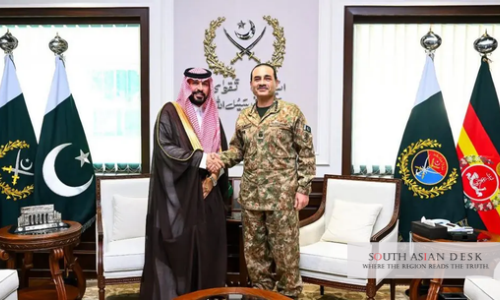
The Makkah Joint Defence Agreement was at the centre of talks in Rawalpindi on Monday, when Pakistan’s military leadership and Saudi Arabia’s new envoy expressed satisfaction with the progress made under the trilateral pact. According to the Inter-Services Public Relations (ISPR), the military’s media wing, Field Marshal Asim Munir, who serves as Chief of Defence Forces and Chief of Army Staff, received the new Saudi ambassador, Dr Rajeh Tami Albugamy, at General Headquarters.
What the ISPR Said About the Meeting
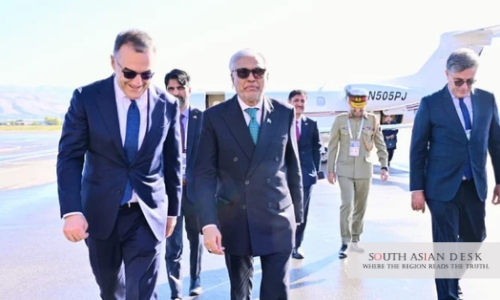
Dr Albugamy took up his duties in Islamabad last Thursday, and the call on Field Marshal Munir was among his first official engagements, Dawn reported. The two sides discussed mutual interests and regional security, according to the ISPR. Both expressed satisfaction at the progress under the Makkah Joint Defence Agreement, and stressed the need for stronger defence collaboration, institutional linkages and strategic coordination.
Field Marshal Munir congratulated the Saudi ambassador on his appointment and said his tenure would further strengthen the fraternal ties between Pakistan and Saudi Arabia. The ISPR statement did not name a specific threat or give details of the progress it referred to.
Origins of the Makkah Joint Defence Agreement
The pact was signed on August 7 at the Al-Safa Palace in Makkah by Prime Minister Shehbaz Sharif, Turkish President Recep Tayyip Erdogan and Saudi Crown Prince Mohammed bin Salman, according to Pakistan’s Foreign Office, as cited by Arab News. Field Marshal Munir accompanied the Pakistani delegation but was not among the signatories. The agreement states that any armed attack against one of the three countries shall be regarded as an attack against them all, a principle of collective defence intended to strengthen deterrence and expand cooperation across all areas of defence.
The accord builds on an earlier bilateral arrangement. Pakistan and Saudi Arabia signed a Strategic Mutual Defence Agreement in September 2025, which also treats an attack on one country as an attack on both, and Pakistan has said it will honour that commitment if Saudi security is threatened.
Implementation Gathers Pace Amid Houthi Attacks
The pact has moved from a statement of principle towards practical measures in recent weeks. According to Khaleej Times, Pakistan, Saudi Arabia and Turkey held an emergency meeting in Riyadh on October 5, after which they said they would move immediately to implement their collective defence commitments, and to ensure the rapid deployment of agreed military forces and capabilities in the kingdom. The statement said implementation would follow approved arrangements and the national laws of each country.
The meeting took place as Houthi attacks on Saudi Arabia intensified. The Saudi-led coalition fighting Yemen’s Houthis said the group had attacked a power distribution station in Madina that supplies electricity to the Prophet’s Mosque, Khaleej Times reported. Dawn linked the recent steps under the pact to these attacks, though the ISPR statement did not name any specific threat.
In an interview on Sunday, the ISPR Director General said Pakistan was providing “whatever support is needed” to defend Saudi Arabia, according to Dawn.
Diplomatic Activity Around the Pact
The ambassador’s meeting at General Headquarters formed part of a wider round of engagements. Prime Minister Shehbaz Sharif reaffirmed Pakistan’s support for the sovereignty, security and territorial integrity of Saudi Arabia in a meeting with Dr Albugamy, while Deputy Prime Minister and Foreign Minister Ishaq Dar also met the envoy and stressed bilateral cooperation.
Pakistani officials have sought to present the arrangement in defensive terms. Interior Minister Mohsin Naqvi told the Global Security Forum in Doha on Monday that the pact is a defence agreement rather than an arrangement for war. The framing matters because Pakistan is simultaneously acting as a mediator between the United States and Iran, and some analysts have suggested the pact could be read as a counterweight to Iranian influence, according to AFP reporting in August.
What to Watch
The key questions are how far the rapid deployment arrangements will go, and how Islamabad balances its obligations to Riyadh against its mediation role in the US-Iran conflict. Monday’s meeting suggests that both governments wish to keep the Makkah Joint Defence Agreement on an institutional footing, and that military-to-military channels, anchored by Field Marshal Munir, will remain central to it.
Follow SouthAsianDesk on X, Instagram and Facebook for insights on business and current affairs from across South Asia.