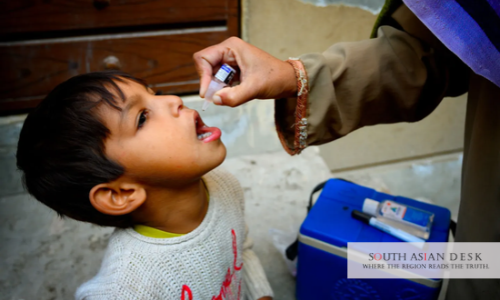
A Karachi polio case in a six-month-old boy has been confirmed, bringing the number of cases reported in Pakistan this year to seven, according to the National Emergency Operations Centre (NEOC) for Polio Eradication. The case, announced on Monday, is the first reported from the city since December 2024, a gap of roughly a year and a half, according to an official of the polio programme cited by Dawn.
Details of the Karachi Polio Case
The patient lives in Union Council Jamali Colony in Karachi East district, Sindh. The case was detected through the country’s polio surveillance network, and the Regional Reference Laboratory for Polio Eradication at the National Institute of Health in Islamabad confirmed the diagnosis, according to the NEOC. The virus involved is wild poliovirus, the naturally circulating form of the pathogen, as distinct from the vaccine-derived strains that occasionally emerge in under-immunised communities.
The NEOC said a comprehensive investigation was under way. The Polio Eradication Initiative (PEI), the programme that coordinates the national campaign, is analysing “the best science-based response to tackle and prevent further transmission,” the centre said. The NEOC also warned that vulnerable children remain at risk for as long as the virus continues to circulate.
Where the Seven Cases of 2026 Have Occurred
Of the seven cases recorded this year, five have been reported from Khyber Pakhtunkhwa, four of them from southern districts, and two from Sindh, including the latest Karachi polio case. The tally compares with 31 cases recorded across the country in 2025, according to figures cited by The Express Tribune.
Karachi has continued to report environmental detections of wild poliovirus this year, the NEOC said, an indication that the virus has persisted in the city even without a confirmed paralytic case. Environmental surveillance, which tests sewage for traces of the virus, is widely used to detect transmission before children fall ill. The persistence of such detections is why health officials treat a confirmed case in a densely populated city as a signal of continuing risk rather than an isolated event.
The Polio Vaccination Campaign and the Road Ahead
The authorities say they have intensified immunisation efforts this year. Four nationwide campaigns have been conducted in 2026, reaching more than 45 million children, some of them on multiple occasions, and the programme has also carried out targeted drives in high-risk areas. A subnational campaign in September vaccinated more than 29.3 million children, according to The Express Tribune.
The next polio vaccination campaign is scheduled for November 2 to 8. It will target nearly 24 million children in 97 districts, including all districts of Karachi, and will be synchronised with a campaign in neighbouring Afghanistan, where the same virus is also endemic. Parents have been urged to ensure that every child under the age of five receives the vaccine in each round.
Progress Remains Fragile
Pakistan and Afghanistan are the only two countries in the world where wild poliovirus remains endemic. The NEOC says Pakistan has reduced annual cases by 99.8 percent from roughly 20,000 in the early 1990s, a decline that reflects decades of vaccination work. Yet the recurrence of cases in a major city shows how quickly gaps in immunity can be exposed. Hence, the focus for health authorities is likely to be on coverage in the neighbourhoods around the affected child, and on the quality of campaign delivery in Karachi’s districts.
The Dawn report did not state whether the child had been vaccinated, and the NEOC has not yet published the findings of its investigation. These details will be important in determining whether the case reflects missed vaccinations, weak routine immunisation or a failure to reach families during earlier rounds.
For now, the latest Karachi polio case serves as a reminder that eradication depends on sustained, high-quality vaccination in every community, and that a single missed child can keep transmission alive. The November campaign will be the next test of whether the programme can close those gaps.
Follow SouthAsianDesk on X, Instagram and Facebook for insights on business and current affairs from across South Asia.