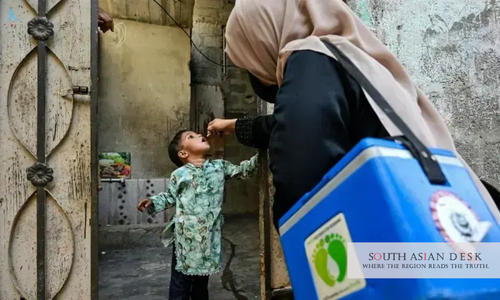
The polio drive in Balochistan got under way on Monday, with health authorities aiming to vaccinate more than 2.2 million children across 31 districts while warning of the risk posed by the virus circulating in neighbouring Afghanistan. The seven-day exercise is the fifth anti-polio campaign the province has launched this year.
Details of the Polio Drive in Balochistan
Balochistan Health Secretary Mujeebur Rehman announced the launch while speaking to the media at the campaign’s inauguration in Quetta. He said more than 8,880 polio vaccination teams had been deployed to administer drops to children under the age of five. Emergency Operations Centre (EOC) Balochistan Coordinator Inamul Haq and Quetta District Health Officer Dr Aimal Mandokhail were also present at the ceremony.
Mr Rehman directed the teams to carry out their duties diligently and to ensure that no eligible child is missed. He also urged parents, teachers, religious scholars and community leaders to support the campaign and to encourage families to have every child under five vaccinated.
Afghanistan and the Risk of Cross-Border Transmission
The timing of the campaign reflects concern over developments across the border. The health secretary warned that more than 50 polio cases reported in Afghanistan this year had heightened the risk of cross-border transmission, with Chaman and Qila Abdullah identified as particularly exposed. He explained that frequent movement of people between the two countries could help the virus spread, which makes stronger surveillance and targeted vaccination essential.
For this reason, special attention is being given to districts bordering Afghanistan, as well as to sensitive areas adjoining Punjab. The approach acknowledges that the virus does not respect administrative boundaries and that a single unvaccinated pocket can undermine progress made elsewhere.
A Strong Record That Officials Say Cannot Be Taken for Granted
Mr Rehman noted that Balochistan has reported no polio cases in the past 24 months and that environmental samples collected last month also tested negative. He credited this progress to the sustained efforts of health authorities and vaccination teams, yet he cautioned strongly against complacency.
The warning carries weight given the wider national picture. A Dawn editorial published on the same day referred to the eighth polio case of 2026 nationally, involving a 13-month-old girl from Khyber’s Bara tehsil. The Balochistan campaign also coincides with a week-long sub-national campaign announced by the National Emergency Operations Centre for November 2 to 8 in 97 districts of the country, which aims to reach 23.9 million children under five.
The health secretary also stressed that children suffering from malnutrition and other health problems could be especially vulnerable if the virus were to re-enter the province. Hence, he argued, maintaining high vaccination coverage is a matter of protecting the most fragile children as much as preserving the province’s polio-free status.
Why Routine Immunisation Matters Alongside Campaigns
Mr Rehman emphasised the need to strengthen routine immunisation alongside special campaigns in order to ensure lasting protection. Campaigns such as the present one are designed to close gaps quickly, but they cannot replace the steady delivery of vaccines through the regular health system. When routine coverage is weak, children can fall through the cracks between campaigns, and the risk of an outbreak rises.
He said eradicating polio required collective efforts by the government, health authorities, international partners and the public, and he reaffirmed that all available resources would be mobilised to keep Balochistan polio-free. The call for community participation is significant in a province where geography, security conditions and population movement have historically complicated vaccination work.
What Happens Next
The campaign will continue for seven days, during which the polio vaccination teams will move through the 31 districts to reach children at their homes. Health officials will be watching closely for any sign of the virus entering from across the border, particularly in the districts nearest to Afghanistan, while surveillance through environmental sampling will remain a key tool for detecting any reintroduction early.
For families, the message from the authorities is straightforward. Every child under five should receive the drops during the campaign, and parents should ensure that routine immunisation schedules are completed on time. The success of the polio drive in Balochistan will depend ultimately on whether the province’s vaccination teams are able to reach every eligible child over the coming week.
Follow SouthAsianDesk on X, Instagram, and Facebook for insights on business and current affairs from across South Asia.