Polio cases in Pakistan have risen to eight this year after the National Emergency Operations Centre (NEOC) for Polio Eradication confirmed a new infection on Sunday in Khyber district of Khyber Pakhtunkhwa (KP). The affected child is a 13-month-old girl from Union Council Janbaz-B in Bara tehsil, according to the Pakistan Polio Eradication Programme (PPEP), as reported by Dawn.
Second case from Khyber district this year
The programme noted that this is the second case reported from Khyber district in 2026 and the sixth from KP overall. The earlier case in the district, confirmed on 5 October, involved a seven-year-old boy from Jamrud tehsil, and Geo News reported at the time that it was the first infection recorded in Khyber district since 2019.
The remaining two of this year’s eight cases were reported from Sindh. The first of the year was detected in early March in a child from Sujawal district, and a seventh case was confirmed on 19 October in Karachi East, the city’s first in roughly 18 months. Within KP, three infections have come from Bannu district, one from North Waziristan and two from Khyber, which means the province has continued to carry most of the national burden.
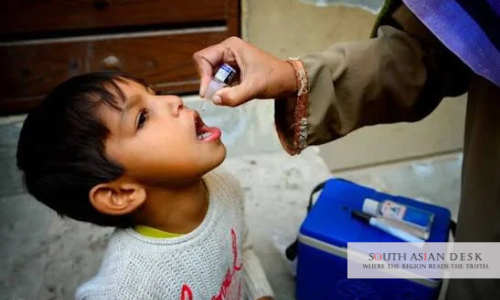
The PPEP said the case was a reminder of the need to vaccinate every child, and warned that no child is safe until all children are consistently protected across the country. Polio has no cure and can cause lifelong paralysis, but it is preventable through safe and effective vaccines.
Virus still circulating in the Peshawar Block
Although overall wild poliovirus transmission has declined this year, the Peshawar Block, which comprises Khyber and Peshawar districts, has reported positive environmental samples, indicating that the virus is still circulating there. The Pakistan Polio Eradication Initiative has begun a case investigation and is analysing a science-based response, including targeted vaccination and efforts to strengthen routine immunisation.
Environmental surveillance, which tests sewage for traces of the virus, is regarded as one of the most sensitive ways of tracking silent transmission, because it can detect circulation weeks or months before paralysis cases appear. Data from the NEOC show a marked improvement over last year. The share of positive environmental samples fell from 48.1 per cent in the first six months of 2025 to 13.1 per cent over the same period of 2026, and the number of positive samples dropped from 369 to 100. Even so, the continued detections in the Peshawar Block explain why health officials treat each new case with urgency.
New polio vaccination campaign under way
A new polio vaccination campaign began on Monday and will run until 8 November. According to Dawn, it aims to reach nearly 24 million children in 97 districts, including Khyber, and will be conducted simultaneously in Pakistan and Afghanistan with strong cross-border coordination. The PPEP urged parents to ensure that every child under five receives the oral polio vaccine in this round and in subsequent ones.
The drive follows a busy year of immunisation. Pakistan has already carried out four large-scale campaigns in 2026, protecting more than 45 million children multiple times, alongside smaller targeted rounds using oral and injectable vaccines in high-risk areas such as the Peshawar Block. A September sub-national campaign also reached tens of millions of children.
Polio Cases in Pakistan: Progress, but a fragile picture
The latest case should be read against a longer decline. Pakistan reported 74 cases in 2024 and 31 in 2025, and the figure for 2026 so far stands at eight, according to NEOC data cited by ARY News. Pakistan and Afghanistan remain the only two countries where polio is still endemic, and the NEOC says annual cases have fallen from an estimated 20,000 in the early 1990s.
Yet the geography of this year’s infections points to persistent obstacles. Four of the first five cases were recorded in the Bannu division, where The Express Tribune reported that security constraints have left some children unvaccinated. Reaching such children, and keeping them protected through repeated rounds, will determine whether the downward trend can be sustained. The new Khyber case, in a district with positive environmental samples, is a further indication that progress remains fragile and that high vaccination coverage must be maintained campaign after campaign.
Follow SouthAsianDesk on X, Instagram and Facebook for insights on business and current affairs from across South Asia.