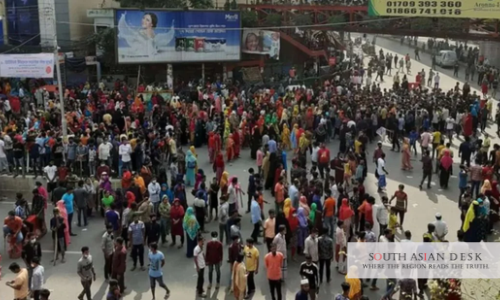
Garment worker protests in Dhaka flared again on Monday morning, when police moved to disperse workers gathering on the roads of Mirpur a day after violent clashes in the same area. According to Dhaka Tribune, police chased workers off the road at around 9:15am, and the officer-in-charge of Mirpur police station, Hafizur Rahman, confirmed the operation. “The workers came to block the road, and we dispersed them,” he said.
Tension lingers in Mirpur
When workers tried to assemble again near Mirpur-10, police intervened, triggering a series of chases and counter-chases. Workers threw bricks and stones at officers, who responded with tear gas shells. The crowd was eventually dispersed, but Dhaka Tribune reported that tension remained high, with most shops closed and police restricting gatherings on the streets and questioning people they regarded as suspicious.
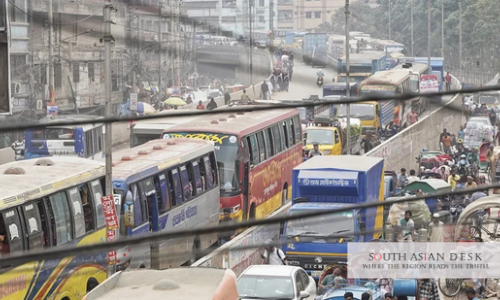
The Monday confrontation followed a far more serious day on Sunday. Hundreds of workers from several factories blocked the Mirpur-10 intersection from around 9am, bringing traffic to a standstill on roads linking Mirpur-11 with Agargaon and Mirpur-2 with Mirpur-13. When the crowd refused to clear the road, police tried to disperse it by force at about 11:15am, using batons, tear gas, sound grenades and water cannon, according to The Daily Star and The Financial Express. Protesters set a police vehicle alight beneath the Mirpur-11 metro station, and The Business Standard reported that at least 19 people were detained.
Metro services and traffic disrupted
The clashes spread beyond the roads. Metro rail trains bypassed Pallabi, Mirpur-11 and Mirpur-10 stations on Sunday at the request of police, and the stations reopened after roughly two hours, Prothom Alo reported. The Financial Express said workers called off their demonstration in the afternoon after blocking the road for about six hours in two phases, after which traffic returned to normal. Workers had also blockaded Mirpur roads on Thursday and Saturday, and some had vandalised factories and shopping malls during the earlier unrest.
The demand behind the unrest
The workers are pressing for a Tk30,000 minimum wage, a figure that Reuters put at about $245 a month. They cite the rising cost of food, housing, transport and healthcare. On Sunday the government announced a six-member wage board, with representatives of factory owners, trade unions and the government, to review pay in the garment sector. Labour Minister Ariful Haque Choudhury urged workers to return to their factories, saying their demand for a wage-setting mechanism had been addressed.
That announcement did not end the protests. Reuters reported that thousands of workers demonstrated on Sunday despite the creation of the wage board, and that hundreds blocked a major highway in Gazipur, prompting owners to shut 25 to 30 factories and authorities to deploy Border Guard Bangladesh personnel. Al Jazeera reported that the unrest began on Saturday, led about 30 factories on the outskirts of Dhaka to declare holidays, and injured several people in Ashulia, including police officers.
Unrest spreads to the Dhaka-Tangail highway
The pattern continued on Monday outside the capital. A local news report said workers again gathered on the Dhaka-Tangail highway in Kaliakair, Gazipur, from about 7am after declining to report for work, and that police fired sound grenades to clear the road. The report noted that the same demand has produced repeated protests, highway blockades and clashes in the area in recent months.
Garment Worker Protests in Dhaka: Why the stakes are high
Bangladesh’s garment industry is the world’s second largest after China’s and contributes about 10 per cent of the country’s gross domestic product, according to Al Jazeera. Prolonged disruption therefore carries consequences well beyond the factory floor. The labour minister warned that sustained unrest could delay export shipments and payments from international buyers, creating further difficulties for manufacturers and workers alike, as Reuters reported. Manufacturers have also pointed to higher production costs and uncertainty in energy markets.
The coming days will test whether the new wage board can persuade workers to return to the production lines. Labour leaders have so far shown little sign of accepting that a review process alone answers their demand, while factory owners face mounting closures and the risk of lost orders. Until the board announces a figure that both sides can accept, further blockades and police action in industrial areas such as Mirpur, Ashulia and Gazipur appear likely.
Follow SouthAsianDesk on X, Instagram and Facebook for insights on business and current affairs from across South Asia.
Read More: