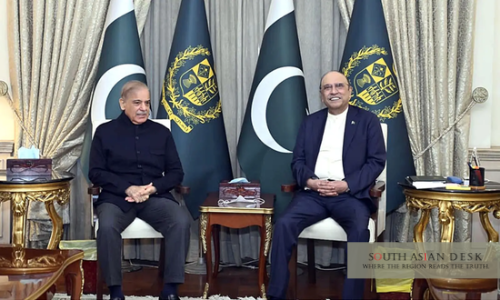
A new provinces referendum cannot go ahead without the approval of parliament, President Asif Ali Zardari and Prime Minister Shehbaz Sharif agreed on Saturday, as the two leaders sought to settle the terms of a debate that has unsettled the ruling coalition. According to official sources who spoke to Dawn, the understanding was reached during a meeting at the prime minister’s Model Town residence in Lahore. Both leaders committed to following the constitutional procedure strictly in any move concerning the creation of new provinces or administrative units.
The meeting followed a fresh round of public discussion triggered two days earlier, when Interior Minister Mohsin Naqvi proposed seeking public opinion through a referendum. Mr Naqvi had argued that such an exercise could put the long-running question to rest, and he assured political parties that they would be consulted before any decision was finalised.
Parliamentary Approval Seen as Non-Negotiable
Sources present at the discussion said the two leaders agreed that parliament could not be sidestepped in deciding whether a referendum should be held and which questions should be put to voters. One official source described the position plainly, saying that the majority in parliament would determine both matters and that, without consensus, the proposal could not advance. The principle of parliamentary approval therefore sits at the centre of the understanding between the two leaders.
The position reflects the constitutional weight of the subject. Under Article 239 of the Constitution, altering the boundaries of a province requires a constitutional amendment passed by a two-thirds majority of the total membership of both houses of parliament. The amendment must also be approved by two-thirds of the total membership of the assembly of the province concerned. Any proposal to redraw provincial lines must clear these hurdles regardless of what a public poll might indicate.
PPP Holds Firm on the Division of Sindh
President Zardari, who was accompanied by former prime minister Raja Pervez Ashraf and Senator Saleem Mandviwalla, made clear that the Pakistan Peoples Party remained aligned with the Sindh Assembly’s resolution opposing the creation of new provinces. The party has repeatedly cited that unanimous resolution in support of its stance. Party chairman Bilawal Bhutto-Zardari and Sindh Chief Minister Murad Ali Shah have also stated on several occasions that the division of Sindh is acceptable to the party neither legally nor politically.
The PPP’s firmness leaves little room for compromise on Sindh, even as the party has indicated it has no objection in principle to the idea elsewhere in the country. Prime Minister Shehbaz, according to the sources, endorsed the president’s view that any step in this direction must strictly follow the procedure laid down in the Constitution.
Differing Voices Within the Ruling Coalition
The debate has also exposed differing views inside the governing alliance. Defence Minister Khawaja Asif recently argued that Pakistan could have as many as 12 provinces if the exercise were guided by administrative needs rather than linguistic, ethnic or political considerations. He maintained that a growing population called for smaller administrative units capable of delivering public services more efficiently. The PML-N, however, has so far avoided articulating a formal policy and has said it will present its position when the matter comes before parliament.
Present at the meeting were Adviser on Political Affairs Rana Sanaullah, Law Minister Azam Nazeer Tarar, National Assembly Speaker Ayaz Sadiq, and the prime minister’s sons, Hamza and Suleman.
New Provinces Referendum: Other Matters Discussed
The two leaders also held a brief one-on-one conversation to discuss a message reportedly conveyed to the president by Mr Naqvi during his recent visit to Nawabshah. The situation of incarcerated PTI founder Imran Khan was also raised. According to the sources, the meeting was told that his recent hours-long interaction with his lawyers, and the release of his two sisters from jail, were not connected to any particular behind-the-scenes development.
A statement issued by the Prime Minister’s Office described the talks as a detailed review of the country’s political, economic and security situation, with an emphasis on coordination among coalition partners. It made no specific mention of the provinces question or the proposed referendum. The statement added that Prime Minister Shehbaz briefed the president on his recent visit to Turkiye, where he attended the 31st Conference of the Parties (COP31) and highlighted Pakistan’s climate action efforts. The two leaders also reaffirmed their commitment to working together to accelerate economic stability and development.
As the discussion continues, the understanding reached in Lahore suggests that any new provinces referendum will be decided on the floor of parliament rather than outside it, and that consensus among the major parties will remain the precondition for progress.
Follow SouthAsianDesk on X, Instagram and Facebook for insights on business and current affairs from across South Asia.