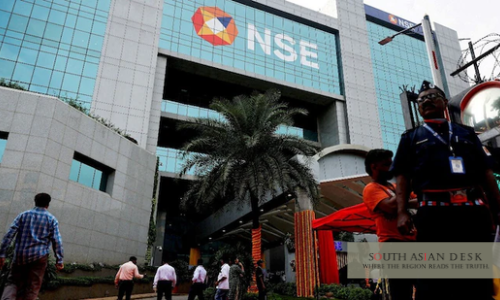
NSE third-largest stock exchange status marks a significant development for India’s financial markets, as the National Stock Exchange of India (NSE) has overtaken Germany’s Deutsche Boerse and the London Stock Exchange in market capitalisation. The exchange operator reached an estimated valuation of $64.1 billion on Thursday, November 26, following a rise in its share price to a new post-listing high.
NSE shares gained approximately 3.5% during Thursday’s trading session, reaching an intraday high of Rs 2,400. The increase brought the company’s market value close to Rs 6 lakh crore, placing it ahead of two major European exchange operators.
According to available market data reported by India Today, Deutsche Boerse was valued at approximately $63.4 billion, while the London Stock Exchange had a market capitalisation of around $62.4 billion. The ranking places NSE behind only the CME Group and Intercontinental Exchange (ICE) among the world’s largest publicly listed exchange operators.
The milestone comes roughly two months after NSE made its long-awaited stock market debut in September, marking a notable change in the ownership and public market profile of one of India’s most important financial institutions.
NSE Third-Largest Stock Exchange Ranking: How India Moved Ahead
The latest ranking reflects the rise in NSE’s share price following its September listing on the Bombay Stock Exchange (BSE). The exchange operator’s shares continued to gain during November, extending their upward movement for a second consecutive trading session on Thursday.
At an estimated market capitalisation of $64.1 billion, NSE moved ahead of Deutsche Boerse and the London Stock Exchange. However, it remains behind two major US-based exchange operators.
CME Group leads the ranking with an estimated market value of $111.6 billion, followed by Intercontinental Exchange at approximately $99.4 billion. ICE is the parent company of the New York Stock Exchange.
The comparison is based on the market capitalisation of publicly listed exchange operators. It should not be confused with rankings based on trading volume, the number of listed companies or the total value of securities traded on an exchange.
NSE’s position is particularly significant because it entered the public market only recently, while its European competitors have established positions in international financial markets over considerably longer periods.
NSE Share Price Rises Following September Stock Market Listing
NSE’s stock market debut took place on September 24, 2026, following a long-awaited initial public offering (IPO). The shares were listed on the BSE at Rs 1,800, representing a premium of 0.84% over the issue price of Rs 1,785.
The IPO was valued at approximately Rs 22,561 crore and received bids for 5.69 times the number of shares offered. Subscription closed on September 21 after opening on September 17.
Since its listing, the NSE share price has experienced notable movements. The stock initially fell to a post-listing low of Rs 1,640, below its issue price, before recovering in subsequent months.
By November 26, the shares had recovered nearly 50% from that post-listing low. The stock had also gained approximately 34% during October, according to figures reported by India Today.
The November performance contributed further to the exchange operator’s rising valuation. NSE shares recorded gains in 14 of the month’s first 18 trading sessions, demonstrating the strength of the upward movement during that period.
The increase in market capitalisation also placed NSE among India’s most valuable publicly traded companies. Its valuation had crossed Rs 5.76 lakh crore on Wednesday, November 25, making it the ninth most valuable company in the Indian stock market at that point.
National Stock Exchange of India and Its Role in Financial Markets
Established in 1992, the National Stock Exchange of India began operations in 1994 as the country’s first electronic stock exchange. Its introduction represented an important development in the modernisation of India’s financial markets by enabling electronic trading rather than relying on traditional trading-floor systems.
The exchange provides trading, clearing and settlement services across several financial instruments, including equities, debt, currencies, commodities and derivatives.
Over the years, NSE has developed into a central institution within India’s financial system. Its trading infrastructure supports a wide range of market participants, including individual investors, institutional investors, brokers and companies seeking access to capital markets.
Its market position is also reflected in the scale of activity conducted through its platforms. The exchange plays an important role in price discovery, liquidity and the execution of transactions across different asset classes.
The company’s recent listing has provided public market investors with an opportunity to trade shares in the exchange operator itself. Previously, ownership was held by existing shareholders, and its public listing represented a significant change in how its valuation could be assessed through daily stock market activity.
What NSE’s Global Ranking Means for India’s Financial Markets
The NSE third-largest stock exchange milestone highlights the growing international significance of India’s financial market infrastructure. Its valuation places the exchange operator alongside some of the world’s most established financial institutions.
The development also reflects investor interest in India’s capital markets and the business of operating financial exchanges. As trading activity and participation evolve, exchange operators remain important to the functioning of financial systems by providing the infrastructure required for transactions and settlement.
However, market capitalisation alone does not provide a complete assessment of an exchange operator’s financial performance or long-term prospects. Share prices can fluctuate in response to investor sentiment, company performance, market conditions and broader economic developments.
NSE’s recent share-price gains therefore do not necessarily indicate that its valuation will continue to rise at the same pace. Its position relative to international competitors could change as market conditions and the valuations of other exchange operators evolve.
For investors, the distinction between an exchange’s market value and its underlying business performance remains important when evaluating the company’s prospects.
The latest ranking nevertheless represents a notable achievement for India’s financial sector. With a market capitalisation of approximately $64.1 billion, NSE has moved ahead of Deutsche Boerse and the London Stock Exchange, securing third place among the world’s largest publicly listed exchange operators.
Its future position will depend on market performance, investor confidence and its ability to maintain its role in India’s expanding financial ecosystem.
Follow SouthAsianDesk on X, Instagram and Facebook for insights on business and current affairs from across South Asia.