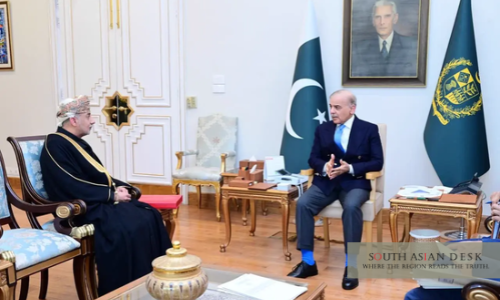
Pakistan-Oman ties received fresh political attention in Islamabad after Prime Minister Shehbaz Sharif called for further strengthening bilateral cooperation with the Gulf state, particularly in trade, investment, energy and defence. The call came during a meeting with the Omani ambassador at the Prime Minister’s House, according to a news release issued by the Prime Minister’s Office.
Why Pakistan-Oman Ties Matter for Trade and Energy
During the meeting, the prime minister highlighted the longstanding brotherly relations between the two countries, which he said are rooted in shared history, faith and culture. He stressed the importance of translating the positive momentum in bilateral relations into tangible results through greater economic engagement and institutional cooperation.
The emphasis on commerce reflects the existing shape of the relationship. Oman is a key supplier of energy to Pakistan, while Pakistan sends rice, textiles and agricultural goods to the Gulf state. Efforts to widen this exchange have continued throughout the year. In April, a delegation of Pakistani rice exporters travelled to Oman on a visit organised by the Trade Development Authority of Pakistan, with the aim of expanding exports and exploring routes into wider Gulf markets. Earlier this week, ministers from the two countries also discussed ways of expanding trade and investment, noting that geographical proximity and cordial relations offer a strong foundation for deeper economic cooperation.
Against this backdrop, the prime minister’s remarks signal that Islamabad wants to move beyond cordial rhetoric and secure measurable gains. Defence was named alongside trade, investment and energy as an area where the partnership could grow, although the official statement did not outline specific projects or agreements.
Regional Developments and the Role of Diplomacy
The two sides also exchanged views on recent regional and global developments. Prime Minister Shehbaz Sharif emphasised the importance of maintaining peace and stability through dialogue and diplomacy, a position consistent with the approach Pakistan has frequently articulated in its engagement with Gulf partners.
For his part, the Omani ambassador thanked the prime minister for receiving him and conveyed the greetings of the Omani leadership. He reaffirmed his country’s commitment to further strengthening its close relations with Pakistan, the statement said.
PCSIR Directed to Support Industrial Growth and Exports
In a separate engagement on Friday, the prime minister chaired a meeting on the Pakistan Council of Scientific and Industrial Research, commonly known as PCSIR. He directed the institution to enhance its research capabilities and contribute more effectively to industrial development, export growth and the promotion of small and medium-sized enterprises. He said the council could play a significant role in helping Pakistani products compete in international markets.
To that end, the prime minister directed all PCSIR laboratories to obtain accreditation in line with international standards, which would allow Pakistani export products to receive internationally recognised certification and validation. He also called for stronger cooperation between the council and the National Vocational and Technical Training Commission to improve industrial and technical training opportunities for young people, and he sought the report of the third-party validation conducted on the institution.
The prime minister also constituted a committee to review the council’s mandate, performance and future role. The committee will examine the institution’s original objectives, legal responsibilities, achievements and untapped potential, and will recommend measures to improve its contribution to the national economy, industrial development and exports.
Participants in the meeting were informed that the Pakistan Council of Scientific and Industrial Research operates 10 research laboratories and units across the country, along with seven technical training institutes, while 12 additional laboratories are nearing completion. Officials said the institution had provided technical training to more than 12,000 young people. Its research and development work spans food, agriculture, biotechnology, pharmaceuticals, textiles, leather, minerals, engineering and energy. The briefing further noted that its laboratories offer domestic industries and exporters facilities for product testing, quality verification and the calibration of technical instruments.
Looking Ahead
The two engagements, though distinct, share a common theme of turning policy intent into economic results. Stronger Pakistan-Oman ties could open new avenues for exporters and investors, while a more capable and internationally accredited research council could help Pakistani products meet the standards demanded by overseas buyers. How quickly these ambitions translate into concrete agreements and measurable trade gains will depend on follow-up action by officials on both sides.
Follow SouthAsianDesk on X, Instagram, and Facebook for insights on business and current affairs from across South Asia.