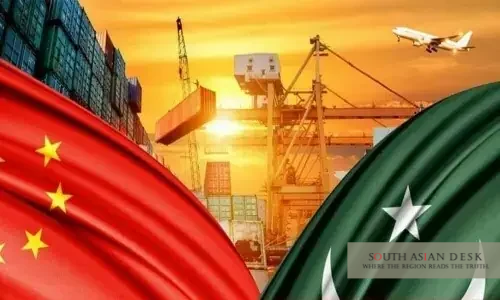
Zero-tariff access for Pakistani goods has been requested from China, with the aim of raising Pakistan’s annual exports to China from about $3 billion to between $20 billion and $25 billion, Planning Minister Ahsan Iqbal said after meeting a senior Chinese Communist Party official. According to a statement, Iqbal raised the request on 26 November with Liu Haixing, Minister of the International Department of the Central Committee of the Communist Party of China (IDCPC).
What Pakistan Asked For
Iqbal asked the department to support preferential, zero-tariff access to the Chinese market for Pakistani goods, and pointed to the tariff concessions China has extended to African countries as a possible model. He was following up on a proposal discussed on 3 November that Prime Minister Shehbaz Sharif had earlier raised with President Xi Jinping. He noted that China imports nearly $3 trillion worth of goods a year, and said the concessions could improve the competitiveness of Pakistani exports in that market.
The statement came from the Pakistani side. It said Iqbal asked for updates on the proposal, which suggests that no decision has been announced and no Chinese response was included.
Why Pakistan Wants Zero-Tariff Access
Pakistan’s case rests on a persistent trade imbalance. Official figures reported by Business Recorder show that Pakistan exported goods worth $2.375 billion to China in fiscal year 2024-25, of which $2.16 billion fell under the existing China-Pakistan Free Trade Agreement, while imports from China were around $20 billion. Bilateral trade stood at about $19.4 billion, and Pakistan’s deficit with China accounted for nearly 59 percent of its overall trade gap. The figure of $3 billion cited by Iqbal differs from the fiscal-year number, because trade data vary by source and period.
For scale, $3 billion is roughly 0.1 percent of China’s annual imports, and $25 billion would be less than one percent. The target is nonetheless a sharp increase, between seven and eight times the current level.
Pakistani officials argue that the concessions it won under earlier phases of the free trade agreement have lost value because China later signed preferential arrangements with the Association of Southeast Asian Nations (ASEAN) and other partners. Both countries currently operate under the second phase of the agreement, which took effect in January 2020. In May, Profit reported that Pakistan planned to ask China to extend unilateral tariff concessions on around 700 product lines under a proposed third phase.
The African Model and Its Limits
China granted zero-tariff treatment to the 53 African countries with which it has diplomatic relations from 1 May 2026 until 30 April 2028, according to Chinese state media reports. Beijing presented it as a measure to boost African exports and rebalance trade.
The effect on African trade has been debated. Analysts quoted in reports said that the practical impact may be limited because most African goods already entered China duty-free under World Trade Organization preferences or least-developed-country treatment, and Africa’s trade deficit with China has continued to widen. Observers in Pakistan have also argued that preferential access produces results only when it is backed by effective execution, such as product standards and export capacity, and noted that countries like Vietnam, Malaysia and Indonesia have grown their exports to China faster than Pakistan.
The Knowledge Corridor and the Second Phase of CPEC
Iqbal also sought support for a proposed Pakistan-China Knowledge Corridor, which would help about 10,000 Pakistani scholars pursue doctoral studies and specialised research over ten years. The proposal includes scholarships, partnerships with leading Chinese universities and co-financing, with priority areas in artificial intelligence, engineering, advanced manufacturing, modern agriculture, biotechnology and mineral sciences.
On the China-Pakistan Economic Corridor, he highlighted industrial and agricultural cooperation, business partnerships, technology transfer, minerals and green development as priorities for the second phase of CPEC. He said the first phase had attracted about $25 billion in investment, added more than 8,000 megawatts of generating capacity, delivered 888 kilometres of highways and motorways and created an estimated 236,000 direct and indirect jobs. He tied the next phase to Pakistan’s URAAN development programme and China’s 15th Five-Year Plan, stressing policy continuity. Iqbal also reaffirmed Pakistan’s commitment to the security of Chinese personnel and projects.
What Comes Next
The next step is China’s response. The statement gave no timeline and did not say which products Pakistan wants covered, how many items are involved or what safeguards China might require. A zero-tariff arrangement would also reduce China’s customs revenue, which Chinese officials would have to weigh against any trade and diplomatic benefits.
Whether Pakistan could take advantage of such access is a second question. Pakistan’s exports to China have remained small and concentrated in a limited range of goods, and the earlier free trade agreement has not narrowed the deficit. Zero-tariff access would lower a barrier, but increasing sales would still depend on meeting Chinese standards, building supply capacity and finding buyers, which the statement did not address.
For now, the request is a stated goal with an ambitious target, and its outcome will depend on talks that are still at an early stage.
Follow SouthAsianDesk on X, Instagram and Facebook for insights on business and current affairs from across South Asia.