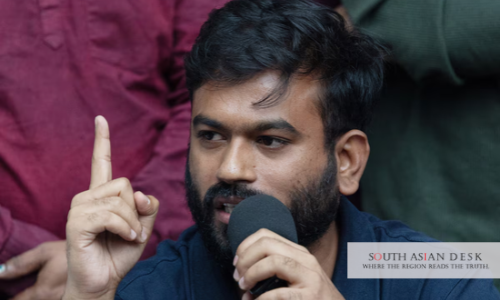
The Abhijeet Dipke arrest has intensified a political confrontation in India’s capital, where a youth-led protest movement is demanding the removal of the country’s top election official. Police arrested Dipke, the founder of the so-called cockroach movement, according to several media reports on Saturday, a day after he was detained ahead of a rally in Delhi.
What Is Known About the Abhijeet Dipke Arrest
Broadcasters NDTV and India Today reported early on Saturday that Dipke was arrested to prevent a breach of the peace and would be presented before a court. Neither outlet gave a date for the hearing.
Dipke was first detained on Friday as he left a house in central Delhi. Police placed him in a vehicle and drove away after a brief argument. Earlier that day, officers had met him and warned him against proceeding with the planned demonstration.
The rally went ahead and drew hundreds of people who waved the national flag. Dipke had called the protest in support of two leaders of his organisation, who were detained earlier this week and sent to jail for five days for demonstrating at a protest site in violation of a ban.
The Cockroach Janta Party and Its Demands
Dipke leads the Cockroach Janta Party, a youth-led group that has joined opposition parties and student organisations in staging near-daily protests this month. Their central demand is the resignation of Chief Election Commissioner Gyanesh Kumar.
Student activist Neha Bora, who has become a prominent face of the demonstrations, was also detained on Friday while trying to reach central Delhi with dozens of supporters. She was later released and confirmed her release in a post on the social media platform X.
Why the Voter List Revision Has Sparked Protests
At the heart of the dispute is the voter list revision conducted by the Election Commission. According to Reuters, more than 130 million voters were deleted from the rolls during the exercise. Protesters and opposition groups argue that the revision favours Prime Minister Narendra Modi’s Bharatiya Janata Party (BJP).
The Election Commission has denied favouring any party. It has said that voters who were wrongly removed from the lists are able to re-enrol. The BJP, for its part, has accused its rivals of attempting to undermine democracy by wrongly questioning legitimate electoral processes.
The competing accounts leave the central question unresolved. Critics point to the scale of the deletions as evidence of a flawed or politically motivated process, while the authorities maintain that the revision is lawful and that a remedy exists for those affected.
Pressure on Chief Election Commissioner Gyanesh Kumar
The campaign against Chief Election Commissioner Gyanesh Kumar has grown over several weeks, with the protests concentrating on his alleged role in the handling of the voter list revision. The Election Commission has rejected claims of bias, and the demand for his resignation has not been met.
The detentions and arrests of protest leaders add a further dimension to the dispute. Supporters of the movement are likely to portray the Abhijeet Dipke arrest as an attempt to suppress peaceful dissent, while the authorities have framed their actions as measures to keep order and enforce restrictions on demonstrations.
What Happens Next
The immediate focus will be on Dipke’s court appearance, which could determine whether he remains in custody. The outcome may also influence the tone and size of further protests, given that the demonstrations have been occurring almost daily.
The wider dispute over the voter list revision shows no sign of easing. With opposition groups, student organisations and the Cockroach Janta Party all pressing for the election chief’s resignation, and the Election Commission and the BJP firmly rejecting the allegations, the standoff is expected to remain a defining political issue in the days ahead.
This article is based on reporting by Reuters, NDTV and India Today. Details may change as the situation develops.
Follow SouthAsianDesk on X, Instagram and Facebook for insights on business and current affairs from across South Asia.