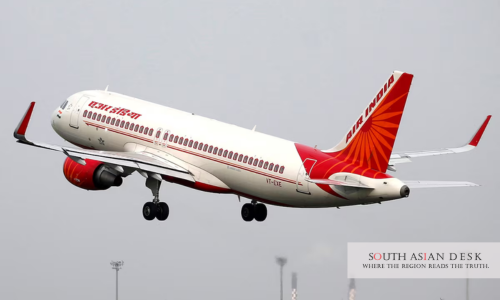
The Air India A320 hydraulic failure that struck flight AI2379 on August 4 has been confirmed by a preliminary analysis from Airbus, which found that the aircraft briefly lost the use of its elevators and ailerons after registering pressure losses across all three of its hydraulic systems. The incident, which caused the plane to drop roughly 300 feet during cruise, injured 24 people aboard before the aircraft stabilised and landed safely in Delhi.
What the Air India A320 Hydraulic Failure Report Reveals
According to the manufacturer’s assessment, prepared in response to a request from Air India for a technical evaluation, the aircraft’s elevators and ailerons, the control surfaces responsible for pitch and roll, were unavailable for about four seconds. During that brief window, the aircraft pitched upward. The first officer applied a full nose-down input on the sidestick, but the flight-control surfaces produced no direct response until the hydraulic systems recovered on their own within seconds.
Airbus has not identified the underlying cause of the pressure losses. The analysis does not confirm whether the aircraft genuinely lost hydraulic fluid or pressure in each of the three circuits, or whether a fault in sensing, wiring or cockpit indication produced the recorded sequence of warnings. As part of its findings, Airbus has asked Air India to carry out further checks on the aircraft’s systems and sensors and to supply additional data from the flight.
Inside Flight AI2379: A 300-Foot Altitude Drop Over Odisha
The Air India flight AI2379 was travelling from Phuket in Thailand to Delhi’s Indira Gandhi International Airport when the sudden loss of altitude occurred while the aircraft was flying over Odisha. The Airbus A320, registered VT-EXO, was carrying 137 passengers, including three infants, along with eight crew members. Air India initially attributed the episode to turbulence, but later revised its account to describe a sudden loss of altitude, dropping the turbulence description altogether.
The 300-foot altitude drop unfolded rapidly during cruise before the flight crew regained control and the aircraft continued safely to Delhi. Indian aviation authorities have classified the event as a serious incident under international rules governing air accident investigations, and the Aircraft Accident Investigation Bureau has opened a formal probe with technical support from Airbus and France’s Bureau d’Enquêtes et d’Analyses.
How the Aircraft’s Hydraulic Systems Are Designed to Work
An A320’s flight controls depend on three independent hydraulic circuits, coloured Green, Blue and Yellow, each of which normally operates at 3,000 pounds per square inch. The Green and Yellow systems typically draw pressure from engine-driven pumps, while the Blue system relies on an electric pump and can draw emergency power from a ram air turbine if required.
A power transfer unit is also built into the aircraft, allowing hydraulic power to move between the Green and Yellow systems without transferring fluid between their separate reservoirs. This layered redundancy is intended to ensure that a fault in one circuit does not leave the aircraft without control authority, which makes the near-simultaneous loss recorded on flight AI2379 a central focus of the ongoing inquiry.
Investigation Widens as Captain’s Drug Test Raises Questions
Separately, the flight’s captain tested positive for marijuana in a confirmatory drug test, according to a person familiar with the matter. No connection between the test result and the loss of altitude has been established at this stage of the investigation. Air India nonetheless introduced mandatory substance testing for all its pilots on Thursday, according to an internal memo circulated to staff, a move that reflects the seriousness with which the carrier is treating the episode even as the technical inquiry continues in parallel.
What Happens Next
Investigators are now working to reconcile flight data, cockpit voice recordings and maintenance logs with the Airbus findings to determine whether the hydraulic pressure losses were genuine or the product of a sensor or indication fault. Airbus has said it will continue providing technical assistance under international protocols governing air safety investigations, and further findings are expected as the Aircraft Accident Investigation Bureau progresses its inquiry. Until then, neither Air India nor Airbus has offered public comment beyond the technical communication already shared with investigators, leaving the precise cause of the four-second control loss unresolved.
Published in SouthAsianDesk, August 15th, 2026
Follow SouthAsianDesk on X, Instagram and Facebook for insights on business and current affairs from across South Asia.