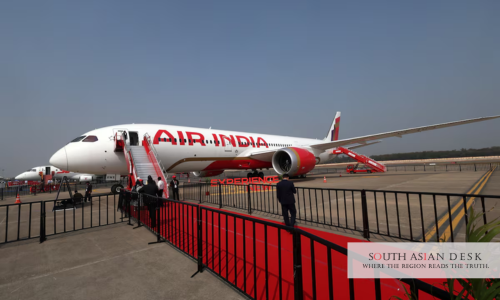
The Air India funding request has come into sharp focus this week, with the carrier reportedly seeking about $1.5 billion in fresh equity from its owners, Tata Sons and Singapore Airlines, according to two people familiar with the matter. The appeal for capital arrives months after the airline posted a record annual loss, adding urgency to a turnaround plan that has already consumed billions of dollars since Tata regained control of the former state-owned carrier in 2022.
If it goes ahead, the infusion would rank among the largest publicly reported requests for shareholder funding since the ownership change, underscoring the scale of the challenges Air India continues to face even as it undergoes a sweeping, multi-billion-dollar revamp that includes refurbishing its existing fleet.
Air India Losses Deepen After Record Annual Loss
The scale of the problem is reflected in the numbers. Air India and its budget subsidiary, Air India Express, posted combined losses of $2.33 billion in the fiscal year ended March, more than double the losses recorded the previous year. Those Air India losses have not stayed confined to India alone. They have also weighed on the profitability of Singapore Airlines, which holds a significant minority stake in the carrier and has been closely tied to its performance since the two airlines’ operations were consolidated.
Industry observers note that the widening losses illustrate how difficult it has been to convert an ambitious restructuring plan into consistent financial performance, even with the backing of two well-resourced global shareholders.
Details of the Air India Funding Request
According to the sources, Air India wants the funds immediately, although the actual infusion is likely to be disbursed in tranches rather than as a single payment. The request is being made in the form of fresh equity rather than debt, the sources said, and discussions between the parties are still ongoing, with no final decision yet reached.
One source added that Singapore Airlines would need to contribute its proportional share of the proposed infusion for the overall investment to proceed as planned. Singapore Airlines currently owns around 25 percent of Air India, a stake it acquired after merging its full-service joint venture, Vistara, into the enlarged carrier in a deal completed in 2024 that included an equity investment of roughly $250 million at the time.
Neither Air India nor Tata Sons responded to requests for comment on the matter. Singapore Airlines said it was working closely with Tata Sons to support Air India’s ongoing transformation programme but declined to comment specifically on the airline’s finances.
Headwinds Behind Air India’s Equity Infusion Push
Several factors have contributed to the pressure behind this equity infusion request. Air India has been affected by Pakistan’s airspace ban on Indian carriers, which has forced costly rerouting on key international corridors. The carrier’s global network was further disrupted by the fallout from the U.S.-Israeli war with Iran, which affected flight paths and operations across the Middle East.
Compounding these operational headwinds, Air India is still managing the reputational and financial fallout from a deadly crash last year that killed 260 people, an event that has continued to shape the airline’s safety scrutiny and public standing even as it presses ahead with fleet renewal and network expansion.
What Happens Next for Tata Sons and Singapore Airlines
The timing of the request is notable, as it comes while Tata Sons prepares for a leadership transition, with chairman N. Chandrasekaran expected to step down in February following a period of internal disagreements. How the funding decision is handled during this transition could offer an early signal of the group’s continued commitment to Air India’s long-term revival.
For Singapore Airlines, the decision carries its own weight. As a minority owner with a clearly defined stake, matching Tata’s contribution would reaffirm its commitment to the joint transformation project, while any hesitation could raise questions about the pace and direction of Air India’s recovery. With discussions still underway and no formal agreement confirmed, the coming weeks are likely to clarify whether this substantial capital injection moves forward as proposed, and what it will mean for an airline still working to convert an ambitious revival plan into sustainable profitability.
Published in SouthAsianDesk, August 26th, 2026
Follow SouthAsianDesk on X, Instagram and Facebook for insights on business and current affairs from across South Asia.