The Badr defence cooperation accord was signed in Doha on Wednesday by Pakistan, Turkiye, Qatar and Indonesia, according to a statement from the Turkish Defence Ministry, which said the agreement aims to boost defence cooperation and strengthen defensive capabilities. The four-nation arrangement is intended to bring together the defence industries of the signatories at a time of heightened regional insecurity, and it adds a new layer to the web of security partnerships that Ankara and its partners have built in recent months. thenews
Details of the Badr Defence Cooperation Accord
The document was signed as the Badr Memorandum of Understanding, a title that signals a framework agreement and not a binding treaty. According to the Turkish ministry, it seeks to foster cooperation in military production, boost military capabilities, and support collaboration in technical military training, research and development. Daily Sabah reported that it would also support military exercises and training. The ministry described the agreement as one of substantial economic importance. Pakistan, Turkiye, Qatar, and Indonesia ink ‘Badr’ defence cooperation accord +3
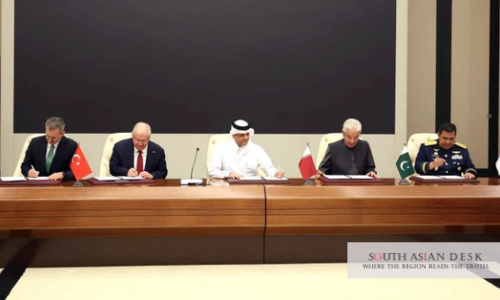
The ceremony in Doha was attended by senior officials from each country. Photographs released by the Turkish ministry show Turkish Defence Minister Yaşar Güler, Qatar’s Deputy Prime Minister and defence minister Sheikh Saud bin Abdulrahman bin Hasan Al Thani, Pakistani Defence Minister Khawaja Muhammad Asif and Indonesian Deputy Defence Minister Yusuf Jauhari signing the accord. Haluk Görgün, who heads the Presidency of Defence Industries in Turkiye, also attended, according to Daily Sabah. thenews
Focus on Defence Industry Cooperation
The wording of the official statements places the emphasis on defence industry cooperation and not on collective security guarantees. The Turkish ministry said the initiative would use the unique military production capabilities of each country to facilitate cooperation and integration, enhance defence industrial capacities, and meet the needs of allied and friendly nations. The Qatari Defence Ministry similarly framed the memorandum as an effort to foster cooperation in defence manufacturing and to promote joint work on research and development, as reported by Al Jazeera. None of the statements reviewed for this report refers to a mutual defence clause. thenews
Görgün was quoted by Türkiye Today as describing the memorandum as a strategic platform that combines the four countries’ industrial capabilities and widens opportunities for joint production and technology development.
Roles Each Country Is Expected to Play
Analysts see a natural division of strengths among the signatories. Speaking to Al Jazeera, defence analyst Arda Mevlutoglu said Turkiye contributes technological expertise, systems integration and a mature defence industry, while Pakistan and Indonesia offer manufacturing capacity, skilled workforces and sizeable domestic markets, and Qatar provides investment potential and demand. On that reading, the accord could allow joint projects that no single member would find easy to finance or scale alone. Al Jazeera
Regional Context Behind the Badr Accord
The agreement comes during a period of sustained conflict in the region. Al Jazeera described it as reflecting a broader effort by countries in the region to widen their network of security partners amid the prolonged US-Israel war with Iran. Reuters noted that Turkiye, which has NATO’s second-largest army and a robust defence industry, has been helping Gulf states, including Qatar, where it maintains a military base, to strengthen their defences. Al Jazeerathenews
The Badr accord also follows a separate agreement concluded in August. At that time, Turkiye signed a mutual defence pact with nuclear-armed Pakistan and Saudi Arabia, under which an attack on one party constitutes an attack on all. Reuters added that Ankara also has close ties with Indonesia, notably in the defence industry. The two instruments differ in nature: the August pact concerns mutual defence, whereas the Badr memorandum is described as an industrial and training framework. thenewsthenews
What Comes Next
The memorandum sets out areas of cooperation but, as reported so far, does not specify projects, budgets or timelines. Türkiye Today noted that it arrives as Turkiye’s defence exports climb to record levels, and Görgün expressed confidence that the cooperation would lead to tangible projects. Whether the Badr defence cooperation accord produces joint production lines, shared training programmes or coordinated research will depend on follow-up agreements between the four governments, details of which have yet to be announced.
Follow SouthAsianDesk on X, Instagram and Facebook for insights on business and current affairs from across South Asia.