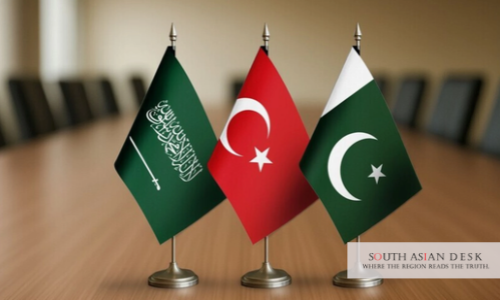
The Makkah defence pact has moved a step closer to taking full effect for Turkey, which has submitted the agreement with Saudi Arabia and Pakistan to its parliament for ratification. Three parliamentary sources told Reuters on Tuesday that the submission moves NATO’s second-largest army closer to a formal mutual defence pledge with Riyadh as the kingdom faces Houthi attacks.
What the Makkah Defence Pact Commits Its Members To
The three countries signed the Makkah Joint Defence Agreement on August 7 in the Saudi holy city. The accord was signed by Turkish President Recep Tayyip Erdogan, Saudi Crown Prince Mohammed bin Salman and Pakistani Prime Minister Shehbaz Sharif. Under its terms, an armed attack on one member is regarded as an attack on all, a formulation similar to NATO’s Article 5. A joint statement issued at signing did not specify what each country had committed to do.
The agreement builds on an earlier bilateral arrangement. Pakistan and Saudi Arabia signed a Strategic Mutual Defence Agreement in Riyadh in September 2025, which also treats an attack on either country as an attack on both.
The Ratification Process in Turkey
Parliamentary ratification is required for Turkey to formally approve the agreement. According to two of the sources, Parliament Speaker Numan Kurtulmus, who is visiting Kyrgyzstan, will refer the document to the foreign affairs commission when he returns. Another source said the commission could debate it as early as Friday. No vote has been scheduled.
Ratification would not, on its own, authorise any deployment. Turkey’s constitution requires separate permission from parliament to send troops abroad, regardless of any international agreement.
Turkey’s Role Amid Houthi Attacks
The submission comes as Saudi Arabia faces attacks from Yemen’s Houthi movement. Reuters reported that Turkey has condemned the attacks, expressed willingness to help meet Riyadh’s military technology needs and agreed to join a Saudi-led coalition to ensure navigational safety in the Red Sea.
Asked how Turkey could help Saudi Arabia defend against the Houthis, Foreign Minister Hakan Fidan said the agreement was not an “offensive agreement”. He added that Turkey would not send troops to another country to carry out attacks on its territory. A Turkish official, speaking anonymously, said Ankara’s contribution was expected to be limited to military equipment, intelligence sharing and weapons systems.
From Signature to Structure
Since August, the three governments have worked to give the Makkah defence pact an institutional shape. On August 13, Turkey’s defence ministry said the three countries would form political and military mechanisms involving defence ministers, foreign ministers and military chiefs, and would plan joint exercises and deeper defence industry cooperation. The ministry said the aim was to place defence ties on a “more institutional and sustainable” footing. It also said the pact was open to expansion, with Egypt mentioned as a potential candidate, and that it did not seek to replace existing alliances.
The first ministerial meeting was held in Istanbul to set up a political and defence strategic committee. At an emergency meeting of the alliance in Riyadh earlier this month, the members agreed to ensure the rapid deployment of military forces and capabilities in Saudi Arabia, subject to national laws, according to The Media Line.
What to Watch Next
Three issues will shape what follows. The first is the pace of the parliamentary review, including whether the foreign affairs commission takes up the agreement this week and how soon a full vote is scheduled. The second is whether Turkey’s parliament is asked, separately, to authorise any deployment, a step that ratification alone would not provide. The third is how the partners define their obligations in practice, given that the signing statement left them unspecified.
For Pakistan, the ratification process in Ankara is a development to follow closely, since it would bring a NATO member into a formal mutual defence arrangement with Islamabad and Riyadh. The reports reviewed for this article do not describe any ratification steps in Pakistan or Saudi Arabia. For now, the Makkah defence pact awaits a decision from Turkey’s legislature.
Follow SouthAsianDesk on X, Instagram and Facebook for insights on business and current affairs from across South Asia.