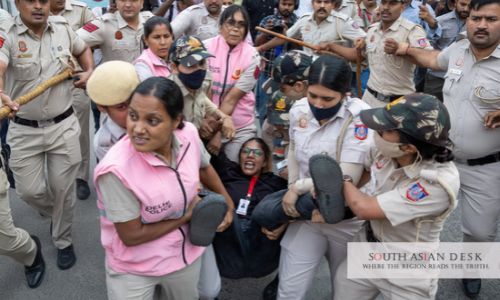
The India protest crackdown has drawn a sharp rebuke from United Nations human rights experts, who on Tuesday called on Indian authorities to stop using excessive force against demonstrators and to open an independent investigation into the conduct of law enforcement. In a statement, about two dozen experts said protesters had sustained injuries and that some had reported ill-treatment.
What Prompted the India Protest Crackdown
Opposition political parties and student organisations have held protests in recent weeks demanding the resignation of Chief Election Commissioner Gyanesh Kumar. They object to a revision of voter lists that they say favours Prime Minister Narendra Modi’s Bharatiya Janata Party. Protesting groups say the removal of about 130 million names from the rolls left eligible voters disenfranchised, with a disproportionate effect on poor and homeless people and on minorities, including Muslims. Reuters noted that earlier mass protests this summer over exam-paper leaks led to the resignation of India’s education minister.
The experts said they were alarmed by a repeatedly heavy-handed police response to peaceful youth-led demonstrations in New Delhi and other parts of the country over the past three months.
What the UN Experts Said
According to the statement, law enforcement agencies have reportedly used force against unarmed students, including lathi charges, in which police use batons to disperse crowds, and have prevented thousands of people from joining the protests, despite the non-violent nature of the assemblies. The experts described the situation as “a broader, troubling pattern” and said they had repeatedly alerted Indian authorities to undue restrictions on peaceful assembly, arbitrary detentions, enforced disappearances and the targeting of student activists.
They also expressed particular concern about reports of sexual violence and other forms of gender-based abuse during the protests and related detentions. Scroll.in, reporting on the statement, said the experts noted that more than 7,000 people, among them young people, journalists, human rights defenders, lawyers and political party members, were recently detained in New Delhi and taken to remote detention centres. Figures for the detentions have varied in other reports, with some citing about 3,000 people.
Calls for Action and an Independent Investigation
The experts urged the authorities to cease the use of excessive force immediately, to rescind blanket bans on assemblies, and to refrain from the misuse of digital surveillance, including biometrics and internet disruptions. The Wire, reporting on the statement, said it also referred to the use of Section 163 of the Bharatiya Nagarik Suraksha Sanhita, India’s new criminal procedure code, to restrict dissent rather than to manage any imminent threat to public order.
The group called for an independent, impartial and thorough investigation into the conduct of law enforcement and affiliated forces, to be launched without delay, in order to ensure accountability, justice and reparations for victims. They also asked India to respect, protect and fulfil the right to peaceful protest.
It is worth noting the status of the signatories. UN experts are appointed by the UN Human Rights Council to monitor and document specific human rights situations, but they serve in an independent capacity and do not speak for the United Nations itself.
India’s Response
The Indian embassy in Washington did not immediately respond to a request for comment on the statement. New Delhi has previously rejected similar criticism. After the UN human rights office raised concern earlier this month about mass detentions in Delhi on October 10, India’s Ministry of External Affairs called the remarks “unwarranted” and an unacceptable interference in its internal affairs. It said India is the world’s largest democracy, where the right to peaceful assembly is guaranteed by the Constitution, that law enforcement acts in accordance with the law, and that the courts remain open to all for redress of grievances. India’s mission in Geneva has also accused the UN rights office of selectivity in its public positions.
Human Rights Watch separately reported in July that Indian security forces used tear gas and batons to suppress largely peaceful student protests in New Delhi on July 20, and urged a prompt and impartial investigation.
What Happens Next
The statement adds international pressure on the government at a time when protests over the voter lists continue. Whether India will accept any form of independent inquiry remains uncertain, given its stated position that such criticism amounts to interference. The experts have made clear that they expect accountability for the India protest crackdown, and further developments are likely to depend on the response of the courts, the Election Commission and the government to the continuing demonstrations.
Follow SouthAsianDesk on X, Instagram and Facebook for insights on business and current affairs from across South Asia.