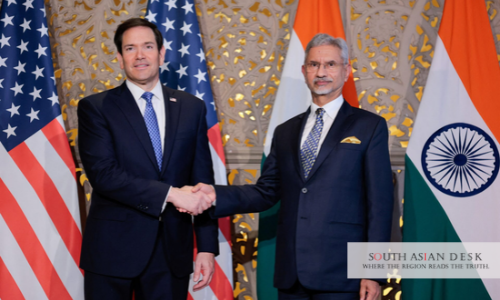
The Rubio India visit has put a long-delayed trade deal and the question of Russian oil back at the centre of US-India diplomacy. US Secretary of State Marco Rubio held talks with Indian External Affairs Minister S. Jaishankar in Mumbai on Tuesday, as the two countries try to deepen energy cooperation and move closer to concluding a bilateral trade agreement.
Trade Deal Talks Near the Finish Line
Speaking to reporters in Mumbai, Rubio said only a small number of items remained to be wrapped up in the trade deal and that he expected this to happen shortly. India’s foreign ministry said the discussions would cover energy, trade, investment and defence.
The optimism follows mixed signals earlier this month. Indian Finance Minister Nirmala Sitharaman said the negotiations had “plateaued”, while Commerce and Industry Minister Piyush Goyal said last week that the first tranche of the agreement was in its final stages. Indian and American officials had also indicated that the long-running effort had stalled again, which gives the secretary’s remarks added weight.
Why Russian Oil Remains the Sticking Point
Russian oil has been a recurring source of friction between Washington and New Delhi. Last year, the Trump administration doubled tariffs on Indian goods to 50 per cent, including a 25 per cent penalty linked to India’s purchases of Russian crude. India has long been one of the largest buyers of Russian oil and relied on discounted supplies after 2022.
The issue has not gone away. US Ambassador to India Sergio Gor has said President Donald Trump is expected to decide within about 10 days whether to use sanctions powers that could affect buyers of Russian oil and gas. Whether India sought an exemption, and whether the subject would feature in the talks with Jaishankar, were questions raised ahead of the meeting.
What the Rubio India Visit Means for Energy Ties
Energy sits at the heart of the trip, which runs from October 17 to 22 and began in Samarkand, Uzbekistan, with the C5+1 ministerial involving Central Asian states. It is Rubio’s second official visit to India this year, after a May visit for a meeting of Quad foreign ministers. Gor described this trip as “a little more business-focused”.
On Wednesday, Rubio is scheduled to visit the Jamnagar refinery in Gujarat and meet business leaders. The complex belongs to Reliance Industries and is regarded as the world’s largest single-site refinery, able to process about 1.4 million barrels of crude oil a day. Gor said he expected Reliance chairman Mukesh Ambani to be present.
The stop carries symbolic weight. Reliance is India’s largest importer of Russian oil, and in November 2025 it said it had stopped importing Russian crude for its export-only refining unit at Jamnagar, in line with US sanctions on Rosneft and Lukoil. Seven months before this visit, Trump also announced that Reliance would back the first major new oil refinery built in the United States in about 50 years, a project Gor has cited as evidence of successful engagement with Indian business.
Political Reaction in India
The itinerary has drawn comment in India. Congress general secretary Jairam Ramesh criticised the government after Gor said Washington expected Jaishankar to travel to Mumbai to meet Rubio, arguing that the decision to bypass Delhi in favour of Mumbai and Jamnagar could signal a change in the nature of bilateral ties. The Indian side has presented the Mumbai meeting as consistent with its established diplomatic practice.
What to Watch Next
Three questions will shape the outcome of the Rubio India visit. The first is whether the remaining gaps in the trade deal are closed in the coming days, as Rubio suggested. The second is the timing and content of Washington’s decision on sanctions affecting buyers of Russian oil. The third is whether the Jamnagar stop produces concrete announcements on energy investment. Until then, both governments continue to describe the relationship as a comprehensive global strategic partnership covering defence, trade, technology and energy, even as the details of that partnership remain under negotiation.
Follow SouthAsianDesk on X, Instagram and Facebook for insights on business and current affairs from across South Asia.
More on India and Rubio: