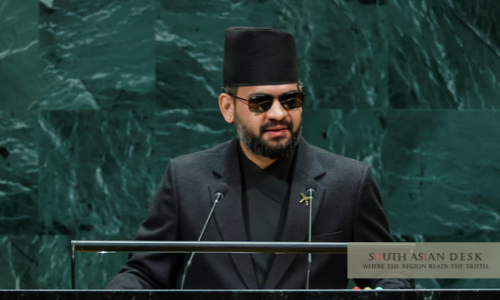
Balendra Shah’s India visit will place flood recovery, trade and energy at the centre of talks between Kathmandu and New Delhi next week, as Nepal’s prime minister makes his first bilateral trip abroad since taking office. Mr Shah is due to meet Indian Prime Minister Narendra Modi on Monday, officials in Kathmandu said on Friday, during a two-day visit scheduled for November 22 and 23.
What to Expect from Balendra Shah’s India Visit
Speaking to reporters, Nepal’s Foreign Secretary Amrit Bahadur Rai said the discussions with Mr Modi would cover a wide range of subjects, from trade to infrastructure development and energy. The 36-year-old prime minister is also scheduled to meet India’s External Affairs Minister, S Jaishankar, and to call on Indian President Droupadi Murmu, according to Nepal’s foreign ministry. Indian media reports said the programme would include delegation-level talks, a joint press conference and a lunch hosted by Mr Modi, and that the Nepali team would number 34 government officials.
Mr Shah will be accompanied by Finance Minister Swarnim Wagle and a group of business officials, which suggests that economic questions will feature prominently on the agenda. In a statement, the foreign ministry described the trip as an important opportunity to review the wide-ranging cooperative partnership between the two countries with a forward-looking perspective, and to maximise mutual benefits for their peoples.
The visit follows a period of preparatory diplomacy. India’s Foreign Secretary, Vikram Misri, travelled to Kathmandu on November 4 and 5 to call on Mr Shah and discuss arrangements, and India’s newly appointed ambassador to Nepal, Sudhakar Dalela, met the prime minister this week.
Flood Reconstruction at the Top of the Agenda
The most pressing item is expected to be assistance for flood reconstruction. Officials said Mr Shah is likely to raise the question of Indian aid for rebuilding the areas devastated by the catastrophic floods that struck in August. According to Reuters, the disaster killed 1,500 people and left more than 5,200 missing, while destroying roads, bridges, power plants, farms and homes.
The scale of the damage has made recovery the biggest challenge so far for Mr Shah, who came to power after sweeping elections held in March, which followed mass anti-corruption protests. He was sworn in on March 27. India was the first country to respond after the August disaster, and Mr Shah has publicly thanked Mr Modi and the Indian government for the support extended to Nepal.
Nepal-India Relations and the Regional Balance
Nepal-India relations rest on deep economic and geographic ties. India is Nepal’s largest trade partner and a major bilateral aid donor, and the two countries share a long open border. Nepal, a landlocked Himalayan state, also borders China, and India and China compete for influence in Kathmandu, a dynamic that gives every high-level exchange an added strategic dimension.
Mr Shah’s choice of India for his first bilateral destination is therefore likely to be read closely in the region, although officials on both sides have framed the trip as a routine and constructive step in a long-standing partnership. Indian officials have described the relationship as a priority under their country’s neighbourhood policy, and observers in Nepal have urged the government to focus on rebuilding trust and confidence rather than arriving in New Delhi with an overly long list of requests.
Aviation Links and Economic Priorities
Beyond disaster recovery, Nepal is pressing India to approve an additional air route for commercial flights from the west to Bhairahawa, near Lumbini, the birthplace of the Buddha, and to the tourist city of Pokhara. Authorities in Kathmandu see better aviation links as a way of boosting tourism and supporting regional airports that have struggled to attract traffic.
Taken together, trade and energy, aviation access and reconstruction funding form a broad but practical set of issues. Energy cooperation in particular has long been a feature of the relationship, with Nepal seeking markets for its hydropower and India seeking reliable clean electricity.
Outlook for the Talks
Whether the discussions yield firm commitments on aid and connectivity will become clearer after the meeting with Mr Modi on Monday. For Mr Shah, a prime minister who rose to office on a wave of public anger over corruption, concrete results for flood-hit communities would carry political weight at home. For New Delhi, the visit offers an opportunity to deepen engagement with a new Nepali leadership at a moment when its support is being closely watched across the region.
Follow SouthAsianDesk on X, Instagram and Facebook for insights on business and current affairs from across South Asia.