Bangladesh Climate Finance Push Intensifies Ahead of COP Talks
Bangladesh climate finance demands took centre stage on Tuesday as Prime Minister Tarique Rahman called for richer nations to deliver faster and more accessible support to countries facing the sharpest impacts of climate change.
Speaking at the World Economic Forum’s Annual Meeting of the New Champions in Dalian, China, Rahman said the global target of $300 billion a year in climate finance by 2035 was not enough to meet the needs of developing countries. His remarks came during his first overseas trip since taking office and ahead of the next round of United Nations climate negotiations in November.
Bangladesh, one of the world’s most climate-vulnerable countries, has long argued that international finance is not moving at the scale or speed required. The country faces intensifying floods, cyclones, river erosion and saltwater intrusion, while also trying to fund adaptation projects, protect livelihoods and shift towards more climate-resilient development.
Rahman urged wealthy countries to honour their commitments and said support must be predictable, accessible and responsive to the needs of nations already suffering climate-related losses.
“The Loss and Damage Fund must move from promise to delivery, with accessible and predictable support for victim nations,” he said.
Why the $300 Billion Climate Finance Goal Is Being Questioned
The $300 billion climate finance goal was agreed at the UN climate summit in 2024. It raised the previous target of $100 billion a year, which developed countries had pledged to mobilise for poorer nations but only met two years late.
For Bangladesh and other climate-vulnerable countries, the new figure remains inadequate. Developing nations have repeatedly argued that their actual climate needs run into the trillions, especially when mitigation, adaptation, disaster recovery and loss-and-damage costs are counted together.
The dispute is not only about the size of the pledge. It is also about the quality of the finance.
Many developing countries want a larger share of climate finance to come as grants rather than loans, warning that debt-heavy support can deepen the financial pressure on countries already struggling with inflation, debt servicing and development needs. They also want simpler access to existing funds, arguing that lengthy approval processes and complex requirements delay urgently needed projects.
Rahman’s remarks reflected that frustration. He called for greater mobilisation of the Green Climate Fund and said climate finance must be easier for vulnerable countries to access.
That point matters for Bangladesh because adaptation is expensive and immediate. Building embankments, improving drainage, dredging rivers, strengthening cyclone shelters, protecting coastal communities and restoring mangroves all require sustained investment. Unlike some mitigation projects, adaptation often produces public benefits without quick commercial returns, making it harder to attract private capital.
Bangladesh’s Climate Vulnerability
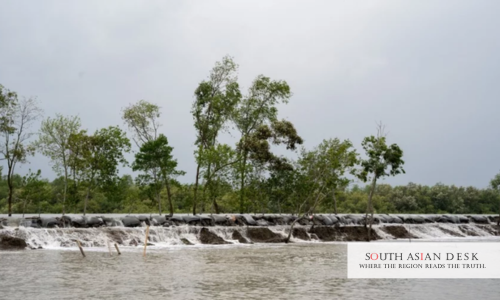
Bangladesh has become a global example of how climate change can affect densely populated, low-lying countries. Millions of people live in areas exposed to river flooding, coastal storms and salinity intrusion. Cyclones have become more destructive as warmer seas intensify extreme weather, while river erosion continues to displace communities and threaten agricultural land.
The climate crisis also interacts with economic pressures. When floods destroy crops, roads, homes and local markets, the costs fall first on households and local governments. When coastal salinity contaminates water and soil, it affects health, farming and migration. When repeated disasters hit the same communities, recovery becomes harder each time.
This is why Bangladesh has pushed for climate adaptation to be treated with the same seriousness as emissions reduction. Rahman said adaptation measures must stand alongside mitigation efforts, pointing to domestic initiatives that include dredging 20,000 kilometres of rivers and canals to reduce flooding and planting 250 million trees.
The message was clear: Bangladesh is not asking the world to act while doing nothing at home. It is arguing that domestic action cannot carry the full burden of a crisis driven largely by historic emissions from richer economies.
Loss and Damage Fund Remains Central
The Loss and Damage Fund has become one of the most politically important issues in global climate diplomacy. It is meant to help countries deal with climate harms that cannot be avoided through mitigation or adaptation, such as destroyed homes, lost land, damaged livelihoods and irreversible environmental harm.
For countries like Bangladesh, the fund is not an abstract climate mechanism. It is tied to real costs already being borne by households, farmers, fishers and coastal communities.
But developing countries have repeatedly warned that the fund must not remain symbolic. They want it to be properly financed, easy to access and targeted towards communities facing the most severe impacts.
Rahman’s call for the fund to move “from promise to delivery” reflects a wider concern among climate-vulnerable countries: climate pledges are often announced with political fanfare, but money arrives slowly, in insufficient amounts, or through mechanisms that are too difficult for the most affected countries to use quickly.
COP30 Climate Talks and the Road Ahead
The timing of Rahman’s remarks is significant. The next UN climate talks are expected to place renewed pressure on wealthy countries to show how the $300 billion goal will be delivered and how finance can be scaled towards the wider needs of developing countries.
For Bangladesh, the issue is both moral and practical. The country contributes only a small share of global emissions but faces some of the world’s sharpest climate risks. Its argument is that climate finance should reflect responsibility, vulnerability and urgency.
The debate will also test trust between developed and developing countries. Past delays in meeting climate finance targets have damaged confidence in global climate negotiations. If the new $300 billion goal is seen as too small, too slow or too dependent on loans and private-sector mobilisation, vulnerable nations are likely to push harder for reform.
Bangladesh’s position is therefore part of a broader demand from developing countries: climate finance must be larger, faster and fairer.
Rahman said climate resilience could not be built by any country alone. That line captures the central challenge before the next climate summit. Bangladesh can strengthen its own defences, dredge waterways, plant trees and invest in resilience, but without stronger international support, the scale of the climate threat will continue to outpace national resources.
For Dhaka, the $300 billion goal is not the end of the climate finance debate. It is the starting point for a larger fight over whether the world is prepared to fund climate resilience at the level the crisis now demands.
Published in SouthAsianDesk, June 24, 2026
Follow SouthAsianDesk on X, Instagram and Facebook for insights on business and current affairs from across South Asia.