Rice methane emissions have become a formal target of Bangladesh’s climate policy after the country joined AcceLER, a regional initiative designed to reduce the climate impact of paddy cultivation. The move was described by Reaz Ahmad in a Dhaka Tribune opinion piece on October 30 as a watershed moment for the country. Ahmad wrote that Bangladesh formally joined the programme on Tuesday, at an event he attended in Dhaka.
What AcceLER is and who is involved
AcceLER stands for Accelerating Scaling of Low-Emissions Rice in Southeast Asia. The project is led by the International Rice Research Institute, with funding from the Global Methane Hub, and was launched in the Philippines in March 2025. It seeks to help partner governments develop national roadmaps that would achieve an aspirational 15 percent reduction in methane emissions from the rice sector by 2030. It also promotes monitoring, reporting and verification systems, including approaches that rely on remote sensing.
Several major rice-producing economies are already taking part, among them Thailand, Vietnam, Cambodia and the Philippines. Ahmad noted that the programme relies on suitability mapping, monitoring systems, remote sensing and institutional capacity building, and that Bangladesh now joins that group.
Why rice methane emissions matter for Bangladesh
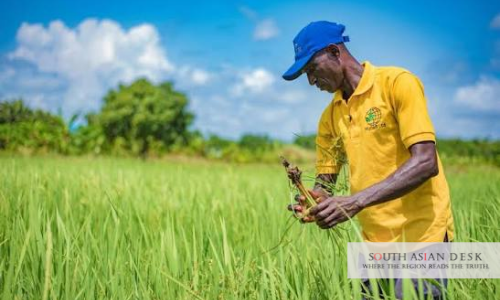
Rice is central to the Bangladeshi economy and diet. Ahmad wrote that it occupies about three-fourths of the country’s cultivated land, while the research institute says it supports roughly 13 million farming households. Flooded paddy fields are also a significant source of agricultural methane, a potent greenhouse gas, which is why the sector is a focus of mitigation efforts worldwide.
Ahmad argued that scaling up science-based and transparent low-emission practices is no longer optional, describing it as a priority for the country’s long-term food security and climate resilience. He also drew attention to Bangladesh’s structural vulnerability as a rice-dependent nation and suggested it could learn from neighbours that have already moved ahead.
Practical steps already under way
The decision follows a two-day workshop held in Dhaka on October 27 and 28, organised by the research institute under the AcceLER project and the CGIAR science programmes on climate action and scaling for impact. The event aimed to strengthen national capacity to measure, report and verify emissions from rice cultivation and to prepare a roadmap for low-emission production.
Agriculture Secretary Md Salim Khan said at the workshop that Bangladesh was committed to climate-resilient and low-carbon agricultural development. Technical sessions covered innovations from the Bangladesh Rice Research Institute, suitability analysis for water management and approaches to a rice-sector methane mitigation roadmap. Participants also reviewed the experience of Cambodia, the Philippines, Thailand and Vietnam.
Among the measures identified as ways to curb emissions are alternate wetting and drying, climate-smart rice varieties, improved fertiliser management, direct-seeded rice and better residue management. Alternate wetting and drying, a method in which fields are periodically allowed to dry rather than staying continuously flooded, has also been associated with lower water use, a point that matters in a country concerned about dwindling groundwater.
The COP31 timing and the finance question
Ahmad stressed that the timing of Bangladesh’s decision is significant. COP31, the next United Nations climate conference, is scheduled for November 9 to 20, 2026, and joining AcceLER allows Bangladesh to arrive with a concrete commitment on curbing greenhouse gas emissions.
He outlined several benefits he expects from successful implementation. These include demonstrating the country’s commitment to global climate goals, advancing its national methane mitigation roadmap and unlocking climate finance that could help farmers participate in emerging global carbon markets. Reliable measurement is likely to be decisive on that last point, since carbon market participation generally depends on verifiable data.
Challenges ahead
Joining the initiative is a first step rather than an outcome. The programme’s target is described as aspirational, and Bangladesh must still build the monitoring systems, train officials and persuade millions of smallholders to adopt new practices without sacrificing yields. Food security remains the priority, and the project’s backers have said the goal is to reduce methane while maintaining or increasing production.
If those conditions are met, the country could strengthen its negotiating position at COP31 while giving farmers a route to new income. If they are not, the commitment risks remaining a headline rather than a change in how rice is grown.
Follow SouthAsianDesk on X, Instagram and Facebook for insights on business and current affairs from across South Asia.
Read More: