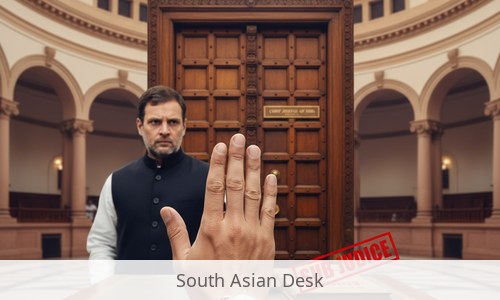
The BJP social media head role in India has changed hands as part of a broader organisational reshuffle announced by Prime Minister Narendra Modi’s Bharatiya Janata Party on Monday. The move comes weeks after youth led protests, amplified heavily through social media, forced the resignation of the country’s education minister and exposed gaps in the ruling party’s digital outreach among younger voters.
Amit Malviya Replaced by Deepak Mhaskey
Amit Malviya, who had led the party’s social media operations since 2015, has been replaced by Deepak Mhaskey, the BJP confirmed in a statement. The party did not provide detailed information about Mhaskey’s prior responsibilities, though his professional profile indicates he previously served as a party spokesperson and headed its information technology cell in central India.
In its statement, the BJP expressed confidence that its digital communication efforts would continue to shape public discourse under the new leadership, though it offered few further details about the change or the reasoning behind the timing.
A Wider Reshuffle Under Nitin Nabin’s Leadership
The change to the BJP social media head position marks the first major reshuffle carried out by Nitin Nabin, who took over as BJP president in January. At 45, Nabin is the youngest person to hold the role, a generational shift widely viewed as part of the party’s broader effort to reconnect with younger voters ahead of future elections.
The reshuffle follows a period of intense scrutiny of the BJP’s digital strategy after a wave of youth led protests, largely driven by Gen Z demonstrators, spread across several Indian cities earlier this year. The protests used social media platforms extensively, with participants producing raps, songs and videos that mocked Modi and his government and challenged the party’s long standing command of online political messaging.
Youth Protests Exposed Gaps in Digital Outreach
The demonstrations proved unusually effective at pressuring the government, ultimately contributing to the resignation of India’s education minister after weeks of sustained pressure. Analysts have noted that the protests marked one of the rare instances in recent years where public mobilisation, largely coordinated online, produced a direct concession from Modi’s administration.
Commentators have pointed out that the BJP’s established communications approach, built around tightly scripted messaging across television and platforms such as WhatsApp and X, struggled to compete with the informal, unpolished style that resonated with younger audiences on platforms like Instagram. Following the protests, Modi reportedly urged party ministers at a cabinet meeting to increase their presence on platforms popular with younger demographics and to adopt a less rehearsed tone in their content.
With more than half of India’s population under the age of 35, and Gen Z expected to represent one of the largest voting blocs by the time of the next general election in 2029, the pressure on the BJP to modernise its digital messaging is likely to remain significant. The replacement of the BJP social media head is widely seen as an early step in that broader recalibration, though it remains to be seen how quickly the change translates into a shift in the party’s online tone and reach among younger voters.
Published in SouthAsianDesk, August 18th, 2026
Follow SouthAsianDesk on X, Instagram and Facebook for insights on business and current affairs from across South Asia.