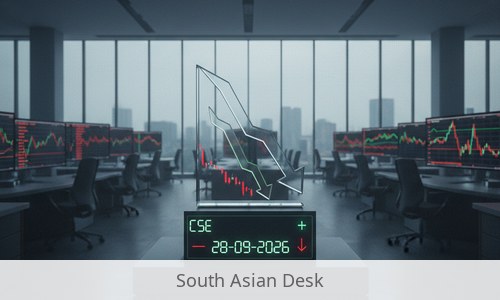
CSE stock market decline has intensified concerns across South Asia, with the Colombo Stock Exchange (CSE) slipping below the 21,000 mark on September 28, 2026, due to broad-based selling and exceptionally low investor participation. Year-to-date turnover hit a historic low, reflecting waning confidence in regional markets. The Nepal Stock Exchange (NEPSE) also recorded a decline on the same day, compounding concerns about South Asian economic stability. This event is now a focal point of September 2026 stock market news.
CSE stock market decline: Comparative Analysis with NEPSE
The NEPSE index fell by 16.47 points to close at 2,613.33 on September 28, 2026, according to OnlineKhabar. This decline, coupled with the CSE’s drop, highlights synchronized market weakness across South Asia. Sri Lanka’s CSE and Nepal’s NEPSE both faced similar challenges, though the CSE’s decline was more pronounced given its higher volatility. The Nepal Stock Exchange performance has drawn attention as a barometer for regional market sentiment. Notably, while the NEPSE saw a decline, its turnover exceeded Rs 5 billion, suggesting some level of continued trading activity despite the drop. This contrast underscores the differing dynamics between the two markets, with the CSE’s historically lower liquidity making it more susceptible to sharp declines during periods of uncertainty.
Factors Influencing Investor Participation
Economic uncertainties, including inflationary pressures and geopolitical tensions, have dampened investor sentiment. The CSE’s year-to-date turnover reached its lowest point in recent memory, as reported by Daily Mirror. External factors such as global interest rate fluctuations and regional trade disruptions have further eroded confidence in emerging market equities. The investor participation CSE has been at a critical low, signaling a shift in market dynamics. Analysts point to several interrelated factors contributing to this trend. Rising inflation in South Asia has pressured consumer spending and corporate earnings, while geopolitical tensions, particularly in the Indo-Pacific region, have created a climate of caution among investors. Additionally, the global central banks’ tightening monetary policies have raised borrowing costs, making equities less attractive compared to fixed-income instruments. In Sri Lanka, the CSE’s vulnerability is compounded by domestic challenges, including fiscal imbalances and a reliance on foreign capital inflows, which have been disrupted by global market conditions.
Regional Market Dynamics and Investor Behavior
The synchronized decline in South Asian stock markets raises questions about the region’s resilience to external shocks. Low turnover rates may indicate reduced liquidity, which could hinder market recovery. Analysts suggest that sustained investor caution could delay capital inflows, impacting infrastructure and development projects across the region. The Colombo Stock Exchange turnover has fallen to levels not seen in years, underscoring the severity of the CSE stock market decline. In Nepal, the NEPSE’s performance, while also negative, reflects a different set of challenges. The country’s smaller market size and reliance on remittances from South Asian diaspora communities have made it less sensitive to global interest rate changes but more vulnerable to domestic policy shifts. However, the NEPSE’s ability to maintain higher turnover despite its decline suggests a degree of resilience in Nepal’s market structure compared to Sri Lanka’s.
Broader Economic Context and Market Outlook
The broader economic context for South Asia in 2026 is marked by a mix of challenges and opportunities. While global economic growth has slowed, regional trade agreements and infrastructure projects, such as the Bangladesh-Bhutan-India-Nepal (BBIN) corridor, offer potential avenues for recovery. However, the current market conditions highlight the need for policy interventions to restore investor confidence. Central banks in the region are closely monitoring inflation trends, with some considering rate cuts to stimulate economic activity. In Sri Lanka, the government has been under pressure to address fiscal deficits and attract foreign investment, but progress has been slow amid political instability. Meanwhile, Nepal’s focus on improving its business environment and reducing regulatory hurdles may help attract capital in the medium term.
Follow SouthAsianDesk on X, Instagram and Facebook for insights on business and current affairs from across South Asia.
Sources
- CSE slips below 21,000 as turnover hits YTD low – dailymirror.lk
- NEPSE falls 16.47 points, turnover exceeds Rs 5 billion – english.onlinekhabar.com