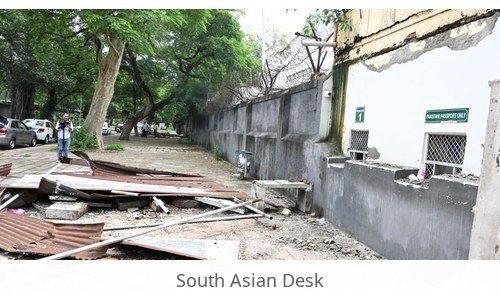
The demolition of unauthorised structures outside the Pakistan High Commission in Delhi on August 20, 2026, has sparked discussions about diplomatic norms and the treatment of foreign missions. As reported by The Hindu, visuals from the site show rubble, broken metal railings, twisted metal frames, roofing sheets, bricks, and chunks of concrete left outside the mission. The Indian Express notes this act is part of a tit-for-tat response between India and Pakistan regarding structures outside their respective high commissions, reflecting ongoing tensions in India Pakistan relations.
Demolition of Unauthorised Structures: Implications for India-Pakistan Relations
Historically, India and Pakistan have engaged in reciprocal actions concerning diplomatic infrastructure. Similar incidents occurred in 2019 when India demolished structures near the Pakistani High Commission in New Delhi, prompting Pakistan to take comparable measures in Islamabad. This latest demolition of unauthorised structures raises questions about the stability of bilateral diplomatic protocols and the potential for further escalation.
The 2019 incident marked a significant moment in the history of India Pakistan relations, as it underscored the fragile nature of their bilateral ties. At that time, Indian authorities cited violations of local zoning laws and security concerns as the rationale for the demolition, a justification that has been echoed in the current event. Pakistan’s response at the time was swift, with officials condemning the move as a violation of diplomatic norms and a provocation. The recurrence of such actions in 2026 suggests that the issue of unauthorized structures near diplomatic missions remains a flashpoint in the broader context of Indo-Pakistani tensions.
Public reactions in both countries have been muted, with Indian media emphasizing adherence to legal frameworks and Pakistani outlets highlighting the “unilateral actions” taken by New Delhi. Governmental statements have avoided direct condemnation, instead focusing on the need for “diplomatic decorum” in handling such matters. This measured response reflects the delicate balance both nations must maintain in their diplomatic engagements, particularly given the broader geopolitical landscape that includes regional security concerns and economic interdependencies.
Legal and Diplomatic Protocols
Under the Vienna Convention on Diplomatic Relations (1961), foreign missions enjoy specific protections, including inviolability of premises. However, structures built outside official boundaries may not be covered by these protections. India’s Foreign Office has stated that the demolished structures violated local zoning laws and posed security risks.
The Vienna Convention’s provisions are clear: diplomatic premises are inviolable, and host states are obligated to protect them from intrusion or damage. However, the convention does not explicitly address structures constructed outside the official diplomatic compound, leaving room for interpretation. This ambiguity has been a point of contention in previous incidents, with both nations asserting their legal positions while maintaining diplomatic decorum.
Diplomats from both nations have called for adherence to international norms, though tensions remain over interpretations of “diplomatic immunity” for non-official buildings. The incident has reignited debates about the need for updated bilateral agreements to address modern challenges in urban diplomacy. Such agreements could clarify the legal status of structures near diplomatic missions, ensuring that future actions are taken in accordance with both national laws and international norms.
The role of local zoning laws in this context is critical. India’s Foreign Office has emphasized that the structures in question were not only unauthorized but also posed a risk to public safety and urban planning. This argument aligns with broader efforts to regulate land use in Delhi, a city that has faced challenges related to unregulated construction and infrastructure development. The demolition of unauthorised structures, therefore, can be viewed as part of a larger initiative to enforce urban planning regulations, albeit in a context that has significant diplomatic implications.
Broader Regional and Diplomatic Context
The incident also highlights the broader regional dynamics that influence India Pakistan relations. Both nations are part of a complex web of regional alliances and rivalries, with issues such as territorial disputes, military posturing, and economic interdependence shaping their interactions. The the result, while seemingly a localized issue, can be seen as a microcosm of the larger challenges in maintaining stable diplomatic relations in a region marked by historical tensions.
The need for dialogue and mutual understanding between India and Pakistan has been repeatedly emphasized by regional analysts and international observers. The current incident underscores the importance of establishing clear communication channels and mechanisms to resolve disputes without resorting to tit-for-tat actions that could further strain bilateral relations. This is particularly crucial in a region where even minor incidents can have significant ripple effects on regional stability.
Follow SouthAsianDesk on X, Instagram and Facebook for insights on business and current affairs from across South Asia.
Sources
- Unauthorised structures outside Pakistan High Commission pulled down in Delhi – thehindu.com
- India-Pakistan tit-for-tat: Demolitions outside High Commissions in Delhi, Islamabad – indianexpress.com
Image: th-i.thgim.com