Who Says Resistance Can’t Laugh?
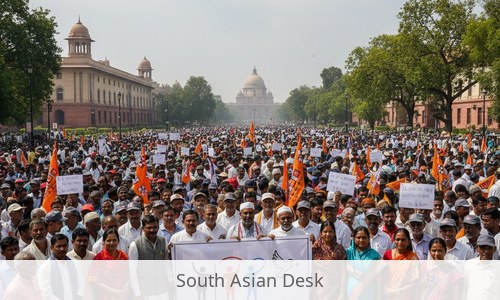
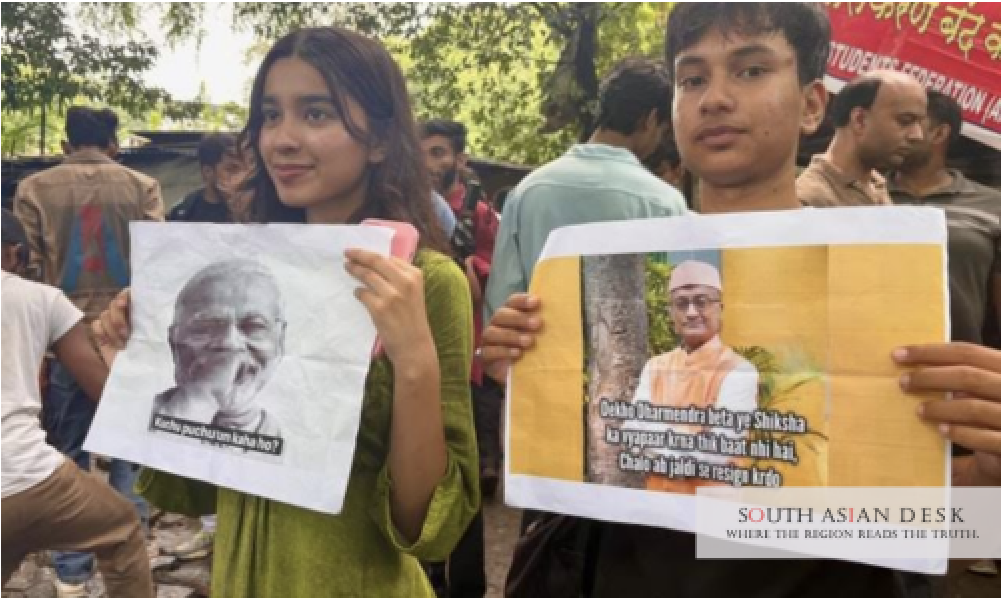
“Mitron, kya aapko democracy dikh rahi hai?” reads one placard raised above the crowd at Jantar Mantar, borrowing the Prime Minister’s familiar salutation while pairing it with the illustration of Dora the Explorer, the cartoon child forever asking her audience to locate what should have been obvious all along. Nearby, another sign declares, “Imagine Sisyphus Taking the NEET Exam Again,” collapsing Greek mythology into India’s examination regime to produce a devastating joke about bureaucratic absurdity and endless repetition. Elsewhere, sanitary pad advertisements are rewritten to mock recurring paper leaks with the assurance that “these won’t leak“; Duracell’s slogan is repurposed into a plea that the Education Minister is “not Duracell” and should finally stop lasting so long; Tinder’s familiar interface announces that “Poore desh ne left swipe kar diya hai”; Melody chocolate wrappers become political satire; Bollywood dialogues are rewritten as constitutional critique; mock courtrooms theatrically prosecute public officials; protesters perform stand-up routines, spoken-word poetry, and parody songs; while others carry placards urging, “Next time PM shaadi-shuda lana, taaki Mann Ki Baat apni patni se kare aur kaam ki baat janta se.” Oversized cockroach masks weave through the crowd, smartphones rise almost instinctively, and within minutes these performances migrate from the street to Instagram Reels, X threads, WhatsApp forwards, and meme pages where they are endlessly captioned, remixed, and recirculated.
At first glance, the atmosphere appears almost carnivalesque. Protest no longer conforms to its familiar visual grammar of solemn speeches, raised fists, and disciplined suffering. Laughter interrupts outrage; parody replaces declamation; wit supplants the performance of grief that has so often functioned as the moral currency of dissent. The question, however, is not whether protest has become less serious. It is whether our inherited understanding of political seriousness has become too impoverished to recognise humour, pleasure, satire, and collective creativity as legitimate idioms of democratic resistance.
This question is older than social media, even if memes have become its contemporary vernacular. Emma Goldman rejected the idea that revolution required renouncing joy; Audre Lorde understood pleasure as a source of political knowledge; adrienne maree brown insists that “pleasure is a measure of freedom”; Carla Bergman and Nick Montgomery theorise joyful militancy as an expansion of collective capacity; and Silvia Federici argues that emancipatory politics incapable of generating joy ultimately reproduces the very forms of domination it seeks to dismantle. Together, they invite us to see contemporary protest not as politics surrendering to spectacle but as a transformed political aesthetic in which memes function as manifestos, parody becomes critique, and laughter itself becomes an infrastructure of solidarity.
Comedian Samay Raina inadvertently captures this paradox in one of his stand-up routines: “Hum janta ko hasta hain, woh achha hai aap ke liye; warna janta sawaal poochhna shuru kar degi aapse.” The joke succeeds because it reveals a deeper political truth. Humour may distract, but it can equally sharpen criticism, destabilise authority, and embolden citizens to ask those questions power precisely would rather remain unasked.
The same insight animates two illustrations by Prasad Bhat (Graphicurry) drawn from The Odyssey. In one, Circe remarks that she never truly transformed men into pigs but merely revealed what they already were. The danger lies not in magic but in power’s capacity to expose obedience masquerading as virtue. In another, Odysseus encounters the Lotus-Eaters, whose enchanted fruit persuades travellers to forget both destination and purpose. The lotus is less a metaphor for hunger than for comfort, distraction, and political amnesia. Sometimes the greatest threat to democratic life is not coercion but the temptation to cease resisting altogether.
These scenes recall one of political thought’s oldest questions: Should a Prince be Benevolent or Should a Prince be Machiavellian? In The Prince, Niccolò Machiavelli famously concludes that while a ruler should ideally be both loved and feared, fear offers the more dependable foundation of authority, provided it never hardens into hatred. Contemporary democracies invite us to reverse the question. Rather than asking how rulers secure obedience, we must ask how citizens resist political orders increasingly organised through surveillance, spectacle, bureaucratic opacity, and the management of public emotion. If power governs through fear and disciplined visibility, what emotional repertoires remain available to democratic resistance? Must dissent continue to perform sacrifice to appear politically credible, or can joy itself become a durable mode of opposition?
Walking through Jantar Mantar reveals not merely a stylistic shift but a transformation in the grammar of protest itself. Where earlier dissent resembled legal argument built on evidence, this movement feels closer to ethnography than advocacy; the task is to understand why a crowd engaged in a prolonged struggle over examination failures, institutional accountability, and public trust continues to sing, laugh, parody, and invent increasingly elaborate satire.
The memes carry this transformation. Protesters joke that the next Kama Sutra position should be named “Modi”; remaining on top while doing nothing. Others flood Giorgia Meloni’s Instagram, asking her to persuade her “boyfriend” to resign. Makeshift Ouija boards and voodoo dolls promise to remove the Education Minister through supernatural intervention when democratic accountability fails. A sanitary pad advertisement’s promise that “these won’t leak” becomes commentary on recurring examination-paper leaks; Duracell’s endurance slogan becomes a joke urging the minister to stop “lasting so long”; Tinder’s interface declares that the country has left-swiped its leadership. A placard reading “Parasite Reporting for Duty” reclaims a judicial insult with gleeful confidence rather than denying it; seriousness, evidently, no longer requires solemnity. These jokes are intentionally excessive and absurd, and absurdity is precisely their political method. As Mikhail Bakhtin recognised in his account of the carnivalesque, ridicule has always worked by temporarily inverting hierarchy, letting authority appear ridiculous rather than untouchable. Social media has not changed this logic, only its speed: humour now travels algorithmically, carrying protest far beyond the physical boundaries of the demonstration.
Emma Goldman’s Living My Life anticipated this politics more than a century ago. Although the apocryphal line “If I can’t dance, I don’t want to be part of your revolution” does not appear verbatim in her autobiography, it captures a sensibility Goldman describes directly: being reprimanded at an anarchist fundraising dance by a fellow activist who believed revolutionary commitment demanded visible austerity. Her objection was never simply a defence of pleasure. It was an insistence that a movement requiring the same emotional discipline as the society it opposed had already begun reproducing the world it claimed to resist.
If Goldman challenged the moral economy of sacrifice, Adrienne Maree Brown’s Pleasure Activism explains why that challenge is politically necessary: pleasure should not be deferred until after liberation, because the experience of freedom must be cultivated within struggle itself, against an activist culture that treats burnout as commitment. Read through brown, Jantar Mantar’s everyday textures cease to look incidental ; the langar feeding anyone who arrives, volunteers distributing water through the July heat, parents bringing children, open mics alternating between testimony and comedy, musicians rewriting Bollywood lyrics into constitutional satire. These are instances of prefigurative politics: the practice of inhabiting, however partially, the social relations one seeks to institutionalise. The protest is not simply demanding a more accountable state; it is rehearsing another form of democratic community through care, hospitality, humour, and shared presence.
Carla Bergman and Nick Montgomery’s Joyful Militancy supplies the most useful vocabulary for this shift. Their critique targets “rigid radicalism” ; a movement culture organised around moral purity, competitive suffering, and perpetual internal policing, where visible exhaustion is mistaken for commitment. Drawing on Spinoza and Deleuze, they redefine joy not as happiness but as an increase in collective capacity, judging a politics by a simpler question: does it leave people more capable of acting together tomorrow than they were yesterday? This recasts the familiar dismissal of memes and carnival as evidence that a generation has mistaken politics for performance; a criticism that rests on the assumption that seriousness must announce itself through visible suffering. If humour attracts participants, sustains morale during prolonged occupations, lowers barriers to participation, and circulates grievances across digital networks at extraordinary speed, laughter is evidence of expanded political capacity, not diminished commitment. This becomes visible in the speed with which protest humour migrates between registers: a handwritten placard photographed at noon becomes an Instagram Reel by evening, a WhatsApp forward by night, an X thread by morning, and a new placard the following day. The meme functions as both political argument and communication infrastructure.
The same concern animates Silvia Federici’s distinction between “sad militancy” and joyful militancy in her interview “Feeling Powers Growing.” Federici argues that left organising long equated seriousness with duty, exhaustion, and the postponement of fulfilment, coding public political action as masculine sacrifice while women sustained movements through invisible labour. Care work, food, friendship, and music are not distractions from struggle but conditions that make it possible. Jantar Mantar repeatedly dissolves this distinction: the same protest that accommodates hunger strikes also feeds strangers through langar; the same occupation that demands institutional accountability becomes a space where children accompany parents and musicians improvise. Protest becomes not merely an interruption of everyday life but the temporary construction of another everyday altogether.
Audre Lorde’s “Uses of the Erotic,” collected in Sister Outsider, provides the final piece by relocating politics from the spectacle of resistance to the experience of living. Lorde distinguishes the erotic from both sexuality and the pornographic: a profound source of feeling, satisfaction, and embodied knowledge that emerges whenever people are fully present in what they do. Such experiences establish an internal measure against which alienation and diminished forms of life can be recognised; the erotic becomes political not because it offers escape from oppression but because it renders oppressive conditions increasingly intolerable. Seen this way, hundreds of students singing together after dispersal, strangers laughing over satirical placards, and crowds collectively producing memes are not interruptions to political struggle but moments in which participants experience forms of solidarity the institutions they criticise repeatedly fail to provide.
The protest’s visual language – Dora the Explorer searching for democracy, Sisyphus condemned to take the NEET examination forever, mock courtrooms, parody election posters, Bollywood dialogues rewritten into constitutional satire- performs the same operation throughout: refusing the emotional monopoly of authority, answering bureaucratic opacity with ridicule, institutional failure with irony, and fear with collective creativity. To dismiss these practices as frivolous is to misunderstand the changing conditions of contemporary democratic politics: a clever placard photographed on a phone can reach millions before a formal press conference concludes, and satire lowers the threshold for participation among citizens who might never read a policy document.
Being “serious” has long been the defining aesthetic of political resistance, expected to unfold through solemn speeches, disciplined marches, and raised fists. The demonstrations at Jantar Mantar suggest this inherited grammar of dissent is being fundamentally reconfigured, prompting an unsettling question: can joy itself function as a mode of political resistance? Can humour, so often dismissed as frivolous, unsettle authority more effectively than anger alone? Many observers continue to occupy the role of self-appointed custodians of political seriousness, treating memes and carnival-like performances as evidence that movements have traded ideological depth for spectacle. Yet the more compelling possibility may be precisely the opposite: that such practices signal not the dilution of protest but the emergence of a new political vocabulary; that our inherited understanding of protest has become too narrowly tied to solemnity to recognise joy, pleasure, and creative irreverence as indispensable languages of democratic resistance.
This “other” politics of resistance cultivates laughter as readily as indignation, parody as confidently as protest, and pleasure not as an escape from politics but as one of dissent’s constitutive languages. It refuses the assumption that political commitment must always be measured through visible suffering or emotional austerity. But would its admirers, the self-appointed gatekeepers of political puritanism and custodians of revolutionary seriousness, approve?
Sohagni Roy
Jamia Millia Islamia
New Delhi
Works Cited
Bakhtin, Mikhail. Rabelais and His World. Translated by Hélène Iswolsky, Indiana University Press, 1984.
Bergman, Carla, and Nick Montgomery. Joyful Militancy: Building Thriving Resistance in Toxic Times. AK Press, 2017.
Brown, Adrienne Maree. Pleasure Activism: The Politics of Feeling Good. AK Press, 2019.
Federici, Silvia. “Feeling Powers Growing: An Interview with Silvia Federici.” Joyful Militancy: Building Thriving Resistance in Toxic Times, by Carla Bergman and Nick Montgomery, AK Press, 2017.
Goldman, Emma. Living My Life. Dover Publications, 1970.
Lorde, Audre. Sister Outsider: Essays and Speeches. Crossing Press, 1984.
Machiavelli, Niccolò. The Prince. Translated and with an introduction by Harvey C. Mansfield, 2nd ed., University of Chicago Press, 1998.