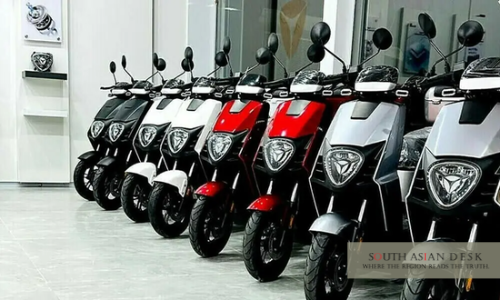
Millat Tractors electric two-wheelers will go on sale on 29 November, when the company enters Pakistan’s electric vehicle market with five lithium-ion-powered bikes and scooters, according to management comments reported by Topline Securities after a corporate briefing on Tuesday. Millat Tractors Limited (MTL), a part of Millat Group and Pakistan’s largest tractor maker, said dealers have been assigned and production is already under way.
What the Millat Tractors Electric Two-Wheelers Plan Involves
The electric two-wheelers will be manufactured by Millat Industrial, a subsidiary of MTL, with an annual production capacity of 250,000 units, according to the briefing. The company said it is diversifying beyond tractors because it expects rising demand for affordable electric mobility, as the government pushes green transport and fuel costs continue to pressure consumers. Prices, battery specifications and range were not disclosed in the report.
The announcement comes as local production of electric two- and three-wheelers is growing quickly. The Engineering Development Board told a Senate committee that Pakistan produced 210,268 electric two- and three-wheelers in fiscal year 2025-26, up from 59,756 a year earlier, and that more than 85 companies hold licences to assemble or manufacture them, with combined capacity above 290,000 electric motorcycles. By comparison, Millat Industrial’s planned capacity of 250,000 units a year is large relative to those totals, although installed capacity is not the same as output or sales.
Policy Support Behind the Shift
The government’s New Energy Vehicle Policy 2025-30 aims for 30 percent of new vehicle sales to be electric by 2030, with particular emphasis on two- and three-wheelers. It includes a subsidy programme of more than Rs100 billion over five years for electric bikes and rickshaws, with Rs9 billion allocated for 2025-26 to support 116,053 electric bikes and 3,171 electric rickshaws.
The picture is not without obstacles. In the same Senate committee session, lawmakers questioned whether charging infrastructure and the skilled workforce are sufficient to support a wider shift to electric vehicles, and called for mandatory technical training at manufacturing plants. Whether demand will match the capacity now being built will depend on prices, battery costs, charging access and how long the subsidies continue.
Tractor Sales and the Green Tractor Scheme
MTL also updated investors on its core business. Under the FY26 Green Tractor Scheme, about 15,000 of the 19,500 allocated tractors were sold. Of the 10,000 high-horsepower tractors allocated, around 95 percent were sold, while under the second scheme for low-horsepower tractors only around 50 percent of allocated customers took delivery, according to the company.
Management expects industry volumes to recover gradually from the current 28,000 to 30,000 units to 35,000 units over the next couple of years, and eventually to 50,000 units as farmer economics stabilise. The company holds about 65 percent of the domestic tractor market, so its view carries weight, although these remain management’s expectations and not forecasts by an independent analyst.
Exports and Market Diversification
MTL exported around 1,384 tractors in FY26, including 350 units to Afghanistan before the border was closed. Since the closure, it has been diversifying its export markets to Mexico and Africa. Management aims to double exports from the current 1,000 units, excluding Afghanistan, to 2,000 units, with Mexico expected to contribute 600 to 700 units.
The company said its price per horsepower is lower than comparable peers in India and China. It also acknowledged that competition in Africa is intense and that it will take time to establish a presence there.
What Comes Next
The 29 November launch will show what the electric range costs and how it compares with existing models, which the report did not disclose. Sales over the first few months, and the number of dealers able to service lithium-ion vehicles, will indicate how quickly Millat Tractors electric two-wheelers can find buyers in a market where dozens of licensed assemblers already compete.
For now, the launch is a stated plan from a company whose main business is tractors. Its success will depend on whether affordable pricing, subsidy support and charging access combine to turn the capacity Millat Industrial has built into actual sales.
Follow SouthAsianDesk on X, Instagram and Facebook for insights on business and current affairs from across South Asia.