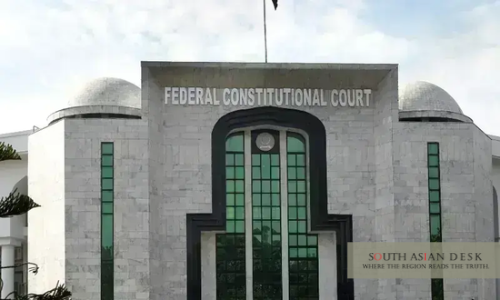
The FCC order on MPO cases has drawn a warm reception from the legal community, with the Supreme Court Bar Association (SCBA) on Wednesday welcoming the Federal Constitutional Court’s (FCC) decision to modify its earlier directive on proceedings before the Peshawar High Court (PHC). The association described the Nov 16 order as a constructive step that protects the constitutional jurisdiction of the high court and supports the rule of law.
In a joint statement, newly elected SCBA President Syed Amjad Shah, Secretary Muhammad Arif Awan and the association’s 29th Executive Committee conveyed their appreciation on behalf of the lawyers’ community. According to the statement, the modified order permits the Peshawar High Court to hear petitions challenging the preventive detention of Pakistan Tehreek-e-Insaf (PTI) workers under the Maintenance of Public Order (MPO) Ordinance, while keeping challenges to the emergency and governor’s rule in Khyber Pakhtunkhwa (KP) outside its remit.
What the Modified FCC Order on MPO Cases Provides
The FCC revised its directive after examining a report submitted by the KP government. The court had earlier asked the provincial administration to identify areas where the armed forces were no longer required to act in aid of civil power, and the report was submitted in response to that direction.
Under the revised order, as described by the SCBA, the PHC can hear petitions against detention orders issued under the MPO Ordinance, but it cannot entertain pleas relating to the proclamation of emergency and governor’s rule in the province. The FCC also clarified that other categories of petitions filed under Article 199 of the Constitution may be entertained and heard by the high court. Reports said the court adjourned the proceedings in the case indefinitely.
How the Dispute Over Article 199 Petitions Began
The controversy dates back to October, when the armed forces were called to act in aid of civil power across KP under an Article 245 order dated Oct 11, followed by a Ministry of Defence office memorandum on Oct 12. The federal government imposed emergency and governor’s rule in the province on the same day as the memorandum.
On Nov 5, a bench headed by Chief Justice Aminuddin Khan suspended proceedings before the PHC in cases filed under Article 199 on or after Oct 12. The court was hearing appeals filed by the KP government against interim orders of the high court. Its written order held that, in terms of clause (4) of Article 245, such proceedings would remain suspended while the armed forces were acting in aid of civil power. The provincial advocate general had argued that clause (3) of the same article prevents a high court from exercising Article 199 jurisdiction in areas where the military is so deployed.
The Nov 5 order effectively stopped the high court from hearing petitions against the preventive detention of PTI workers and activists under the MPO Ordinance. During the Nov 16 hearing, PTI lawyer Barrister Gohar argued that the earlier order had disrupted proceedings before the PHC and brought the professional practice of lawyers to a halt.
SCBA Highlights Access to Justice and Judicial Independence
In its statement, the Supreme Court Bar Association said the modification of the earlier injunctive order was a welcome move towards safeguarding the high court’s constitutional jurisdiction, strengthening access to justice and upholding the rule of law. The office bearers called the decision “a positive development” and expressed hope that it would further reinforce public confidence in the independence of the judiciary and the constitutional system.
The lawyers’ body also reiterated its commitment to the supremacy of the Constitution, the independence of the judiciary and the rule of law. Bar associations have traditionally played an influential role in Pakistan’s legal debates, and the SCBA’s response reflects the importance the legal community attaches to the ability of citizens to approach a high court.
Why the FCC Order on MPO Cases Matters for Detainees
Article 199 is the provision under which high courts hear constitutional petitions, including those that challenge the lawfulness of detention. When such proceedings are suspended, detainees and their lawyers lose a principal avenue for seeking relief close to home. For that reason, any change in the scope of the FCC order on MPO cases carries practical consequences for those held under preventive detention provisions, as well as for the lawyers who represent them.
The Federal Constitutional Court’s decision to revisit its earlier directive after reviewing the provincial government’s report has been welcomed by the bar as a measured adjustment. How the PHC proceeds in the coming weeks, and whether the armed forces continue to act in aid of civil power in the province, will determine how far the modified order restores normal court functioning in Khyber Pakhtunkhwa.
Follow SouthAsianDesk on X, Instagram and Facebook for insights on business and current affairs from across South Asia.
Read More: