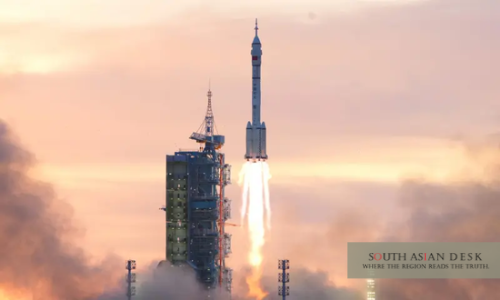
The first Pakistani astronaut, Zeeshan Ali, entered orbit on Wednesday after China’s Shenzhou-24 spacecraft lifted off from the Jiuquan Satellite Launch Centre. The 40-year-old is part of a three-member crew bound for the Tiangong space station, and his flight marks a historic milestone for Pakistan’s space programme.
A Successful Launch From Jiuquan
The spacecraft, carried by a Long March-2F rocket, lifted off at 8:18am Beijing Time, which was 5:18am in Pakistan. Before the launch, a send-off ceremony was held at the centre for the three astronauts, who then boarded the capsule. Shortly after liftoff, an official at the centre announced that Shenzhou-24 had been sent to its preset orbit and declared the launch mission a complete success, adding that the spacecraft was functioning well.
Planning Minister Ahsan Iqbal, who is currently in China, witnessed both the send-off and the launch. In a post on X, he described the moment as the beginning of a new era for Pakistan’s space programme and said the Pakistani flag had risen into orbit carrying the hopes of the nation. He also linked the achievement to the friendship between Pakistan and China and to the China-Pakistan Economic Corridor, calling the flight the first step towards a brighter future for the country in space.
The Crew and the Mission Ahead
China’s Tang Hongbo is commanding the mission, while Wu Yi serves as pilot. Ali has joined the crew as payload specialist. Once Shenzhou-24 docks with the Chinese station, he will also become the first foreign national to board it. He is expected to spend around a week in space, working alongside his Chinese colleagues on a range of experiments.
According to the China Manned Space Agency, the crew will conduct about 90 experiments during the mission. The agency has said the objectives also include an orbital rotation with the crew of the earlier Shenzhou-23 mission, routine operations and maintenance of the station, and continued space science research involving payloads carried on board.
How the First Pakistani Astronaut Was Chosen
The path to this flight began with a cooperation agreement signed in February 2025 between Pakistan’s space agency, Suparco, and the China Manned Space Agency. Under the arrangement, two Pakistanis were to train in China, with one of them joining a mission to the Tiangong space station. In April, Ali and Khurram Daud were selected to begin that training, and Ali was eventually chosen to fly.
Speaking at a press briefing in Jiayuguan on Tuesday, Ali said he was deeply grateful to the Chinese government for helping Pakistan realise its dream of reaching space. He explained that he had arrived at the Astronaut Centre of China a few months earlier carrying the hopes of 250 million Pakistanis. He also stressed that the future of the partnership matters more than the flight itself, describing the mission as “not a finish line; it is a launch pad”. He expressed the hope that cooperation between the two countries would grow from a single astronaut on a single flight to multiple joint missions, and eventually to the Moon, Mars and beyond.
Addressing young people in Pakistan, Ali urged every child watching to look up at the sky and remember that he would be up there with their dreams. In a personal message to his family, he promised that whenever he looked back at Earth, he would search first for the light of home.
Life Aboard the Tiangong Space Station
Tiangong, which means Celestial Palace in Chinese, has been fully operational since late 2022. The station can host up to six astronauts during handovers, when an arriving crew of three overlaps with the departing crew. This handover will be different from the usual routine.
Shenzhou-23 commander Zhu Yangzhu will remain on the station to support Beijing’s study of how the human body copes in space. The research is considered a crucial step towards a planned crewed mission to the Moon and a potential journey to Mars. Zhu is due to stay for a year, and by the time he leaves he will hold the record for the longest single stay in orbit by a Chinese astronaut. The rest of the Shenzhou-23 crew will depart Tiangong alongside Ali.
What Comes Next for Pakistan’s Space Programme
For Pakistan, the significance of the flight extends well beyond the week Ali will spend in orbit. The mission places the country among the nations with a citizen who has travelled to space, and it opens a new chapter in its partnership with China, which has already extended into areas such as infrastructure and technology. Officials have framed the launch as the beginning of a longer journey rather than a one-off achievement.
Ahsan Iqbal described the flight as Pakistan’s “URAAN”, the Urdu word for flight, and said it was only the start of a brighter and more glorious future. As the first Pakistani astronaut completes his work aboard the Chinese station, attention will turn to whether this historic mission leads to further joint flights and a more ambitious role for Pakistan in space exploration.
Follow SouthAsianDesk on X, Instagram and Facebook for insights on business and current affairs from across South Asia.