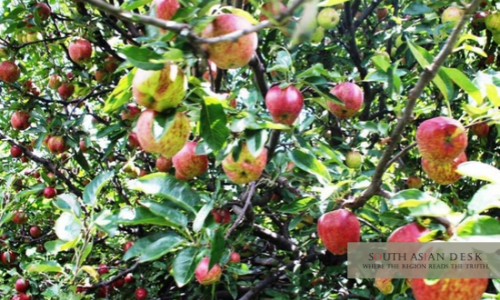
Humla apple exports have more than doubled this year, with farmers across the district’s seven rural municipalities earning Rs82.65 million from sales, according to the Agriculture Development Office in Humla. The district produced 5,005 metric tonnes of apples, and more than 1,377 metric tonnes were sold outside the district after improved road connectivity helped link local orchards to external markets, The Himalayan Times reported.
What the Figures Show for Humla Apple Exports
Of the total harvest, 1,377.6 metric tonnes from about 690 hectares of orchards were sent outside the district for sale, said Chudamani Pant, chief of the Agriculture Development Office. Sarkeghad Rural Municipality accounted for the largest share at 500 metric tonnes, followed by Simkot with 400 tonnes, Kharpunath with 200 tonnes, Chankheli with 140 tonnes, Tanjakot with 67.6 tonnes, Namkha with 50 tonnes and Adanchuli with 20 tonnes.
Apple sales outside the district earned nearly Rs40 million last year, meaning this year’s Rs82.65 million is more than double. Dividing the earnings by the tonnage gives an average of about Rs60 per kilogram, a figure based on the published numbers and not stated in the report. Officials noted that the figures do not include apples sold and consumed within Humla, so the total value of the district’s apple production is likely higher.
Road Connectivity and the Karnali Apple Trade
The increase follows a change in access. Humla’s district headquarters, Simikot, was connected to the national road network in mid-2025, according to Kathmandu Post reporting. Before that, farmers in the district struggled to sell their harvest. In 2024, Humla produced 4,224 tonnes of apples but none reached the market, because vehicles could not travel on the roads, the newspaper reported at the time, and apples were sometimes sent by air at high cost.
Local trader Arjun Fadera of Adanchuli Rural Municipality said growing returns from apple farming have encouraged more farmers to invest in orchard management and production. The Agriculture Development Office said the expansion of road connectivity has enabled larger volumes of Humla apples to reach outside markets, contributing to a significant increase in trade.
What the Report Does Not Say
The meaning of “exports” in the report is limited. It refers to apples sent outside Humla for sale, and does not say whether any went outside Nepal or where the main buyers were. It also did not give last year’s tonnage, so it is not possible from the report alone to tell how much of the rise in earnings came from larger volumes and how much from higher prices. The orchard area of about 690 hectares is also larger than the roughly 518 hectares cited in earlier reports, and the report did not explain the difference.
Challenges Facing Karnali Province Apple Farmers
Wider reporting suggests that roads are only part of the picture. Karnali’s apples supply about 47 percent of Nepal’s domestic apple market between September and November, according to the Kathmandu Post, but farmers have not benefited in proportion to the increase in output. Ganesh Bahadur Adhikari, who heads the agriculture office in Karnali, said inadequate storage, the absence of grading facilities, poor road connectivity and packaging problems continue to prevent farmers from securing fair prices. Unsold or rotting apples often end up as livestock feed.
Frequent blockages of the Karnali Highway have also hit traders. One Jumla trader told the Kathmandu Post that even a one-day blockade can cause apples worth millions of rupees to rot. Nepal also imports apples, mainly from China and India, and domestic growers compete with those supplies in the market. To support the sector, the Karnali provincial government announced plans to establish an Apple Board, with Rs140 million allocated for the initiative in the current fiscal year.
What Comes Next
The next test will be whether the gains hold. A year of higher earnings does not show whether prices, volumes and access will stay at this level, since road closures, weather and competition from imports can all change the outcome. Whether storage, grading and packaging facilities are built will also influence how much of the crop reaches buyers in good condition and at a good price.
For now, Humla apple exports show a clear improvement in farmer income following better road access, though the report leaves open where the apples were sold and how much of the increase came from prices. The district’s experience will help show whether road links can turn the Himalayan region’s orchards into a dependable source of income.
Follow SouthAsianDesk on X, Instagram, and Facebook for insights on business and current affairs from across South Asia.
Read more: