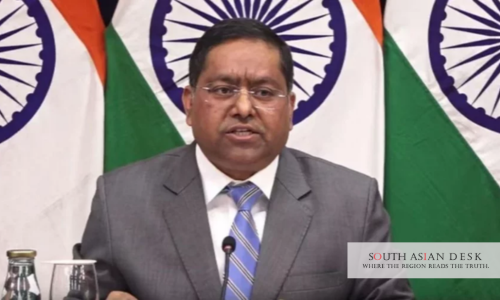
India Bangladesh joint action against militancy has been proposed by New Delhi, after a United Nations Security Council report raised concerns over the activities of Al-Qaeda in the Indian Subcontinent across South Asia and its attempts to gain a foothold in Bangladesh. Indian foreign ministry spokesperson Randhir Jaiswal made the offer at the ministry’s regular press briefing on Tuesday, describing terrorism and national security as concerns that should matter to every country in the region.
Jaiswal said terrorism represented a common threat that both nations needed to confront together, framing the proposal as part of a broader call for collective regional action rather than a response aimed at any single country. His comments came in response to questions about whether India and Bangladesh currently have a bilateral mechanism in place to counter militant activity.
India Bangladesh Joint Action Against Militancy – AQIS Bangladesh Concerns Drive the Latest Diplomatic Exchange
The AQIS Bangladesh concerns referenced by Jaiswal stem from the thirty eighth report of the UN Security Council’s Analytical Support and Sanctions Monitoring Team, which tracks the activities of groups linked to Islamic State and Al-Qaeda. The report noted that Al-Qaeda in the Indian Subcontinent has continued to evolve from a fragmented organisation into a more structured regional entity, building logistics and financial networks while operating through small, decentralised cells rather than large formations. It also expressed concern that the group was seeking to expand its network and establish a foothold in Bangladesh.
This structural shift has made the group harder for regional security agencies to track, according to the monitoring team, since decentralised cells leave a smaller operational footprint than the larger networks associated with earlier iterations of the organisation.
Red Fort Attack Cited as Evidence of the Group’s Reach
The Red Fort attack, a car bomb explosion near the historic monument in Delhi in November 2025 that killed several people, was formally attributed to AQIS in the same UN report, marking a shift from earlier assessments that had linked the attack to a different militant group. India’s National Investigation Agency has since filed a lengthy charge sheet against multiple accused individuals in connection with the blast, and the case remains under judicial review.
The attribution of the Red Fort attack to AQIS has added weight to the UN monitoring team’s broader warning about the group’s expanding regional ambitions, including its reported efforts to establish a presence in Bangladesh.
Other Bilateral Issues Raised at the Briefing
Beyond the security discussion, Jaiswal addressed several other elements of the India Bangladesh relationship during the briefing. Asked about a possible visit to India by Bangladesh’s head of government, he said any new information on the matter would be shared in due course. On Bangladesh’s request for an additional 4,000 litres of diesel, he noted that the two countries already maintain cooperation in the fuel sector and said the request was being reviewed in light of India’s own requirements, refining capacity and supply availability.
Jaiswal also addressed the status of Indian-funded infrastructure projects in Bangladesh, saying both countries wished to maintain a relationship that was positive, constructive and forward looking, based on mutual interest and equality.
Teesta Water-Sharing Talks Remain Under Existing Mechanisms
On the question of Teesta water-sharing, a longstanding point of discussion between the two countries, Jaiswal said he was not aware of any formal request from Bangladesh to resume talks specifically on that issue. He noted that matters involving shared rivers between the two countries continue to be addressed through existing bilateral mechanisms, including the Joint Rivers Commission and other technical committees, which he said remained active.
The remarks suggest that while security cooperation has moved to the forefront of the bilateral agenda following the UN report, other long-running issues between the two countries, including river-sharing arrangements, continue to be handled through established institutional channels rather than fresh high-level negotiations.
Published in SouthAsianDesk, August 19th, 2026
Follow SouthAsianDesk on X, Instagram and Facebook for insights on business and current affairs from across South Asia.