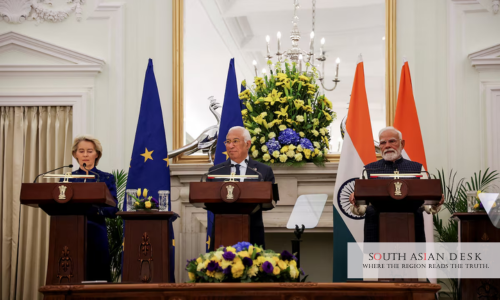
Evian-les-Bains, Wednesday, June 17, 2026 — The India EU Free Trade Agreement will be formally signed before the end of this year, European Commission President Ursula von der Leyen confirmed on Wednesday following a trilateral meeting with Prime Minister Narendra Modi and European Council President Antonio Costa on the sidelines of the G7 Summit in France.
Von der Leyen posted on X that since concluding what she called “the mother of all trade deals,” the EU had been moving fast to deliver on its commitments, and that the formal signing of the Free Trade Agreement would take place by the end of the year.
In synchronised posts, both von der Leyen and Costa addressed Modi directly, confirming plans to accelerate work on an investment agreement alongside the FTA, step up security and defence cooperation, and advance the India-Middle East-Europe Corridor, known as IMEC, to deepen connectivity between the two blocs.
A Landmark Deal Nearly Two Decades in the Making
The India-EU FTA was concluded on January 27, 2026, following negotiations that had stretched across nearly two decades. Talks were first launched in 2007 but were suspended in 2013 before being resumed in subsequent years.
Von der Leyen had signalled the deal’s imminent finalisation as early as January 20 at the World Economic Forum in Davos, describing it as potentially creating a market of two billion people accounting for almost a quarter of global GDP, and framing it as part of Europe’s broader strategy to champion fair trade and strategic partnership over isolation.
The agreement was concluded at Hyderabad House in New Delhi, with Modi, Costa, and von der Leyen as signatories, and is subject to approval by the Council of the European Union, the consent of the European Parliament, and completion of ratification through India’s Union Council of Ministers.
India EU Free Trade Agreement: What the Deal Covers
The comprehensive pact spans goods, services, and digital trade and is set to create a free market covering nearly two billion people and a quarter of the global economy, opening new avenues for trade, investment, and technology cooperation.
The agreement covers 96.6 percent of all goods traded between the EU’s 27 member states and India, encompassing products ranging from textiles and medicines to European wine and cars, with high import tariffs on the latter set to fall significantly.
Modi, posting on X after the trilateral session, described the period as a great time for India-EU ties and said the two sides had discussed how to deepen economic linkages further. He said their growing cooperation could play an important role in strengthening peace, stability, and prosperity in the current global environment.
India’s Ministry of External Affairs spokesperson Randhir Jaiswal confirmed the meeting, noting that the leaders had recalled the historic 16th India-EU Summit held in India earlier this year and welcomed the strong progress made in bilateral relations, in particular the conclusion of the FTA, before exchanging views on regional and global matters of mutual interest.
Modi Deepens India-Germany Ties on Summit Sidelines
Beyond the trilateral EU session, Modi held a separate bilateral meeting with German Chancellor Friedrich Merz at the G7, with both leaders expressing satisfaction at the renewed momentum in the India-Germany Strategic Partnership as both countries mark 75 years of diplomatic relations.
Modi said the talks with Merz were fruitful, covering trade, investments, the circular economy, defence, information technology, and cultural linkages. Both leaders agreed that early implementation of the India-EU FTA would further deepen the India-Germany relationship.
IMEC and the Broader Strategic Agenda
The confirmation of a year-end signing timeline for the India EU Free Trade Agreement extends well beyond tariff reductions. The EU leaders specifically highlighted plans to advance IMEC, the India-Middle East-Europe Corridor, as part of a broader connectivity push that would link India’s economy more directly to European markets through a trans-regional infrastructure network.
The Evian commitments come as India simultaneously confirmed that its free trade agreement with the United Kingdom will enter into force on July 15, 2026, and as talks with Canada on a Comprehensive Economic Partnership Agreement continue with a target of completion this year. Taken together, Wednesday’s developments at the G7 summit placed India at the centre of a sweeping realignment of global trade architecture, with the world’s two largest economies and its most powerful trading blocs all moving to lock in preferential access to the Indian market within the same diplomatic window.
Published in SouthAsianDesk, June 18, 2026
Follow SouthAsianDesk on X, Instagram and Facebook for insights on business and current affairs from across South Asia.